TorontoOntario · 36 tours
 Niagara FallsOntario · 25 tours
 New York CityNew York · 30 tours
 Las VegasNevada · 8 tours
 San FranciscoCalifornia · 16 tours
 VancouverBritish Columbia · 17 tours
 DubaiUAE · 54 tours
 Abu DhabiUAE · 5 tours
 Buenos AiresArgentina · 23 tours
 AthensGreece · 31 tours
 AucklandNew Zealand · 38 tours
 CancunMexico · 54 tours
No destinations match “”. Try searching all tours instead — that search understands full questions, not just place names.
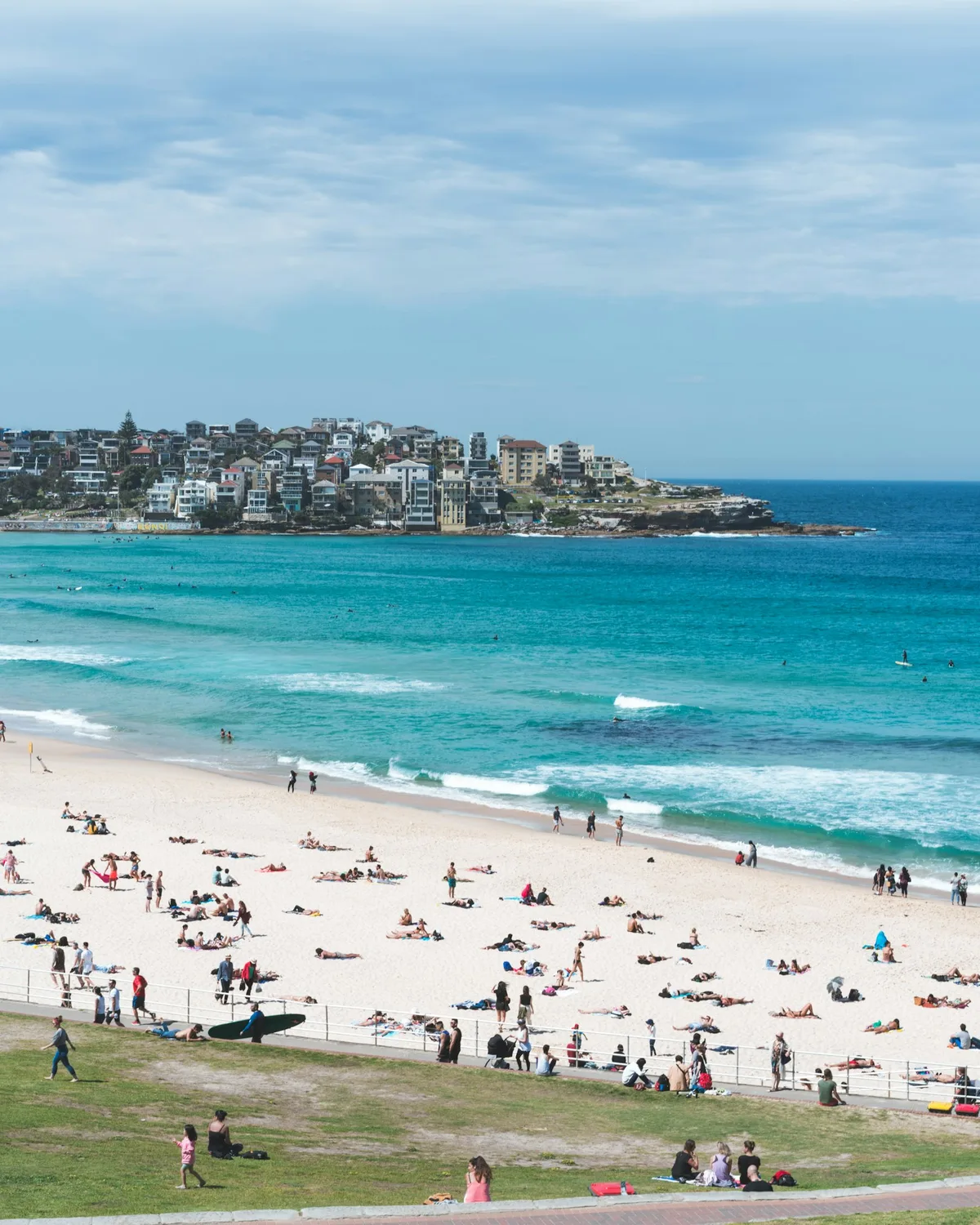
Sydney's best-known city beach, a curve of sand backed by the coastal Bondi to Coogee clifftop walk and a long-running ocean swimming pool cut into the rocks at its southern end.
Visitor guide
Bondi Beach is a famous ocean beach and suburb in Sydney, New South Wales, Australia, about 7 km east of the city centre. It is a crescent of sand about a kilometre long, backed by a promenade, a historic pavilion and the cafes of Campbell Parade, and it is the starting point of the coastal walk to Coogee.
Wikipedia explains that the name Bondi comes from the Dharawal language and refers to the sound of waves breaking on rocks, a loud thud, and is also linked to a type of fighting stick. The earliest European record of the word dates from around 1899 to 1903. The area was inhabited for tens of thousands of years by Aboriginal peoples, including the Bidjigal, Birrabirragal and Gadigal, and evidence such as paths, rock carvings and shelters remains.
Unusually for Sydney, the beach faces south, and Ben Buckler Point shelters its northern end. Wikipedia notes that the northern end is gentler, while the southern end can have a hidden rip current known as the Backpackers' Rip. Flags mark safe swimming areas, and the southern end is favoured by surfboard riders. Whales and dolphins pass offshore during migration seasons.
The land was granted to the road builder William Roberts in 1809. In 1851 Edward Smith Hall and Francis O'Brien bought about 200 acres known as the Bondi Estate, and O'Brien later opened it as a picnic ground and resort. After disputes over access, Wikipedia records that the beach became public in 1882, and the first tram line reached it in 1884. Waverley Council built the first surf bathing sheds in 1903. The Bondi Pavilion opened in 1929, an event that drew a huge crowd, and the beachfront Campbell Parade was rebuilt as a boulevard the same year.
Beach culture here has deep roots. Two clubs, Bondi Surf Bathers' Life Saving Club and North Bondi Surf Life Saving Club, were founded in 1907, and Wikipedia says the Bondi Surf Bathers' club claims to be the world's first surf lifesaving club. Club members are credited with inventing the surf reel. The Bondi Icebergs Swimming Club began in 1929 as a winter swimming group for lifesavers wanting to stay fit, and its ocean pool at the southern end remains a landmark.
Swimwear rules were also a point of public debate, with bathing costume protests in 1907 and decency regulations that were only relaxed in 1961, according to Wikipedia. On 6 February 1938, known as Black Sunday, large waves swept people off a sandbank, and lifesavers rescued or resuscitated more than 250 people, an event that shaped Australian surf rescue history.
Bondi hosts regular events including the Sculpture by the Sea exhibition in November, the City to Surf fun run in August and the Flickerfest short film festival in January. Beach volleyball for the 2000 Olympic Games was played here, and a skate park opened in 1991 with a bowl added later. The beach and its community have also been the setting for television series such as Bondi Rescue and Bondi Vet. On 25 January 2008 Bondi Beach was added to the Australian National Heritage List.
The beach is easiest to enjoy in the morning, when the sand is quieter. The Bondi to Coogee clifftop walk starts at the southern end, and a private tour can combine Bondi with the headlands, other eastern beaches and harbour sights.
See every tour and attraction we cover in Australia.