TorontoOntario · 36 tours
 Niagara FallsOntario · 25 tours
 New York CityNew York · 30 tours
 Las VegasNevada · 8 tours
 San FranciscoCalifornia · 16 tours
 VancouverBritish Columbia · 17 tours
 DubaiUAE · 54 tours
 Abu DhabiUAE · 5 tours
 Buenos AiresArgentina · 23 tours
 AthensGreece · 31 tours
 AucklandNew Zealand · 38 tours
 CancunMexico · 54 tours
No destinations match “”. Try searching all tours instead — that search understands full questions, not just place names.
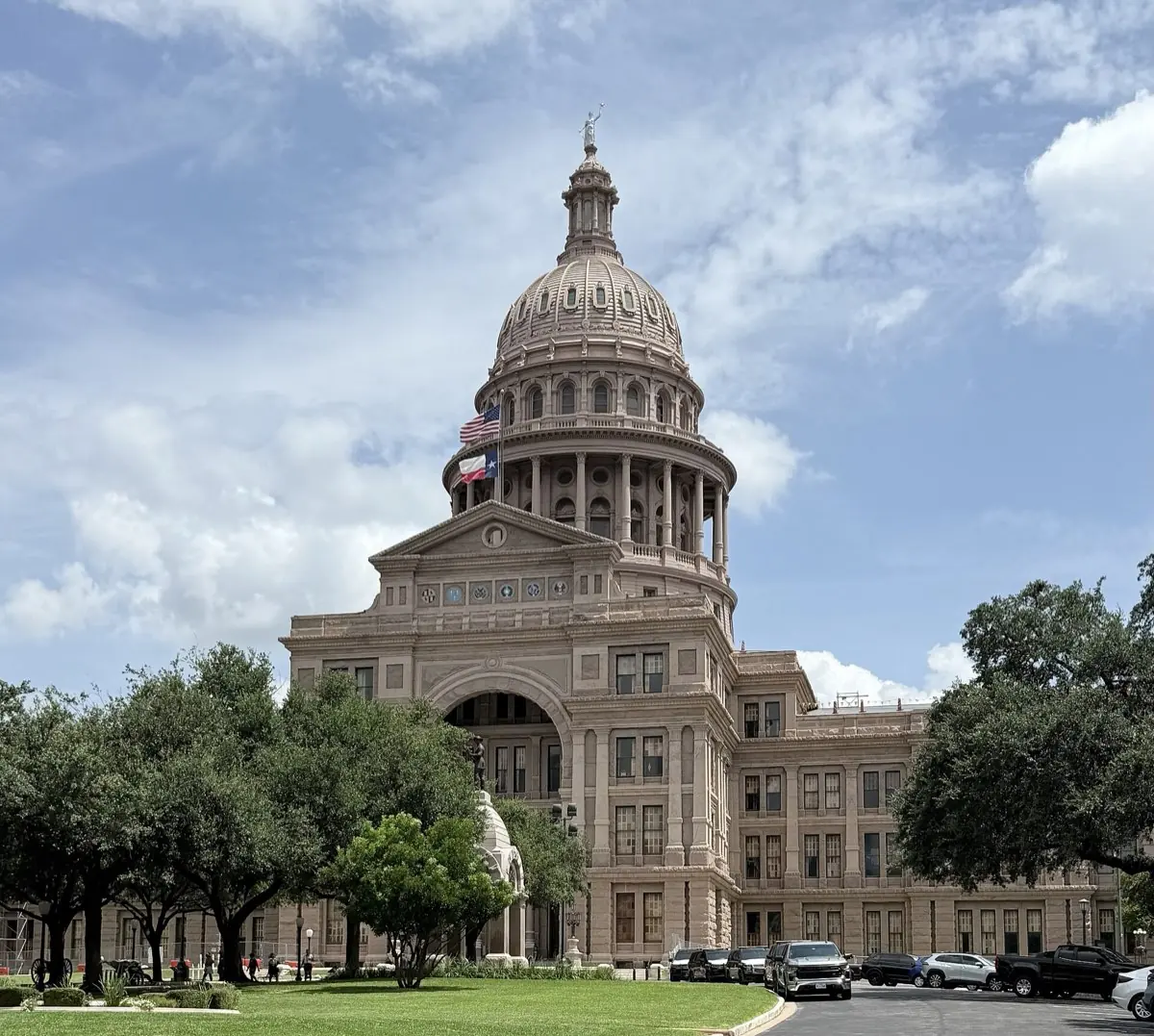
Built from pink granite and, at 302 feet, taller than the US Capitol in Washington, D.C.
Visitor guide
The Texas State Capitol in Austin is the seat of Texas government, housing the Legislature and the Governor's offices. Faced in sunset red granite and topped by a dome, it stands 302.64 feet tall, which Wikipedia ranks as the sixth-tallest state capitol. It is a National Historic Landmark and is run by the Texas State Preservation Board.
Austin became the capital of the Republic of Texas in 1839, and the first capitol was a log structure inside a stockade. A limestone capitol was built in 1853 and burned on November 9, 1881. The Constitution of 1876 had already authorized 3 million acres of Panhandle land to pay for a new building. Chicago's John and Charles Farwell, through the Capitol Syndicate, built it in exchange for that land, which became the XIT Ranch.
A nationwide competition in 1880 drew eight architects and eleven designs, and Detroit architect Elijah E. Myers's plan was approved; Wikipedia dates his design to 1881. The cornerstone, a 12,000-pound stone holding a zinc box of mementoes, was laid on March 2, 1885, Texas Independence Day. The building opened to the public on April 21, 1888, San Jacinto Day, and was formally accepted in mid-May 1888 by Senator Temple Houston, on May 16, 1888, according to the Preservation Board.
The plan called for limestone from south Austin, but it discolored when exposed to air, so builders switched to red granite donated by the owners of Granite Mountain in Burnet County. About 188,518 cubic feet of it was shipped on a specially built railroad, which Wikipedia puts at 2.3 miles. More than 1,000 people worked on the building. When complete it had 392 rooms, 924 windows and 404 doors, according to the Preservation Board, and the dome rests on a wrought-iron framework imported from Belgium.
The statue on top of the dome was built of 80 zinc pieces welded into four sections and hoisted into place in February 1888. By the 1980s deterioration of the original zinc was evident. It was removed by helicopter in November 1985, and an aluminum replacement cast from molds of the original was placed in June 1986. The original is displayed at the Bullock Texas State History Museum.
The rotunda beneath the dome holds portraits of Texas governors and presidents of the Republic of Texas, and Wikipedia describes it as a whispering gallery. Six coats of arms under the dome represent the Spanish, French, Mexican, Republic of Texas, Confederate and United States periods. The House and Senate chambers sit on the second floor, with public galleries above. The Preservation Board's self-guided tour also stops at the Governor's Public Reception Room, the Supreme Court courtroom, an Agricultural Museum, the Legislative Reference Library and the Visitors Center.
A fire on February 6, 1983, began in the east wing and spread across the second floor; firefighters saved the building, and the Legislature created the Preservation Board in response. Exterior restoration began in 1991 and interior work in 1992, with ten historic spaces returned to their 1888-1915 look, including the two chambers, and the work was completed in 1995. The four-story underground Capitol Extension, begun in 1990, opened in 1993 with 667,000 gross square feet, and its skylights and inverted rotunda are visible at ground level. The Capitol was listed on the National Register in 1970 and designated a National Historic Landmark on June 23, 1986.
See every tour and attraction we cover in Austin.