TorontoOntario · 36 tours
 Niagara FallsOntario · 25 tours
 New York CityNew York · 30 tours
 Las VegasNevada · 8 tours
 San FranciscoCalifornia · 16 tours
 VancouverBritish Columbia · 17 tours
 DubaiUAE · 54 tours
 Abu DhabiUAE · 5 tours
 Buenos AiresArgentina · 23 tours
 AthensGreece · 31 tours
 AucklandNew Zealand · 38 tours
 CancunMexico · 54 tours
No destinations match “”. Try searching all tours instead — that search understands full questions, not just place names.
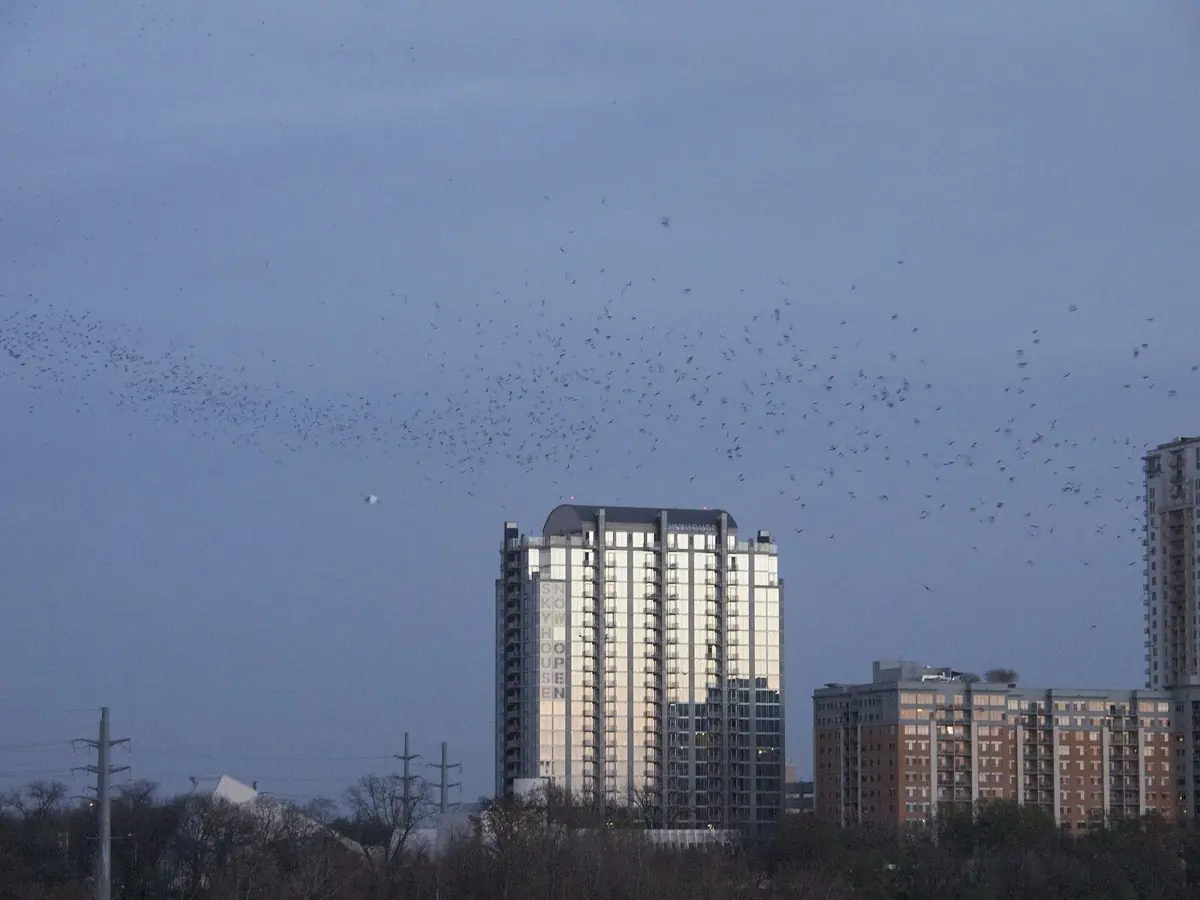
Home to North America's largest urban bat colony, which streams out at dusk each summer evening.
Visitor guide
The Ann W. Richards Congress Avenue Bridge in downtown Austin is home to a large summer colony of Mexican free-tailed bats. Texas Parks and Wildlife estimates about 1.5 million bats, while Bat Conservation International (BCI) gives a range of 750,000 to 1.5 million. Their emergence at sunset has become one of Austin's best-known sights.
This is a maternity colony: females gather to give birth and raise young, and Texas Parks and Wildlife estimates about 750,000 pups are raised here each year. The bats migrate between Texas and Mexico, and BCI describes a spring journey of well over a thousand miles. Mexican free-tailed bats are small, averaging about 12 grams, and mostly eat moths, including agricultural pests such as cotton bollworm and corn earworm moths. Most mothers have one pup, typically born in June according to BCI.
Wikipedia adds that a female's pregnancy lasts 11 to 12 weeks, that mothers recognise their own pups by scent and voice among crowded nursery groups, and that the young become independent at about four to seven weeks. Bats of this species can fly very high, up to around 3,300 metres, and can travel about 50 kilometres in a night to feed. Estimates of how much the colony eats vary widely between sources, from about 10,000 to 30,000 pounds of insects a night.
The bridge itself is a concrete arch, 945.9 feet long, which opened on April 4, 1910, and is owned by the City of Austin. It replaced earlier crossings at the site, including a pontoon toll bridge from about 1869 or 1871 and an iron bridge built in 1884, according to Wikipedia. The bats began roosting there in the early 1980s, shortly after the bridge was rehabilitated; sources give 1980 or 1982 for that work.
Accounts of the rebuild say the new beam design left narrow gaps, described as about an inch wide and 16 inches deep, and those gaps proved to be ideal roosting crevices. A Garden and Gun article says they offered shelter from predators and warm, incubator-like conditions for raising pups. By the mid-1980s hundreds of thousands of bats had moved in, though they may have been in the area earlier in smaller numbers.
Texas Parks and Wildlife says many residents at first feared the bats, and early news coverage was alarmist; petitions called for the colony to be removed. Merlin Tuttle moved BCI to Austin in 1986, and an education campaign that began with community leaders and the media is credited with shifting public opinion, as people came to understand how many insects the bats eat. The city renamed the span the Ann W. Richards Congress Avenue Bridge on November 16, 2006. Wikipedia cites a 1999 study that estimated the colony's economic impact at $7.9 million a year, a figure that dates from that study and should be read as such.
The bats emerge around sunset. Texas Parks and Wildlife lists three main ways to watch: the free Austin American-Statesman Bat Observation Area on the southeast side of the bridge, with educational kiosks; the bridge itself; and boat tours on Lady Bird Lake. BCI suggests keeping voices low, avoiding lights and camera flashes, and standing to the side instead of directly under the bridge. It notes that the bats keep their own schedule and are hard to predict, and may stay roosted in cold or rainy weather. Visitor estimates differ by source, from more than 100,000 a year according to BCI to about 140,000 according to Texas Parks and Wildlife.
See every tour and attraction we cover in Austin.