TorontoOntario · 36 tours
 Niagara FallsOntario · 25 tours
 New York CityNew York · 30 tours
 Las VegasNevada · 8 tours
 San FranciscoCalifornia · 16 tours
 VancouverBritish Columbia · 17 tours
 DubaiUAE · 54 tours
 Abu DhabiUAE · 5 tours
 Buenos AiresArgentina · 23 tours
 AthensGreece · 31 tours
 AucklandNew Zealand · 38 tours
 CancunMexico · 54 tours
No destinations match “”. Try searching all tours instead — that search understands full questions, not just place names.
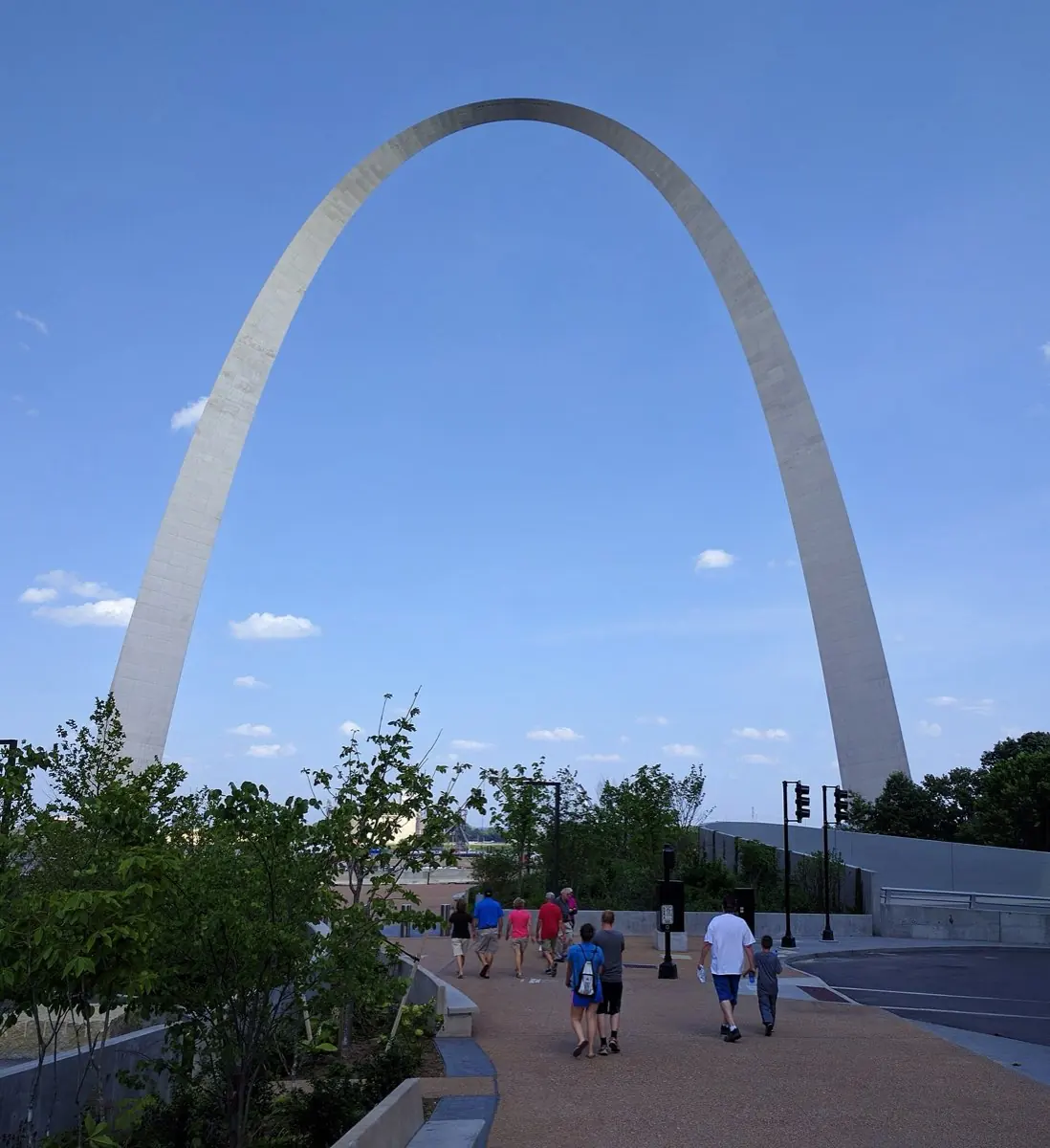
At 630 feet, the tallest arch in the world, commemorating St. Louis's role as gateway to the American West.
Visitor guide
The Gateway Arch is a stainless-steel inverted catenary on the St. Louis riverfront, standing 630 feet tall and spanning 630 feet between the outer faces of its legs at ground level. Designed by Finnish-American architect Eero Saarinen, it anchors Gateway Arch National Park and is the most recognizable image of the city. It was conceived as a monument to Thomas Jefferson, the Louisiana Purchase and the nation's westward expansion.
The idea of a riverfront memorial took shape in the 1930s. In 1935 President Franklin D. Roosevelt signed an executive order enabling the Secretary of the Interior to develop the Jefferson National Expansion Memorial on the old St. Louis waterfront. Demolition of the old commercial buildings began in October 1939 and was largely complete by 1942; the Old Cathedral and the Old Rock House were the only structures spared. World War II then paused the project, and in 1947 a national design competition was launched. Saarinen's design was announced as the winner in February 1948.
According to the National Park Service, the form is an inverted catenary, the curve a heavy chain takes when hung freely between two supports. The Arch's geometry is technically a weighted catenary, adjusted for legs that taper as they rise, and structural engineer Hannskarl Bandel is credited with the equations behind it. Each leg is an equilateral triangle in cross-section, with 54-foot sides at ground level narrowing to 17 feet at the top. The NPS describes the structure as having no real internal skeleton: a stainless-steel outer skin and a carbon-steel inner skin act together as a composite, with reinforced concrete filling the space between the walls up to the 300-foot mark.
Groundbreaking took place in June 1959, and the final section was set in October 1965 (arch construction itself is usually dated from February 1963). Wikipedia gives the cost as about $13 million. The tram and the underground museum and visitor center followed; the visitor center opened in June 1967, and the memorial was formally dedicated in May 1968.
The tram is the signature experience: two trains of small passenger capsules travel inside the legs, a design necessitated because a conventional elevator could not follow the curving, narrowing shaft. Wikipedia reports each train carries 40 passengers, a trip of about four minutes up, with an observation deck near the apex that, per Wikipedia, has sixteen windows per side and views reported up to 30 miles.
At the base, the underground Museum at the Gateway Arch tells the story of westward expansion; the NPS notes that a major riverfront-and-park project led by the Gateway Arch Park Foundation (then CityArchRiver) later reshaped the grounds. The same park includes the Old Courthouse, where Dred and Harriet Scott sued for their freedom, and its rotunda. In 2018 Congress redesignated the site from a national memorial to a national park, with no change to its boundaries or mission. The monument is also a National Historic Landmark, designated in 1987.
Voyzo arranges this stop as a private tour with your own vehicle and driver and door-to-door pickup, so the grounds, museum and Old Courthouse can be paced to your group. Tram tickets, hours and access change, so check the National Park Service for current details before you go.
See every tour and attraction we cover in St. Louis.