TorontoOntario · 36 tours
 Niagara FallsOntario · 25 tours
 New York CityNew York · 30 tours
 Las VegasNevada · 8 tours
 San FranciscoCalifornia · 16 tours
 VancouverBritish Columbia · 17 tours
 DubaiUAE · 54 tours
 Abu DhabiUAE · 5 tours
 Buenos AiresArgentina · 23 tours
 AthensGreece · 31 tours
 AucklandNew Zealand · 38 tours
 CancunMexico · 54 tours
No destinations match “”. Try searching all tours instead — that search understands full questions, not just place names.
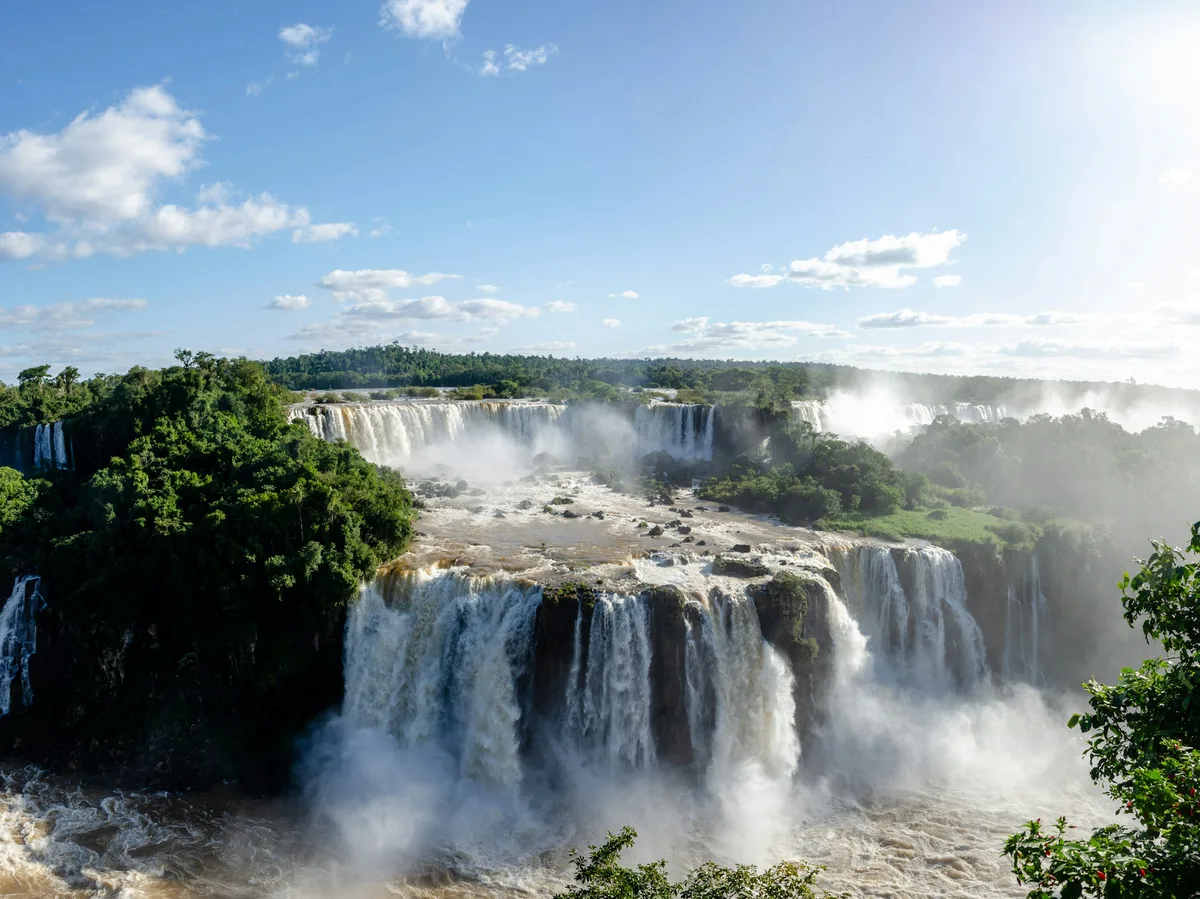
A system of roughly 275 individual waterfalls spanning the Brazil-Argentina border, with the Brazilian side offering sweeping panoramic views across the entire cascade, including the thunderous Devil's Throat.
 Multi-Day Tours
Rio's icons, the Brazilian side of Iguazu Falls, and three nights deep in an Amazon lodge — a complete, entirely Brazil-based introduction to the country's headline sights.
 Multi-Day Tours Popular Pick
Our best all-around introduction to Brazil — São Paulo, Iguazu Falls, Rio de Janeiro, and the coast at Paraty and Ilha Grande, all in a realistic ten days.
 Multi-Day Tours
Our most complete Brazil route — Rio, the Amazon, the dune coast of the northeast, the Pantanal wetlands, and Iguazu Falls, all in one continuous itinerary.
Visitor guide
Iguazu Falls is a vast system of waterfalls on the Iguazu River, on the border between Brazil's state of Paraná and Argentina's Misiones Province. The Brazilian side, within Iguaçu National Park near Foz do Iguaçu, is known for its panoramic views across the whole curtain of cascades and for a walkway that leads toward the Devil's Throat.
The falls are formed by the Iguazu River tumbling over layers of columnar basalt that belong to the Serra Geral formation of the Paraná Basin. According to Wikipedia, the river drops in a two-step staircase with steps of roughly 35 and 40 metres, and the crest of the falls runs for about 2.7 kilometres before being broken up by islands into separate falls and cataracts.
The count of individual falls changes with the river's level. The article gives 275 drops in its infobox, while noting that figures between 150 and 300 are quoted depending on the water. The longest single drop is given as 82 metres, and the heights of the falls as a whole as 60 to 82 metres.
The most famous section is the Devil's Throat, a long, narrow chasm said to be around 80 to 90 metres wide and 70 to 80 metres deep, into which about half of the river's flow is described as plunging. The border between Argentina and Brazil runs through it. Because the river's course forms a reversed J, Brazil holds the overwhelming share of the river basin but only around a fifth of the falls themselves, while Argentina holds close to 80 percent of them. That geography is why visitors often describe the Brazilian side as the place for the big view and the Argentine side as the place to get up close.
The name comes from Guarani or Tupi words generally rendered as meaning water and big. The first European record of the falls is credited to the Spanish conquistador Álvar Núñez Cabeza de Vaca in 1541. A well-known legend, which should be read as folklore rather than history, tells of a deity who wanted to marry a woman named Naipí; when she fled by canoe with her mortal lover Tarobá, the angry deity split the river and condemned the couple to an endless fall.
In the nineteenth century the engineer André Rebouças campaigned for the preservation of the falls, an early conservation effort that Wikipedia places only a few years after Yellowstone became the world's first national park.
The falls are protected by national parks on both sides. UNESCO inscribed Argentina's Iguazú National Park in 1984 and Brazil's Iguaçu National Park in 1986. Climate in the region is humid subtropical, with rain through the year and the heaviest flows usually from December to February, though the falls remain impressive in drier months. A record flow of 45,700 cubic metres per second was recorded on 9 June 2014, far above the mean annual flow given as roughly 1,750 cubic metres per second.
The Brazilian entrance lies about 20 kilometres from the city of Foz do Iguaçu, and a walkway along the canyon runs close to the base of the Devil's Throat, with viewpoints looking across at the Argentine cascades. The three-country meeting point of Brazil, Argentina and Paraguay lies downstream, near the junction with the Paraná River. A private guided visit with a driver suits the site well, since it links town, park and viewpoints without the need to arrange separate transfers.
See every tour and attraction we cover in Brazil.