TorontoOntario · 36 tours
 Niagara FallsOntario · 25 tours
 New York CityNew York · 30 tours
 Las VegasNevada · 8 tours
 San FranciscoCalifornia · 16 tours
 VancouverBritish Columbia · 17 tours
 DubaiUAE · 54 tours
 Abu DhabiUAE · 5 tours
 Buenos AiresArgentina · 23 tours
 AthensGreece · 31 tours
 AucklandNew Zealand · 38 tours
 CancunMexico · 54 tours
No destinations match “”. Try searching all tours instead — that search understands full questions, not just place names.
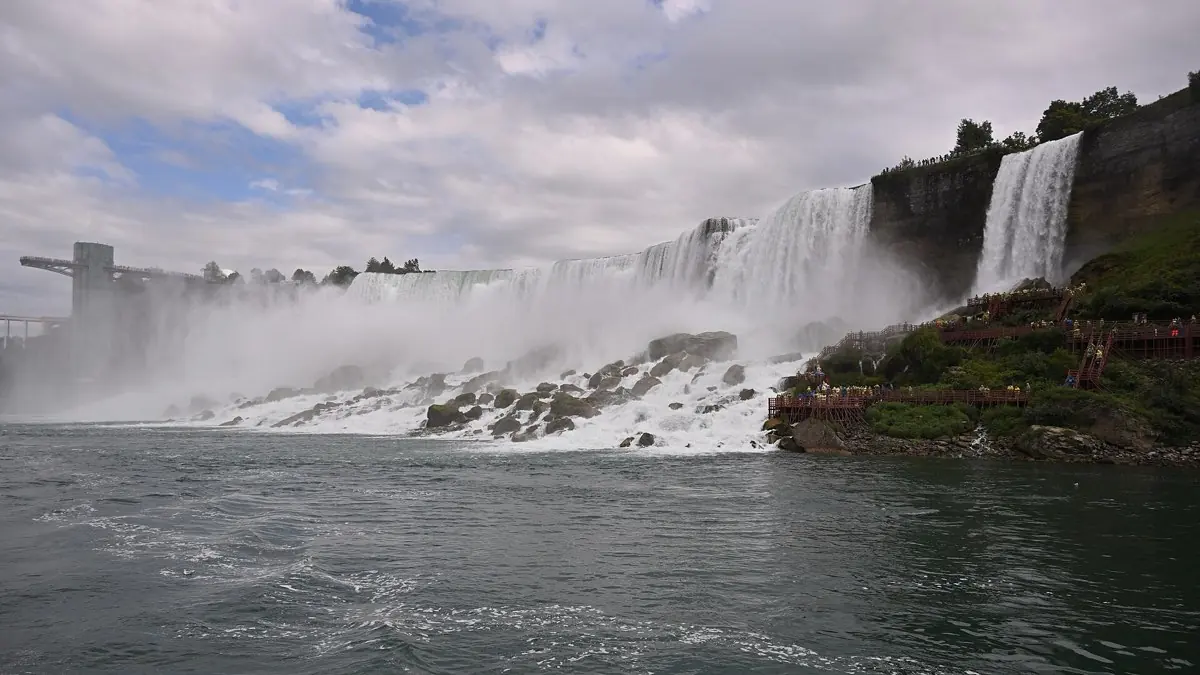
A wooden boardwalk just feet from Bridal Veil Falls, close enough to feel its full force.
Visitor guide
Cave of the Winds is a walkway attraction on the American side of Niagara Falls that takes visitors down to the gorge and out onto wooden decks beside Bridal Veil Falls. It takes its name from a real cave that once existed behind the falls, which collapsed during the twentieth century.
The way to the cave began before the cave was found. A staircase attached to the cliff face on Goat Island was built in 1829 with money from Nicholas Biddle of Philadelphia, according to a caving reference site. In July 1834, Berry H. White and George Sims, both local residents, are recorded as the first people to enter the space behind the falls. It was first called Aeolus's Cave, after the Greek god of the winds, because of the roaring air the falls drove through it.
Early visitors described it in different sizes. Wikipedia gives it as about 130 feet high, 100 feet wide and 30 feet deep, while Horatio A. Parsons, whose 1840 guidebook described the cave, gave other figures, so the dimensions are best treated as approximate. Guided tours were officially under way by 1841, and visitors reached the cave through Goat Island and a staircase that descended toward the falls.
Rockfalls reshaped the experience. One in 1920 closed the tour, and it reopened in 1924 (some sources say 1925) with visitors standing in front of Bridal Veil Falls on decks and walkways rather than behind it. A historical marker listing dates the opening of an elevator station to 1925, replacing the old Biddle Stairs, though sources vary on that date as well. A much larger rockfall in 1954, followed by the dynamiting of a dangerous overhang, destroyed the cave itself. The deck experience continued, and it is what visitors use today.
The cave was what geologists call an erosion cave, shaped as the falls cut back upstream. The Niagara gorge's surface rock is Lockport dolomite, a hard, limestone-like layer, and softer rock lies beneath it. Water wears the soft layers away faster, undercutting the hard cap and leaving hollows behind the falls until the overhang fails. According to Niagara Falls State Park, the falls began more than 12,000 years ago near what is now Lewiston, New York and Queenston, Ontario, and have been working their way upstream ever since. That same process explains why the Cave of the Winds could not last: the rock above an undercut space eventually collapses.
An elevator carries visitors from between the American and Canadian Falls down to river level at the base of the American Falls, with sources giving the drop as roughly 150 to 175 feet. From there, redwood decks and platforms lead up to Bridal Veil Falls. The best-known spot is the Hurricane Deck, where visitors stand about 20 feet from the falling water (another source says 15). Wind there can reach about 68 mph (109 km/h), and Wikipedia says the conditions can feel like a tropical storm.
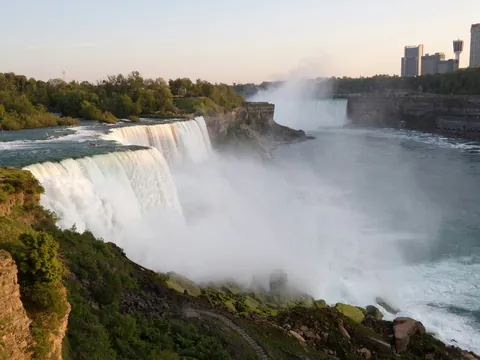
Bridal Veil Falls is the smallest of the three Niagara waterfalls. Wikipedia gives it a vertical drop of 78 feet before the water tumbles down a pile of fallen boulders into the Maid of the Mist pool, for a total height of 181 feet, and a crest only about 56 feet wide. It has also been called Luna Falls and Iris Falls. It is separated from the American Falls by tiny Luna Island, about 350 feet long and 130 feet wide, which is reached by a pedestrian bridge from Goat Island; the island's name is said to come from the lunar rainbows that appear in the mist under a full moon.
The decks are not permanent. Each fall, park staff remove the Hurricane Deck and its walkways board by board, a job that takes about four weeks, because falling ice would hit the wood and the ice buildup below would be too heavy. The structures are not bolted down; wooden supports are wedged into rock crevices. According to a Niagara Falls USA profile of the crew, the work is done by state park employees, many of whom had little carpentry experience when they started. The wood is power-washed, stained and reused where possible, with about 30 percent of the lumber new each year.
The decks sit inside Niagara Falls State Park, created as the Niagara Reservation in 1885 after years of campaigning to clear mills, factories and signs from the viewing areas. Frederick Law Olmsted and Calvert Vaux completed its design in 1887, favoring public access and natural scenery over commercial attractions. The Cave of the Winds is one of several viewpoints in a landscape that was deliberately laid out to be walked.
You will be close to the water, so plan to get wet, and check Niagara Falls State Park for current hours, access, footwear and gear details. The attraction is part of the park system and its operation depends on season and conditions, so confirm before you go.
A Voyzo private tour can include Cave of the Winds in a Niagara Falls USA day, with a private vehicle and driver collecting you door to door and fitting the decks around the rest of your plans.
See every tour and attraction we cover in Niagara Falls.