TorontoOntario · 36 tours
 Niagara FallsOntario · 25 tours
 New York CityNew York · 30 tours
 Las VegasNevada · 8 tours
 San FranciscoCalifornia · 16 tours
 VancouverBritish Columbia · 17 tours
 DubaiUAE · 54 tours
 Abu DhabiUAE · 5 tours
 Buenos AiresArgentina · 23 tours
 AthensGreece · 31 tours
 AucklandNew Zealand · 38 tours
 CancunMexico · 54 tours
No destinations match “”. Try searching all tours instead — that search understands full questions, not just place names.
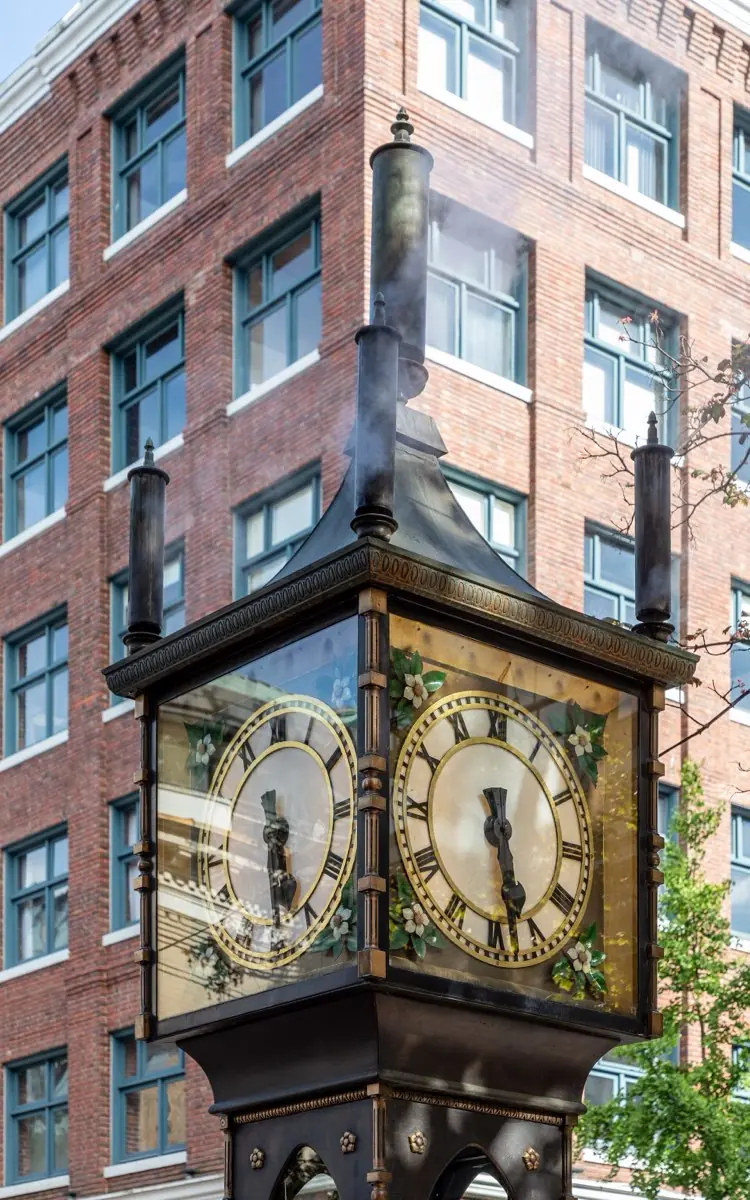
Vancouver's oldest neighbourhood, known for cobblestone streets and its landmark steam-powered clock.
Visitor guide
The Gastown Steam Clock stands at the corner of Cambie and Water Streets in Gastown, the district where Vancouver began. It dates from 1977, so it looks antique but is a modern creation, built over a steam grate in the downtown steam-heating system. It is one of the most photographed small landmarks in the city.
The clock was designed and built in 1977 by Vancouver horologist Raymond Saunders, with metalwork by Doug Smith, and was commissioned by Gastown merchants rather than by the city. Its purpose was partly to give the revitalised district a focal point and partly to make use of, and cover, a steam vent in the pavement; sources note that it also discouraged people from sleeping on the warm grate in cold weather. Saunders went on to build further steam clocks elsewhere, including one in Otaru, Japan, and one for the Indiana State Museum, and died in November 2024.
Sources disagree on how to rank it. Some describe it as the second steam clock ever built, after one made by John Inshaw in Birmingham, England, in 1859; others call it the world's first of its kind. Voyzo treats the claim cautiously: it is better described as a famous modern steam clock than as a record-holder.
The steam comes from Vancouver's low-pressure downtown steam network, fed by a plant near the Georgia Viaduct. Per Wikipedia, steam drives a miniature steam engine in the base of the clock, which lifts steel balls up a chain; as the balls descend, their weight drives a conventional pendulum escapement connected to the four faces. Steam whistles, not bells, sound the Westminster chime and the time. Accounts differ on the present mechanism, with some saying the original design proved unreliable and that electricity now helps drive the hands, so the detail is worth treating as approximate.
In October 2014 the clock was removed for refurbishment by a City of Vancouver team working closely with its original horologist, Raymond Saunders, and returned on 20 January 2015, according to the Gastown BIA. The City of Vancouver said the ball-loading mechanism had worn over 37 years and could no longer be reliably maintained. Local businesses helped fund restoration of the steam mechanism.
Gastown takes its name from John "Gassy" Deighton, a seaman who opened a saloon here in 1867; the settlement grew around the Hastings Mill and seaport and was officially surveyed as the Granville townsite. The area was rebuilt after the Great Fire of 1886. In the 1960s campaigners resisted plans that would have cleared much of it for a freeway, and the province protected it as a historic district in 1971. Parks Canada recognises the Gastown Historic District as a National Historic Site of Canada, designated in 2009, and describes it as an intact area of commercial buildings built mostly between 1886 and 1914. The designation is commemorative and does not add extra legal protection.
See every tour and attraction we cover in Vancouver.