TorontoOntario · 36 tours
 Niagara FallsOntario · 25 tours
 New York CityNew York · 30 tours
 Las VegasNevada · 8 tours
 San FranciscoCalifornia · 16 tours
 VancouverBritish Columbia · 17 tours
 DubaiUAE · 54 tours
 Abu DhabiUAE · 5 tours
 Buenos AiresArgentina · 23 tours
 AthensGreece · 31 tours
 AucklandNew Zealand · 38 tours
 CancunMexico · 54 tours
No destinations match “”. Try searching all tours instead — that search understands full questions, not just place names.
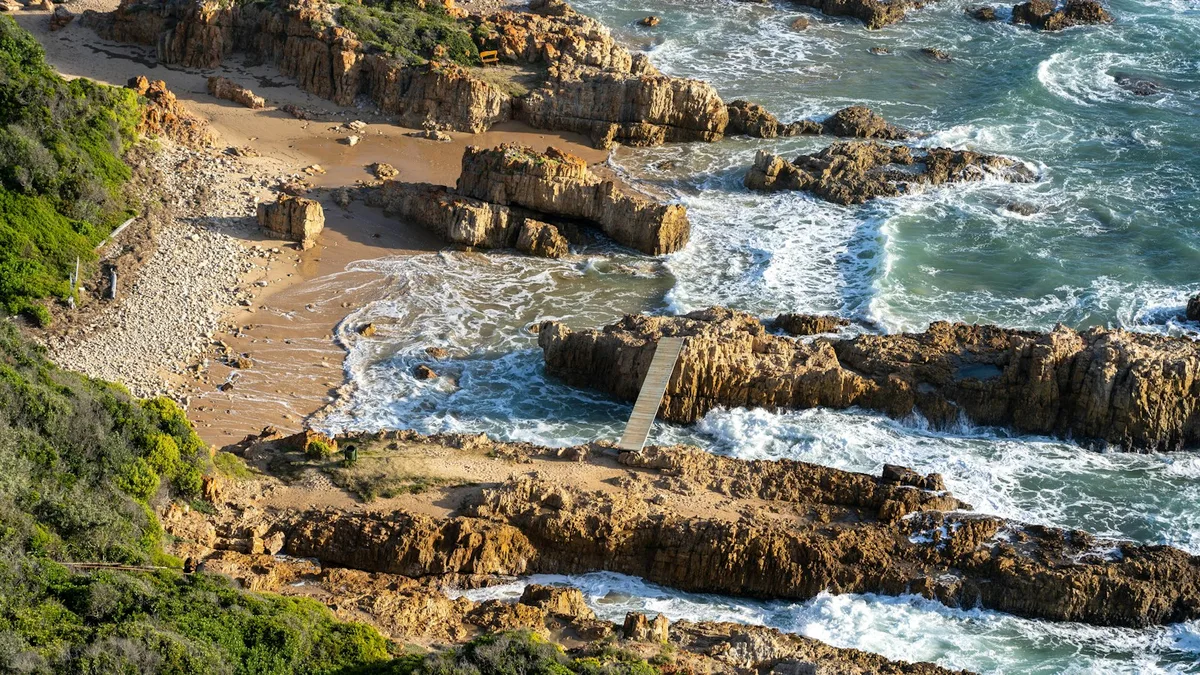
Two sandstone cliffs guarding the narrow, current-swept entrance to the Knysna Lagoon on the Garden Route, a lookout point over one of South Africa's most dramatic stretches of coastline.
Visitor guide
Knysna Heads are two large sandstone headlands guarding the narrow entrance from the Indian Ocean to Knysna Lagoon, on South Africa's Garden Route in the Western Cape. They form a dramatic gateway to the lagoon and a well-known lookout over a rugged stretch of coast.
Knysna is a coastal town of around 76,150 people at the 2019 estimate, on the N2 roughly 60 kilometres east of George and 33 kilometres west of Plettenberg Bay. It is built mainly on the north shore of a large, warm-water estuary called Knysna Lagoon, which is fed by the Knysna River. The lagoon reaches the ocean through a gap between two big headlands of Peninsula Formation quartzite, popularly called The Heads. Wikipedia says their waters are treacherous and unpredictable, with a reputation for claiming boats and fishermen. Nearby formations are known locally as The Map Stones.
The eastern head is heavily developed, while the western head is partly protected by the private Featherbed Nature Reserve, developed by the television presenter William Smith, who inherited the land from his father, the ichthyologist J. L. B. Smith.
The transport brig Emu was the first European vessel to enter the Heads, in 1817. It struck a rock now called Emu Rock and was holed, and its crew beached it to prevent it sinking. HMS Podargus later surveyed the area, sailed into the lagoon and recovered the cargo. The German vessel Paquita sank on the eastern side of the Heads in 1903.
Fossilised hominid footprints about 90,000 years old and other finds suggest humans have lived in the area for a very long time. San hunter-gatherers were the first inhabitants, followed by Khoekhoe peoples, including the Houtunqua, or Outeniqua, whose name is usually translated as the people who bear honey. Chief Dikkop, who died in 1816, was the last recorded chief. The first Europeans arrived in 1760, and George Rex, a British-born entrepreneur often called the founder of Knysna, acquired the farm Melkhoutkraal in 1804. The Thesen family, Norwegians bound for New Zealand, settled in Knysna and later set up a steam sawmill and small shipyard, which moved to what is now Thesen Island.
To the north, afromontane forest covers the hills for about 20 kilometres, giving way higher in the Outeniqua Mountains to fynbos. The climate is warm oceanic, with summer maximums averaging about 25 degrees Celsius and winter maximums around 17 to 18. The area receives high rainfall for South Africa, about 719 millimetres a year, with the wettest period from October to November.
The Knysna Oyster Festival was first held in 1983 and runs for ten days in late June or early July. The Simola Hillclimb, held in early May, has a 1.9 kilometre course. A fire driven by strong winds from the Cape Storm swept through the town and surrounding areas on 7 June 2017, causing deaths and displacement; Wikipedia says it was first reported as arson but later attributed to lightning.
The viewpoints are reached by road, and sea conditions at the Heads can be rough, so boat trips depend on weather. A private guided visit with a driver suits a Garden Route day that also takes in the lagoon, forests and nearby beaches.
See every tour and attraction we cover in South Africa.