TorontoOntario · 36 tours
 Niagara FallsOntario · 25 tours
 New York CityNew York · 30 tours
 Las VegasNevada · 8 tours
 San FranciscoCalifornia · 16 tours
 VancouverBritish Columbia · 17 tours
 DubaiUAE · 54 tours
 Abu DhabiUAE · 5 tours
 Buenos AiresArgentina · 23 tours
 AthensGreece · 31 tours
 AucklandNew Zealand · 38 tours
 CancunMexico · 54 tours
No destinations match “”. Try searching all tours instead — that search understands full questions, not just place names.
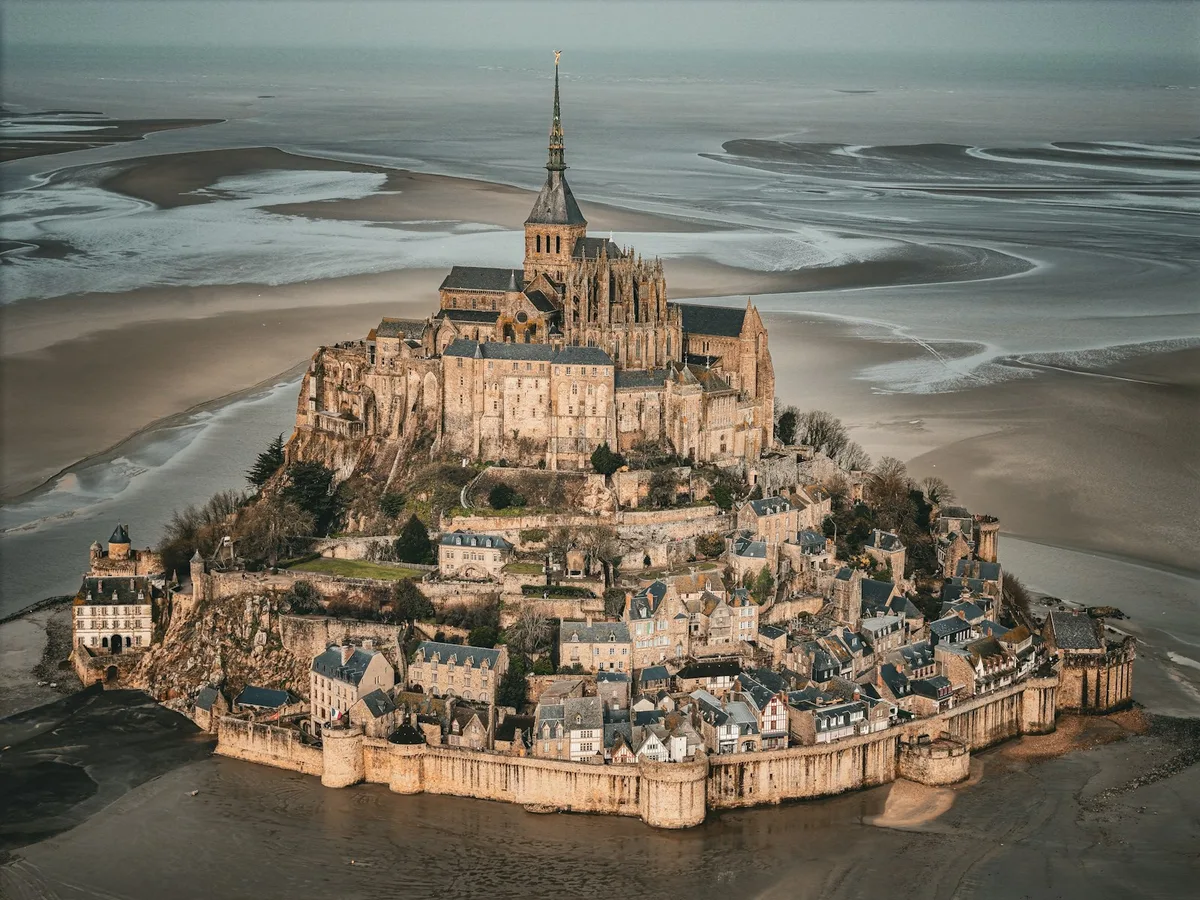
A rocky tidal island in Normandy crowned by a medieval Benedictine abbey, connected to the mainland by a causeway and surrounded by some of Europe's most dramatic tidal shifts.
Visitor guide
Mont-Saint-Michel is a tidal island and commune in Normandy, northwestern France, about one kilometre off the coast at the mouth of the Couesnon River. A medieval Benedictine abbey crowns the rocky island, which was inscribed on the UNESCO World Heritage List in 1979 together with its bay.
According to Wikipedia, the island is made of leucogranite that solidified underground about 525 million years ago. It was once dry land, and as sea levels rose several granite outcrops, including Tombelaine to the north, were left standing in the bay. The island covers about 7 hectares, has a circumference of roughly 960 metres, and rises to 92 metres above sea level. Its resident population is very small, recorded as 23 in 2023.
The bay has a very large tidal range, with roughly 14 metres between the highest and lowest water marks. Medieval pilgrims nicknamed the mount "St. Michael in peril of the sea", and walking the sands unguided can still be dangerous. The salt meadows around the bay are used for grazing sheep, producing a local speciality known as pre-sale lamb.
Before the first monastery, in the 8th century, the island was called Mont Tombe. According to legend, the archangel Michael appeared in 708 to Aubert, bishop of Avranches, and told him to build a church on the rock. In 933 the mount became definitively part of Normandy, and Norman ducal patronage financed the abbey's Romanesque architecture in the following centuries. The Bayeux Tapestry shows an episode set near the mount, and the monastery supported William the Conqueror's claim to the English throne in 1067.
The island's position made it defensible as well as sacred. English forces besieged it unsuccessfully during the Hundred Years' War, in 1423-24 and again in 1433-34, and Wikipedia says it remained unconquered. Fortifications such as the Corbins tower and the Penine tower date from the late 14th century under the abbot Pierre le Roy.
Pilgrimage declined after the Reformation, and by the French Revolution scarcely any monks remained. The abbey was converted into a prison, which held political prisoners until it closed in 1863. A campaign launched in 1836, supported by figures including Victor Hugo, sought to save it as a national architectural treasure, and it was declared a historic monument in 1874. Architect Edouard Corroyer then spent about fifteen years restoring the Merveille, the monastic complex on the mount's north side.
A tidal causeway was replaced by a raised causeway in 1879, which encouraged silting of the bay. A restoration project begun in 2009 included a hydraulic dam, removal of the old causeway and car park, and a new bridge opened in 2014. Since 2012 the mainland car park has been about 2.5 kilometres from the island, and visitors walk or use shuttles. Wikipedia says more than three million people visit each year. Tide times affect what you see, so a private driver and guide can help time the visit.
See every tour and attraction we cover in France.