TorontoOntario · 36 tours
 Niagara FallsOntario · 25 tours
 New York CityNew York · 30 tours
 Las VegasNevada · 8 tours
 San FranciscoCalifornia · 16 tours
 VancouverBritish Columbia · 17 tours
 DubaiUAE · 54 tours
 Abu DhabiUAE · 5 tours
 Buenos AiresArgentina · 23 tours
 AthensGreece · 31 tours
 AucklandNew Zealand · 38 tours
 CancunMexico · 54 tours
No destinations match “”. Try searching all tours instead — that search understands full questions, not just place names.
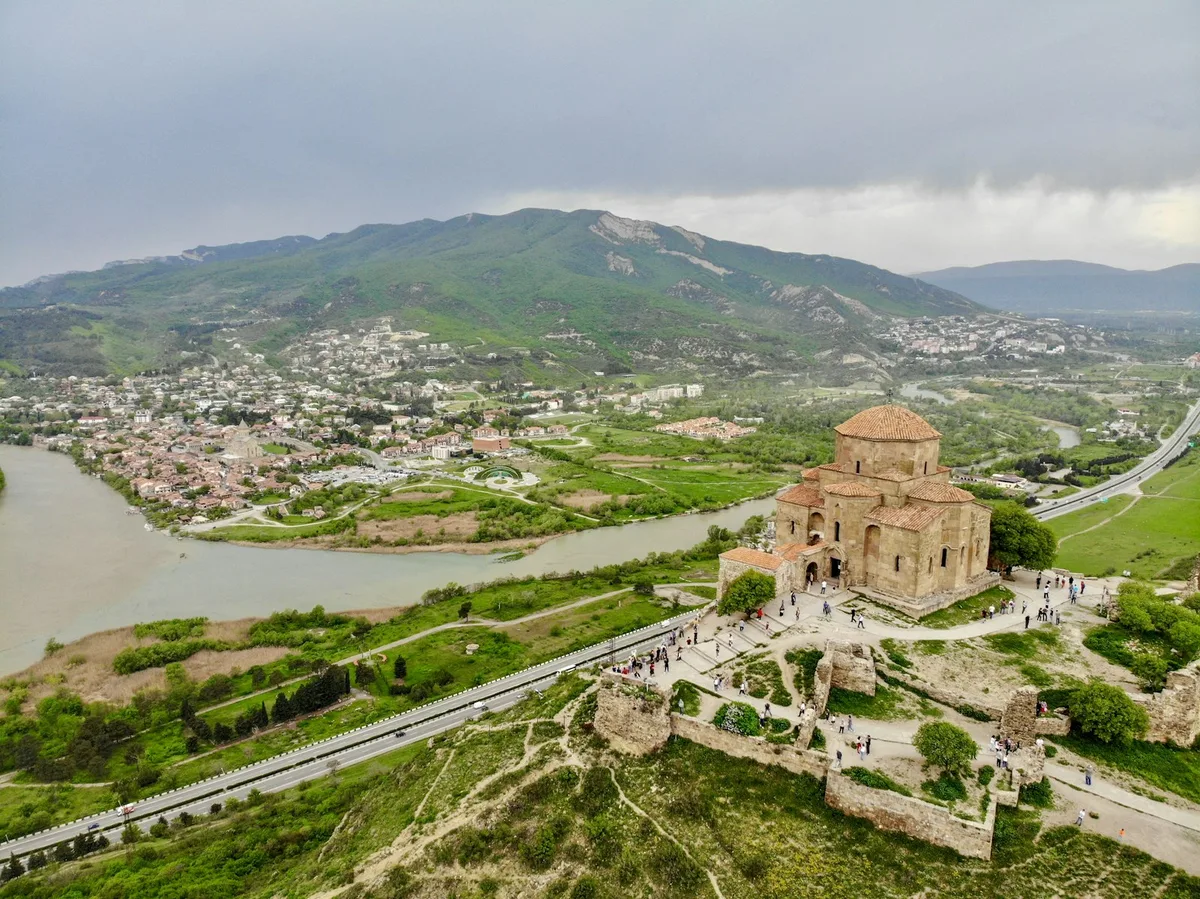
Georgia's ancient capital, where the 6th-century Jvari Monastery sits on a hilltop overlooking the confluence of the Mtkvari and Aragvi rivers beside the UNESCO-listed Svetitskhoveli Cathedral.
Visitor guide
Mtskheta is a small town in Georgia at the confluence of the Mtkvari and Aragvi rivers, and above it stands the Jvari Monastery, a sixth-century Georgian Orthodox church on a mountaintop. Together with Svetitskhoveli Cathedral and other monuments, they form the Historical Monuments of Mtskheta, a UNESCO World Heritage Site since 1994.
Wikipedia states that Mtskheta was the capital of the early Georgian Kingdom of Iberia from the 3rd century BC to the 5th century AD, and that the capital moved to Tbilisi under King Dachi in the early 6th century. Christianity became the state religion of Iberia in 337, and Mtskheta remains the headquarters of the Georgian Orthodox Church. It was the coronation and burial place of most Georgian kings until the end of Georgian political independence in the 19th century.
The town has about 7,400 residents and is described as one of the oldest continuously inhabited cities in the world. The Armazi citadel on Mount Bagineti controlled the southern and eastern approaches, and the Samtavro Monastery is listed as a 4th-century monument, with a nearby necropolis dated from the mid-3rd millennium BC to the 10th century.
Vakhtang Gorgasali built a large basilica here in the 5th century, and in the 11th century Catholicos Melchizedek I built a new church on top of it. Remains of an earlier wooden church lie within the cathedral. It is the main church of Mtskheta and a key site in Georgian Christian tradition.
Local tradition, which should be read as legend rather than documented history, holds that the Holy Tunic of Christ was brought to Mtskheta from Jerusalem by local Jews during the reign of Pharasmanes I, and the cathedral's name and fame in Georgian Christianity are bound up with that story.
Tradition holds that St Nino set up a wooden cross on a former pagan temple site in the early 4th century. A small church was built over the cross's remains around 545, and the Great Church is generally dated to 590-605, with inscriptions naming its builders. Historian Cyril Toumanoff identifies them differently, so some details remain debated.
Architecturally, Jvari is a domed tetraconch with four apses, with the dome resting on squinches rather than pillars. It became the model for the Jvari type of church in Georgia and Armenia. Bas-reliefs on the eastern and southern facades show rulers, nobles and Christian scenes, some with Asomtavruli inscriptions. Arabs burned the church in 914, but it survived, and stone walls were added in the late Middle Ages.
From the monastery you look down on the meeting of the two rivers and the roofs of Mtskheta. The monuments were listed as endangered between 2009 and 2016 because of stonework and fresco deterioration and were placed under Enhanced Protection in 2016. Wikipedia noted that erosion from acid rain and wind threatened Jvari as of 2007.
A private visit from Tbilisi is straightforward, and a guide can explain how the churches reflect Georgia's conversion to Christianity.
See every tour and attraction we cover in Georgia.