TorontoOntario · 36 tours
 Niagara FallsOntario · 25 tours
 New York CityNew York · 30 tours
 Las VegasNevada · 8 tours
 San FranciscoCalifornia · 16 tours
 VancouverBritish Columbia · 17 tours
 DubaiUAE · 54 tours
 Abu DhabiUAE · 5 tours
 Buenos AiresArgentina · 23 tours
 AthensGreece · 31 tours
 AucklandNew Zealand · 38 tours
 CancunMexico · 54 tours
No destinations match “”. Try searching all tours instead — that search understands full questions, not just place names.
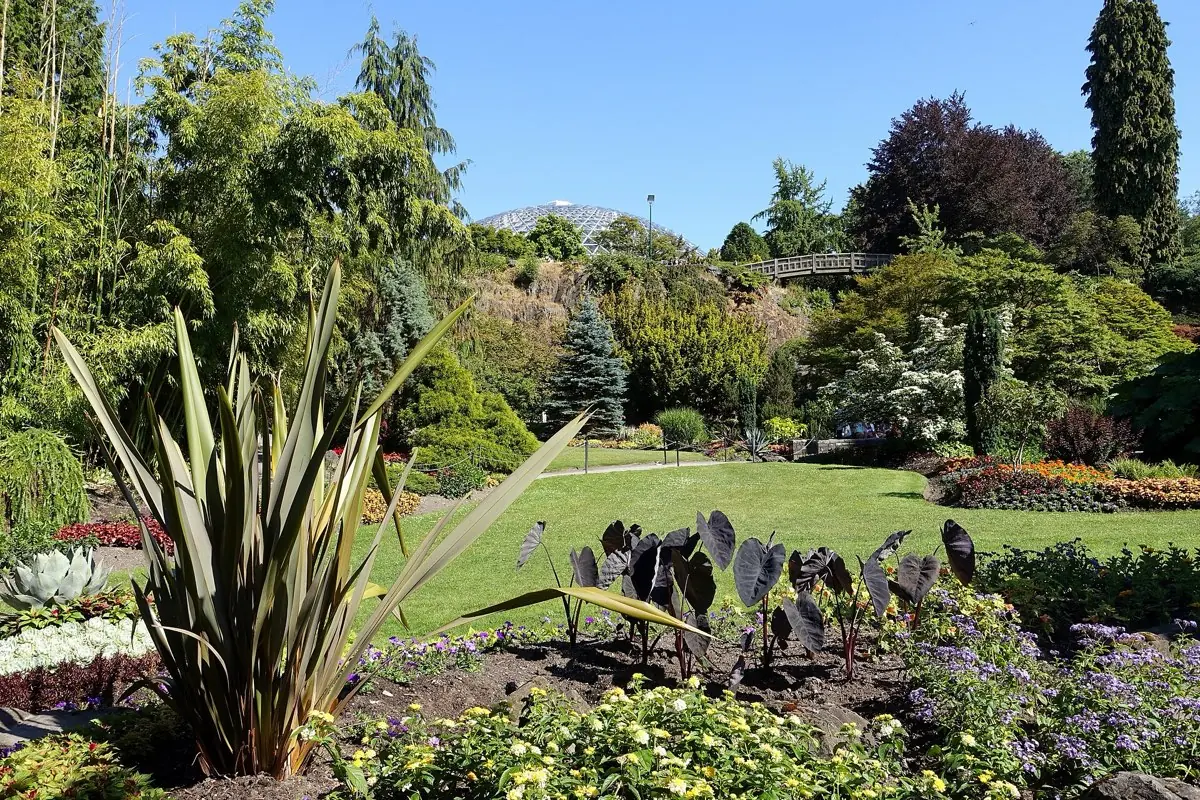
One of Vancouver's highest points, with manicured gardens and panoramic city views.
Visitor guide
Queen Elizabeth Park crowns Little Mountain in Vancouver, the city's high point at roughly 125 to 150 metres above sea level depending on the source, and is known for its quarry garden, the Bloedel Conservatory and sweeping views toward downtown and the North Shore mountains. Much of it was once a basalt quarry, and the park is considered an early example of landscape rehabilitation in Canada.
Wikipedia describes Little Mountain as a volcanic outcropping formed between 31 and 34 million years ago, and a geology writer identifies the quarried rock as middle Tertiary basalt. The park covers about 52 to 53 hectares in south Vancouver, depending on the source, and the hill gives its name to the surrounding Riley Park-Little Mountain neighbourhood.
Little Mountain was owned by the Canadian Pacific Railway and quarried for basalt between roughly 1890 and 1911, supplying road material for parts of South Vancouver and Shaughnessy. The two small quarries produced no building stone, and stepped marks in the rock show the plug-and-feather method of splitting it. Reservoir dates vary: one source says a quarry became a city reservoir in 1908, another says two reservoirs were dug in 1911 to improve water pressure, and a third says the 1920s. The reservoir was later covered by a parking lot in 1963. Sources give the city's purchase date as 1928 or 1929, and the park was named in honour of Queen Elizabeth after the 1939 royal visit, with one source placing the formal naming in April 1940.
The BC Tulip Association proposed turning the quarry into a garden in 1936. Park Board deputy superintendent Bill Livingstone is credited with the design; a geology writer says that in 1948 he cleared the quarries and used the gullies as a backdrop for plantings and water features, blasting out pools and dynamiting old walls. Sources disagree on when it opened: one says the Quarry Gardens were officially launched on October 20, 1951, while another says the larger quarry opened as an arboretum in 1953 and the smaller one in 1961. The park's arboretum is linked to a 1948 agreement with the Canadian Pulp and Paper Association. The terraced beds, stream and waterfall are set into the old rock walls.
The Bloedel Conservatory, a Canadian centennial project, was proposed by Park Board superintendent Stuart Lefeaux and Livingstone, and funded by a gift from timber executive Prentice Bloedel, reported as $1.25 million in one source and $1.4 million in another, then the largest the city had received. It opened on December 6, 1969. Historicplaces.ca lists its construction as 1967 to 1969. Wikipedia describes a triodetic dome about 140 feet in diameter and 70 feet high, designed by McKinley Underwood and inspired by the Buckminster Fuller dome at Expo 67, built of 1,490 plexiglass bubbles and 2,324 aluminum tubes. Its frame was made in Ottawa and put up in about ten days, and the dome stands over a concrete-covered city reservoir, so construction followed strict water-supply rules. Eight air-circulating units and 24 mist sprayers maintain three climate zones (rainforest, subtropical and desert), with around 500 plant species and more than 200 birds, per Wikipedia. Wikipedia calls it Canada's first geodesic conservatory, but Voyzo has not found an independent source for that claim.
The conservatory is on the Canadian Register of Historic Places (listed in 2008) and the City of Vancouver heritage register. In 2009 the Park Board voted to close it, but a community campaign led to a proposal from the Friends of the Bloedel and the VanDusen Botanical Garden Association, approved on September 20, 2010. In 2013 the Friends received the City of Vancouver Heritage Commission Award of Honour.
The plaza outside holds Henry Moore's bronze Knife Edge Two Piece, donated by Prentice and Virginia Bloedel. Moore made it in 1962-65 in an edition of four full-size casts, each about 366 cm long and around three tonnes, plus smaller working models. The artist's own copy is at his foundation in Hertfordshire, another stands opposite the Palace of Westminster in London, and another is at the Rockefeller estate Kykuit in New York.
Besides the gardens, Wikipedia lists a celebration pavilion, fountains and plaza, Painters' Corner, pitch and putt golf, a disc golf course, tennis courts and a lawn bowling club among the park's features.
VanDusen Botanical Garden and Main Street's cafes are a short drive away, and Granville Island lies to the north.
See every tour and attraction we cover in Vancouver.