TorontoOntario · 36 tours
 Niagara FallsOntario · 25 tours
 New York CityNew York · 30 tours
 Las VegasNevada · 8 tours
 San FranciscoCalifornia · 16 tours
 VancouverBritish Columbia · 17 tours
 DubaiUAE · 54 tours
 Abu DhabiUAE · 5 tours
 Buenos AiresArgentina · 23 tours
 AthensGreece · 31 tours
 AucklandNew Zealand · 38 tours
 CancunMexico · 54 tours
No destinations match “”. Try searching all tours instead — that search understands full questions, not just place names.
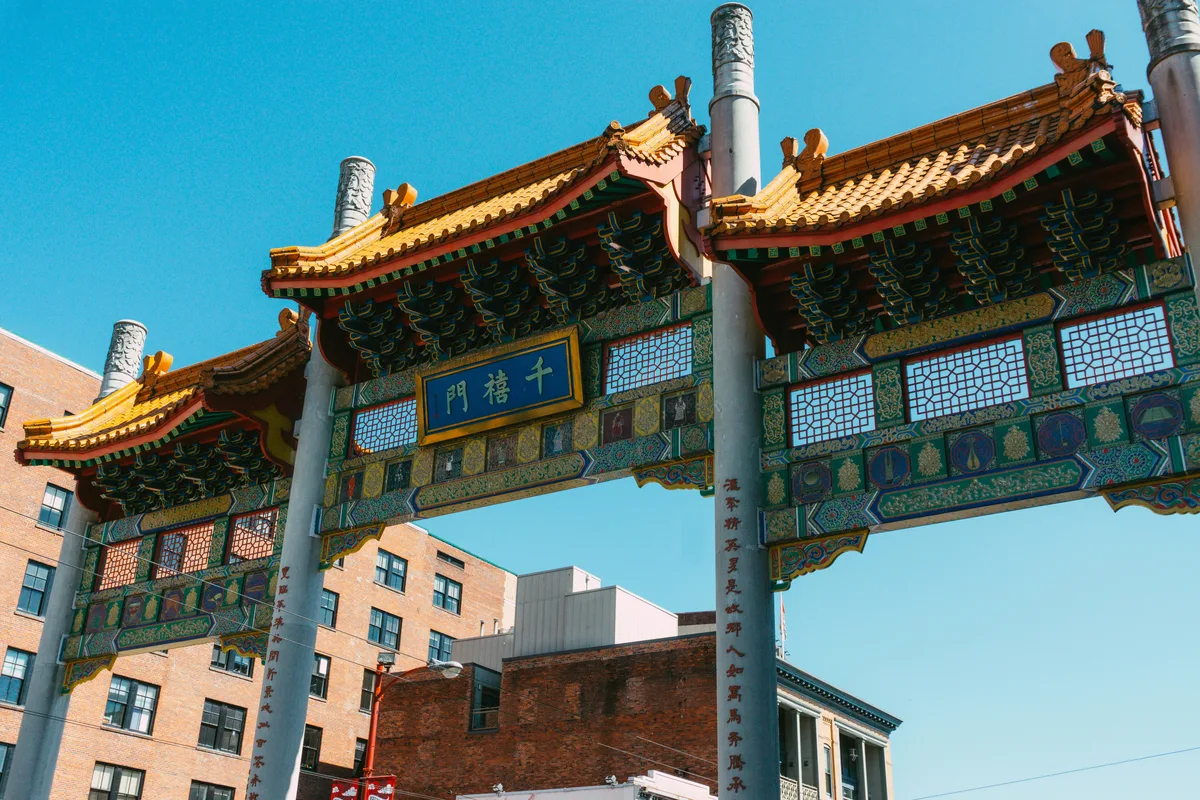
One of the oldest and largest Chinatowns in Canada, entered through the ornate Millennium Gate on Pender Street, with the Dr. Sun Yat-Sen Classical Chinese Garden and a mix of family-run shops and modern restaurants.
Visitor guide
Vancouver's Chinatown is a compact historic district on the east side of downtown, centred on Pender Street between Taylor Street and Gore Avenue. It is a National Historic Site of Canada and, by Wikipedia's account, the country's largest Chinatown, shaped by railway-era immigration, exclusion and decades of community resilience.
Chinese immigrants, mostly men, arrived in British Columbia in large numbers after the 1858 gold rush and during Canadian Pacific Railway construction in the 1880s. Parks Canada notes that the neighbourhood was first settled in the 1880s and that discrimination and segregation pushed newcomers to cluster in a self-contained district. By 1900 it covered about four blocks, with Pender Street (then Dupont) as its main commercial street.
The community faced a long run of discriminatory policy. The Chinese Immigration Act of 1885 imposed a $50 head tax, which rose to $100 in 1900 and $500 in 1903. In September 1907 an anti-Asian rally organised by the Asiatic Exclusion League turned into a riot that displaced about 2,000 Chinese residents. The Chinese Immigration Act of 1923 repealed the head tax but effectively ended Chinese immigration to Canada, apart from limited exceptions, and it remained in force for decades.
Clan societies and associations grew up to support newcomers. The Chinese Benevolent Association, organised by figures including Yip Sang, Chang Toy and Wang Yu Shan, has a building at 104-108 East Pender dating from 1901-1910. Provincial heritage protection for the area began in 1971, and Parks Canada reports that 24 properties are on the Vancouver Heritage Register.
Parks Canada's page gives two designation dates, 2010 in its heritage-value text and 2011 elsewhere; Wikipedia gives July 19, 2011. Either way, the reasons are consistent: it is one of the oldest and largest Chinatowns in Canada, it developed partly as a self-segregated enclave in response to hostility elsewhere in the city, and it shows a hybrid architectural style combining Chinese regional elements with Western building methods. That style is visible in features such as recessed balconies, decorative cornices, strong verticality and tall ground-floor ceilings with mezzanines. The street grid dates to the 1880s, and about 70 contiguous properties, mostly two to four storeys, are part of the designated area.
The Chinatown Millennium Gate, designed by local architect Joe Y. Wai and erected in 2002, marks the western end of the district on Pender Street. It stands on the site of a temporary arch built for the 1901 royal tour, and its inscription reads "Remember the past and look forward to the future."
The Sam Kee Building on West Pender, dating from 1913 and built for Chang Toy's Sam Kee Company, is recorded by Guinness as the world's narrowest commercial building, with a ground-floor depth of about 1.5 metres; Wikipedia notes this claim, so treat it as a listing rather than a settled fact. Nearby, the Dr. Sun Yat-Sen Classical Chinese Garden, opened in 1986 and designed by Joe Wai, Donald Vaughan and Wang Zu-Xin, sits behind the Chinese Cultural Centre courtyard and is the district's largest open public space according to Parks Canada.
Keefer Street, historically the southern edge of the 1900 district, is another main commercial street, and the 1971 Chau Luen Tower at 325 Keefer is a mid-century addition. The neighbouring residential area of Strathcona lies to the southeast.
Wikipedia, citing a 2011 revitalisation plan, reports that many Chinatown businesses had declining revenue and that the community had aged as many Chinese Canadians moved to other parts of the metro area. Heritage protection and revitalisation efforts continue, so visits give a picture of a living working neighbourhood rather than a museum piece. Shops, restaurants and associations here still serve residents as well as visitors.
Pender and Keefer Streets, the Millennium Gate and the Chinese Cultural Centre are all within a few blocks, so the district is easy to explore on foot. Opening times of the garden and individual businesses vary, so check each operator before you go.
A private vehicle and driver with door-to-door pickup can drop you at the Millennium Gate and meet you again when you've finished walking the blocks, rather than having to find parking in a busy corner of downtown.
See every tour and attraction we cover in Vancouver.