TorontoOntario · 36 tours
 Niagara FallsOntario · 25 tours
 New York CityNew York · 30 tours
 Las VegasNevada · 8 tours
 San FranciscoCalifornia · 16 tours
 VancouverBritish Columbia · 17 tours
 DubaiUAE · 54 tours
 Abu DhabiUAE · 5 tours
 Buenos AiresArgentina · 23 tours
 AthensGreece · 31 tours
 AucklandNew Zealand · 38 tours
 CancunMexico · 54 tours
No destinations match “”. Try searching all tours instead — that search understands full questions, not just place names.
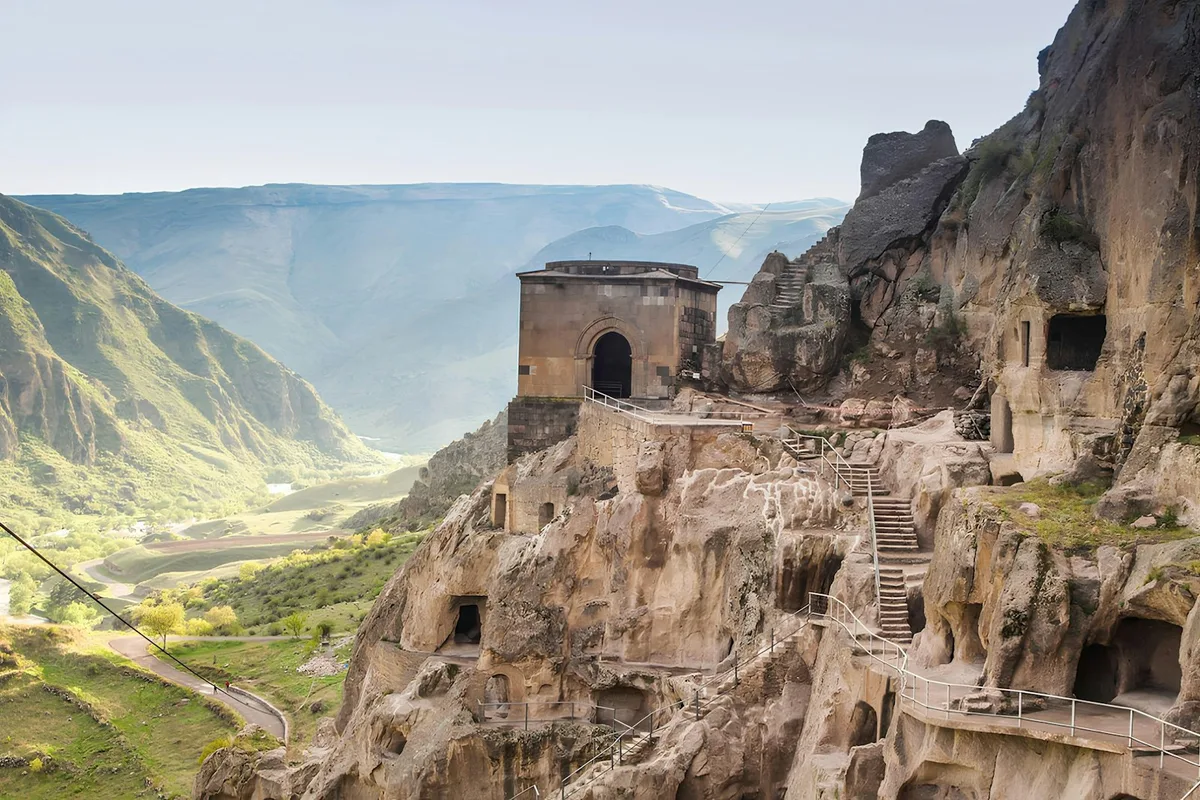
A cave monastery complex carved into a cliff face near Akhaltsikhe in the 12th and 13th centuries, once housing thousands of rooms across nineteen tiers before an earthquake exposed much of it.
Visitor guide
Vardzia is a cave monastery in southern Georgia, carved into the slopes of Erusheti Mountain above the Mtkvari (Kura) River, about 30 km from Aspindza. Built mainly in the second half of the 12th century, it is one of the most striking medieval sites in the Caucasus.
Wikipedia states that most building took place in the second half of the 12th century. The first phase came under King Giorgi III, who reigned from 1156 to 1184, and the Church of the Dormition was carved and decorated after his death, before Queen Tamar's marriage in 1186. The site was therefore not founded by Tamar alone, although popular accounts often credit her. The site had defensive features and an aqueduct about 3.5 km long to supply water.
The complex stretches about 500 metres along the cliff in up to 19 tiers and contains roughly 500 caves. The eastern section has 242 rooms and the western section 165, including numerous chapels, wine cellars, a refectory and a forge.
This scale makes Vardzia more than a single church. It was an entire community cut into the rock, with living spaces, storage, workshops and worship rooms, and its defensive features suggest it also served as a refuge.
Travel sources add a popular origin story for the name, which should be read as legend: Tamar, lost in the caves while hunting with her uncle, called out to him. Some sources describe the site as begun by Giorgi III as a military stronghold and turned toward religious use under Tamar, though others caution that crediting Tamar with the whole project reflects national pride more than evidence.
The central church, dating to the 1180s, has an important series of wall paintings, including a portrait of Tamar and Giorgi III holding a model of the church. Wikipedia says the paintings are considered significant to the development of medieval Georgian mural art. The portrait of the royal patrons shows how closely the monastery was tied to the crown during Georgia's Golden Age.
The 1283 earthquake damaged the site; travel accounts say a large slab of the cliff sheared away and exposed rooms that had been hidden inside the rock, though estimates of the damage vary. Counts of rooms, churches and monks also differ widely between sources. In 1551 Persian forces under Shah Tahmasp I sacked Vardzia, and after the Ottomans arrived in 1578 the monks left and the site was largely abandoned.
Today Vardzia is part of a state heritage reserve, and the wider Vardzia-Khertvisi area has been submitted for UNESCO World Heritage listing. Wikipedia notes that some monks still live on site, so it remains partly a place of worship rather than only a museum.
The site is in the south of Georgia, a long drive from Tbilisi. Visitors walk through narrow rock-cut spaces and up and down steps, so sturdy shoes and some stamina help. A private tour with a driver makes the distance manageable and lets a guide describe the layers of the complex, from the wine cellars to the church paintings.
See every tour and attraction we cover in Georgia.