TorontoOntario · 36 tours
 Niagara FallsOntario · 25 tours
 New York CityNew York · 30 tours
 Las VegasNevada · 8 tours
 San FranciscoCalifornia · 16 tours
 VancouverBritish Columbia · 17 tours
 DubaiUAE · 54 tours
 Abu DhabiUAE · 5 tours
 Buenos AiresArgentina · 23 tours
 AthensGreece · 31 tours
 AucklandNew Zealand · 38 tours
 CancunMexico · 54 tours
No destinations match “”. Try searching all tours instead — that search understands full questions, not just place names.
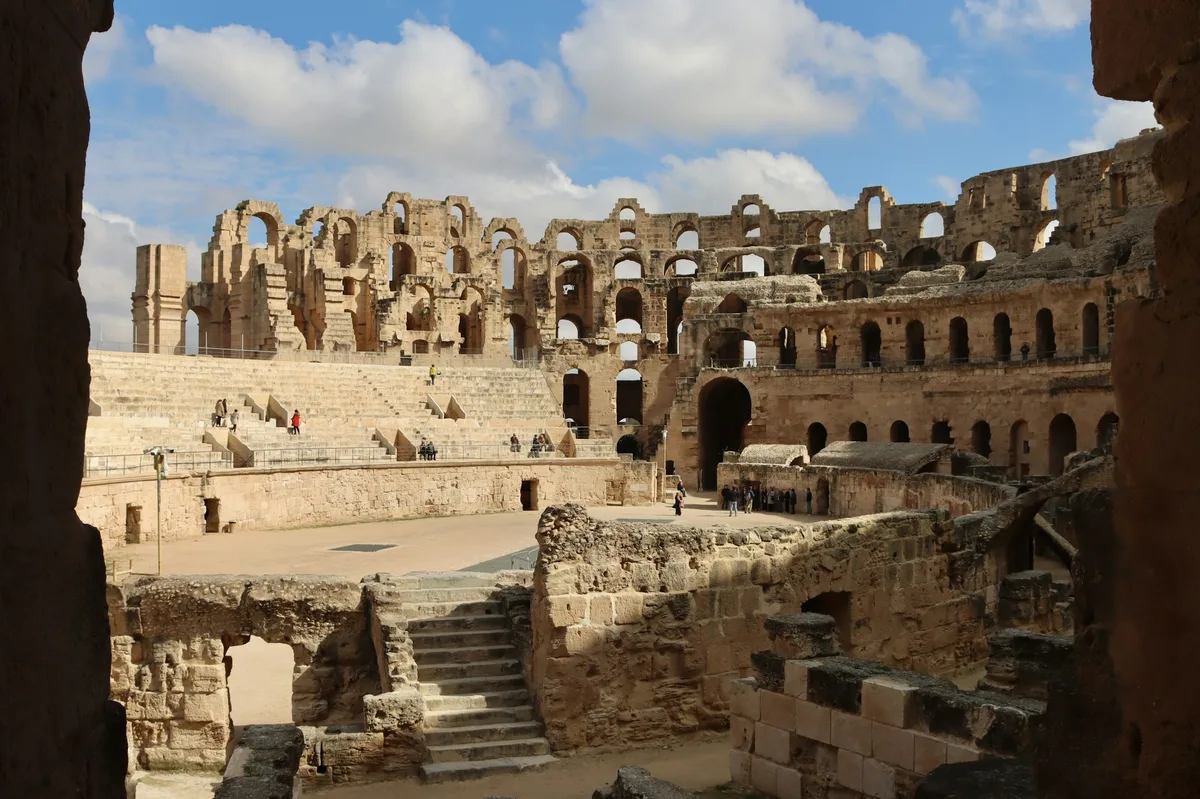
A UNESCO-listed Roman amphitheatre in the town of El Jem, described by UNESCO as the largest colosseum in North Africa and among the best-preserved Roman amphitheatres, and among the largest in the world.
Visitor guide
The Amphitheatre of El Jem is a Roman oval amphitheatre in the town of El Djem, Tunisia, ancient Thysdrus in the Roman province of Africa. It has been a UNESCO World Heritage Site since 1979, with an extension in 2010, and is described by Wikipedia as one of the best-preserved Roman stone ruins in the world.
The amphitheatre was built around 238 AD. Wikipedia's infobox credits Gordian III, while the text says a proconsul named Gordian is often credited but argues the young Gordian III, born at Thysdrus, is more likely the patron. It was the third amphitheatre built on the same site and was left unfinished after his death.
The estimated capacity is 35,000. The major axis measures 148 metres and the minor axis 122 metres, and the structure stands 36 metres high. It is built of stone blocks on flat ground rather than against a hillside, and it is exceptionally well conserved. Wikipedia describes it as unique in Africa.
In the Middle Ages the amphitheatre was used as a fortress, sheltering residents during Vandal attacks in 430 and Arab attacks in 647. In 1695 Mohamed Bey El Mouradi made an opening in one wall to stop the followers of his brother Ali Bey al-Muradi, who had gathered inside. Around 1850 Ahmad I ibn Mustafa enlarged the breach to about 30 metres. In the late 18th and 19th centuries it was believed to have been used as a saltpetre factory, and in the second half of the 19th century it held shops, dwellings and grain storage.
The site features in Monty Python's Life of Brian and the travel series Long Way Down. Nike's 1996 commercial Good vs Evil was filmed there with international footballers in a gladiatorial-style game, and the fourth episode of The Amazing Race 1 ended at the amphitheatre. The 2013 closing concert of the Festival international de musique symphonique d'El Jem was held in the arena.
El Djem is a small town in central Tunisia, and the amphitheatre dominates its skyline. Its position on flat ground means it is visible from a distance, and its scale makes it a major regional landmark.
Thysdrus was built, like most Roman settlements in ancient Tunisia, on a former Punic settlement, and was a centre of olive oil production and export. Wikipedia says that by the early 3rd century it rivalled Hadrumetum (Sousse) as the second city of Roman North Africa after Carthage. The town appears on the 4th-century Peutinger Map and was the seat of a Christian bishopric. An abortive revolt began in AD 238 after Gordian's suicide, and Roman troops loyal to Maximinus Thrax sacked the city afterwards. Drifting sand helped preserve the city and its suburban villas, and from the 17th century stones from the amphitheatre were reused for the nearby village and for the Great Mosque in Kairouan. Wikipedia describes the arena as used mainly for gladiator shows and small-scale chariot races, and the town today has about 21,500 residents.
A private guide can explain the construction, the later uses of the building and the Roman province it served, and a private vehicle and driver can link El Jem with the coastal cities and Kairouan.
See every tour and attraction we cover in Tunisia.