TorontoOntario · 36 tours
 Niagara FallsOntario · 25 tours
 New York CityNew York · 30 tours
 Las VegasNevada · 8 tours
 San FranciscoCalifornia · 16 tours
 VancouverBritish Columbia · 17 tours
 DubaiUAE · 54 tours
 Abu DhabiUAE · 5 tours
 Buenos AiresArgentina · 23 tours
 AthensGreece · 31 tours
 AucklandNew Zealand · 38 tours
 CancunMexico · 54 tours
No destinations match “”. Try searching all tours instead — that search understands full questions, not just place names.
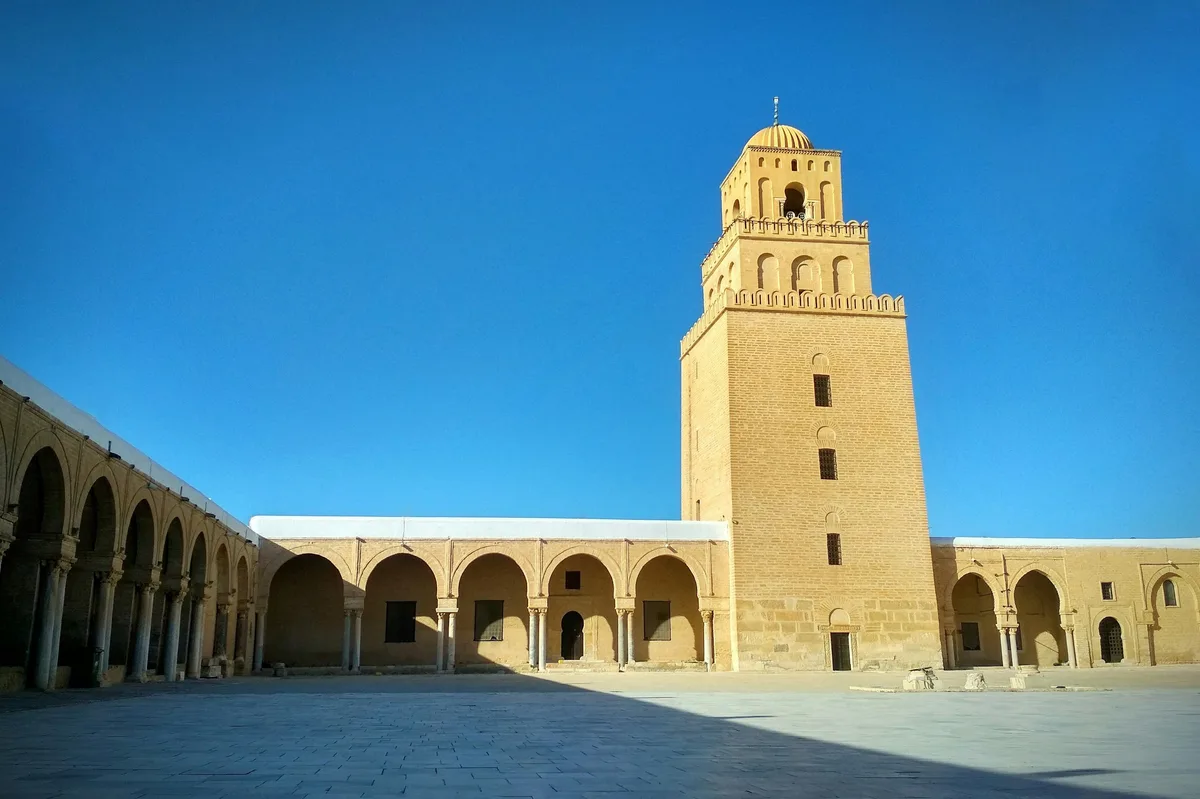
One of the oldest mosques in the Islamic world, at the center of Kairouan's UNESCO-listed medina and a major pilgrimage site in North Africa.
Visitor guide
The Great Mosque of Kairouan, also known as the Mosque of Uqba, stands in Kairouan, Tunisia. Wikipedia describes it as one of the oldest places of worship in the Islamic world, founded in 670 by the Arab general Uqba ibn Nafi when he established the city of Kairouan. It was designated a UNESCO World Heritage Site in 1988 as part of Kairouan.
The mosque was destroyed around 690 during the Berber occupation led by Kusaila and rebuilt in 703 by Hasan ibn al-Nu'man. It was expanded around 724 to 728 under Bishr ibn Safwan, who began the minaret, and reconstructed in 774 under Yazid ibn Hatim. In 836 Emir Ziyadat Allah I rebuilt it, giving it roughly its current form, and additional bays were added in 862 to 863 and 875.
The mosque covers more than 9,000 square metres; UNESCO describes its layout as a quadrilateral of 135 by 80 metres. It has a hypostyle prayer hall, a marble-paved courtyard and a square minaret, and is noted for the first Islamic use of the horseshoe arch. The courtyard measures roughly 67 by 52 metres and is surrounded by double-arched porticoes, with a sundial, wells and a rainwater impluvium feeding an underground cistern.
Sources give the minaret's height as roughly 32 to 36 metres (Britannica cites about 35 metres); it has a square base, rises in three tiers, and is usually described as having about 129 interior steps. Its base contains reused Roman stones with Latin inscriptions. Wikipedia calls it the oldest standing minaret in the world and a prototype for minarets in the western Islamic world.
The prayer hall has about 414 columns of marble, granite or porphyry, with more than 500 across the whole mosque. Many came from sites such as Sbeitla, Carthage, Hadrumetum and Chemtou, with capitals in Corinthian, Ionic and Composite styles reused from Roman or Byzantine buildings. A legend says no one can count the columns without going blind.
The mihrab dome of around 836 is one of the oldest notable domes in the western Islamic world. The mihrab is surrounded by 139 lusterware tiles and 28 carved marble panels. The teak minbar, made around 862 from wood imported from India, is described as the oldest surviving minbar in the Muslim world. The cedar maqsura screen dates to the first half of the 11th century under the Zirid prince al-Mu'izz ibn Badis.
From about the 9th to the 11th centuries the mosque was a centre of Maliki legal teaching and also taught mathematics, astronomy, medicine and botany. Wikipedia compares its role to that of the University of Paris in the Middle Ages.
As a working place of worship, the mosque has its own visiting arrangements. A private guide can explain its architecture and history and advise on respectful conduct, and a private vehicle and driver can link Kairouan with El Jem, Sousse and Tunis.
See every tour and attraction we cover in Tunisia.