TorontoOntario · 36 tours
 Niagara FallsOntario · 25 tours
 New York CityNew York · 30 tours
 Las VegasNevada · 8 tours
 San FranciscoCalifornia · 16 tours
 VancouverBritish Columbia · 17 tours
 DubaiUAE · 54 tours
 Abu DhabiUAE · 5 tours
 Buenos AiresArgentina · 23 tours
 AthensGreece · 31 tours
 AucklandNew Zealand · 38 tours
 CancunMexico · 54 tours
No destinations match “”. Try searching all tours instead — that search understands full questions, not just place names.
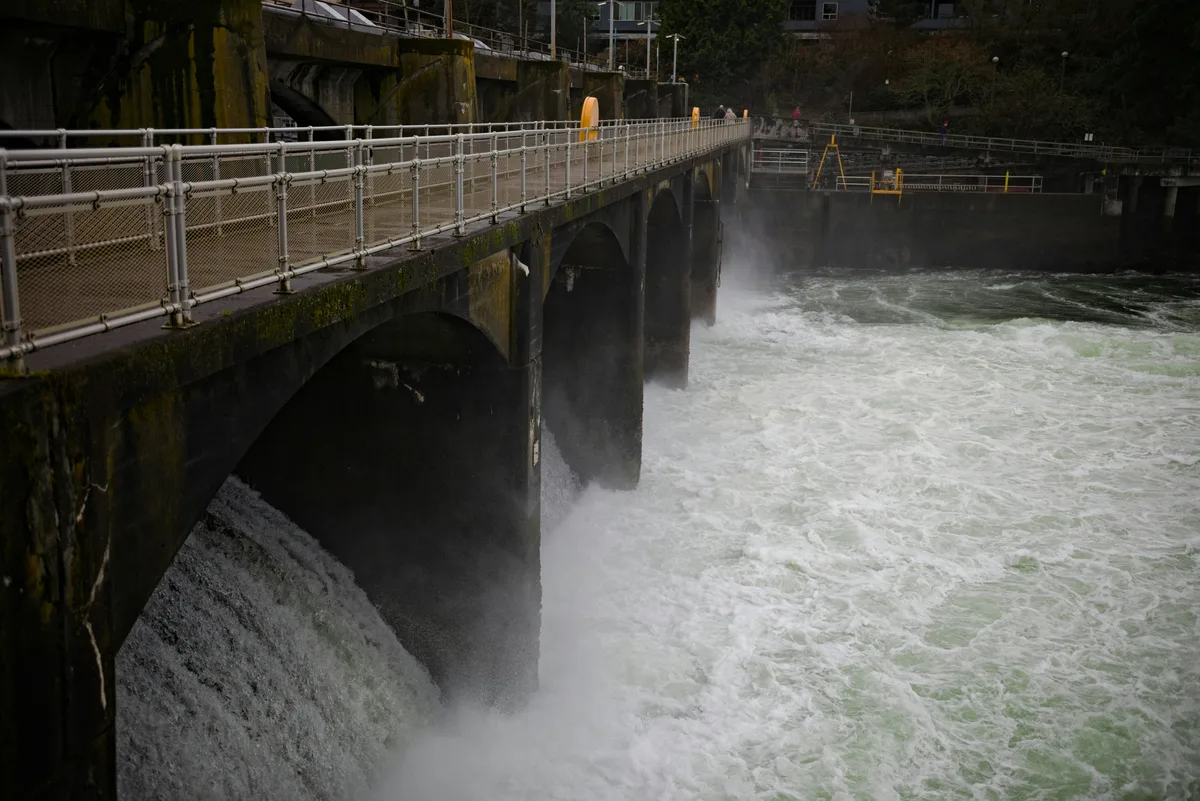
A working set of ship locks connecting Puget Sound to Seattle's inland lakes, with a fish ladder for migrating salmon.
Visitor guide
The Hiram M. Chittenden Locks, known locally as the Ballard Locks, stand at the west end of Salmon Bay in Seattle, where the Lake Washington Ship Canal meets Puget Sound. Operated by the U.S. Army Corps of Engineers, they move boats between the saltwater of the Sound and the freshwater of Lake Union and Lake Washington, while also keeping saltwater out of the lakes.
Ideas for a waterway linking the lakes to the Sound go back a long way. Wikipedia reports that Seattle pioneer Thomas Mercer argued for such a canal in a speech in 1854, that Harvey Pike began cutting a small channel between the lakes in the early 1860s, and that Chinese laborers dug a modest channel connecting the lakes, which HistoryLink dates to around 1885 (Wikipedia gives 1883), though these early private efforts were small and incomplete. Before the canal, Lake Washington drained south through the Black River into the Duwamish River. Planning for the modern canal began in 1891, and Congress funded the locks in 1910.
Hiram M. Chittenden, Seattle District Engineer from 1906 to 1908, reviewed a developer's plan for a single wooden lock and proposed instead a large and a small concrete and masonry lock at the narrow west end of Salmon Bay. Chittenden, born in New York in 1858, was a West Point graduate who had earlier supervised road building in Yellowstone National Park and wrote histories of the American fur trade. He was also among the first elected commissioners of the Port of Seattle. Construction began in 1911, the first ship passed through in 1916, and the locks were formally opened on July 4, 1917. One account describes half the city's population lining the shores for the dedication. The wider Ship Canal project was declared complete in 1934. Chittenden died in Seattle on October 9, 1917, and the locks were renamed for him in 1956.
The canal that the locks serve runs about eight miles from Puget Sound through Salmon Bay, the Fremont Cut, Lake Union, Portage Bay and the Montlake Cut to Lake Washington. Several bascule bridges followed the locks, including the Fremont and Ballard bridges around the time of opening, the University Bridge in 1919, and the Montlake Bridge in 1925.
The project had a large environmental cost. Lowering Lake Washington by about 8.8 feet dried out more than 1,000 acres of wetlands and altered the streams that had flowed into and out of the lake.
There are two chambers: a small lock measuring 30 by 150 feet and a large lock measuring 80 by 825 feet. A 235-foot spillway with six gates helps regulate lake levels, and a salt water barrier and drain help keep saltwater from moving upstream. Wikipedia describes the barrier as a hinged metal structure that can be flooded to let deep-draft vessels pass. Sources describe the locks as carrying more boat traffic than any other lock in the United States. They are listed on the National Register of Historic Places (1978) and are a National Historic Civil Engineering Landmark.
Every fish moving between Lake Washington and Puget Sound must pass through the locks, the spillway or the fish ladder. Chittenden himself planned a fish ladder, and the original, built in 1917, had 10 steps. A 1976 rebuild increased it to 21 weirs and added a viewing room. Chinook, coho and sockeye salmon use the ladder; steelhead are considered functionally extinct here. Check the operator for current viewing information.
Next to the locks is the Carl S. English Jr. Botanical Garden. It began in 1931, when the Corps hired English to tend grounds that were then little more than a construction staging area. Sources credit him with more than 570 species and 1,500 varieties of plants gathered over a 43-year career there. The site as a whole draws more than a million visitors a year.
This is a place where the main show is boats passing through, so a private tour with a driver lets you fit it in at your own pace and be collected at the gate. Check the operator for current hours, access and tours.
See every tour and attraction we cover in Seattle.