TorontoOntario · 36 tours
 Niagara FallsOntario · 25 tours
 New York CityNew York · 30 tours
 Las VegasNevada · 8 tours
 San FranciscoCalifornia · 16 tours
 VancouverBritish Columbia · 17 tours
 DubaiUAE · 54 tours
 Abu DhabiUAE · 5 tours
 Buenos AiresArgentina · 23 tours
 AthensGreece · 31 tours
 AucklandNew Zealand · 38 tours
 CancunMexico · 54 tours
No destinations match “”. Try searching all tours instead — that search understands full questions, not just place names.
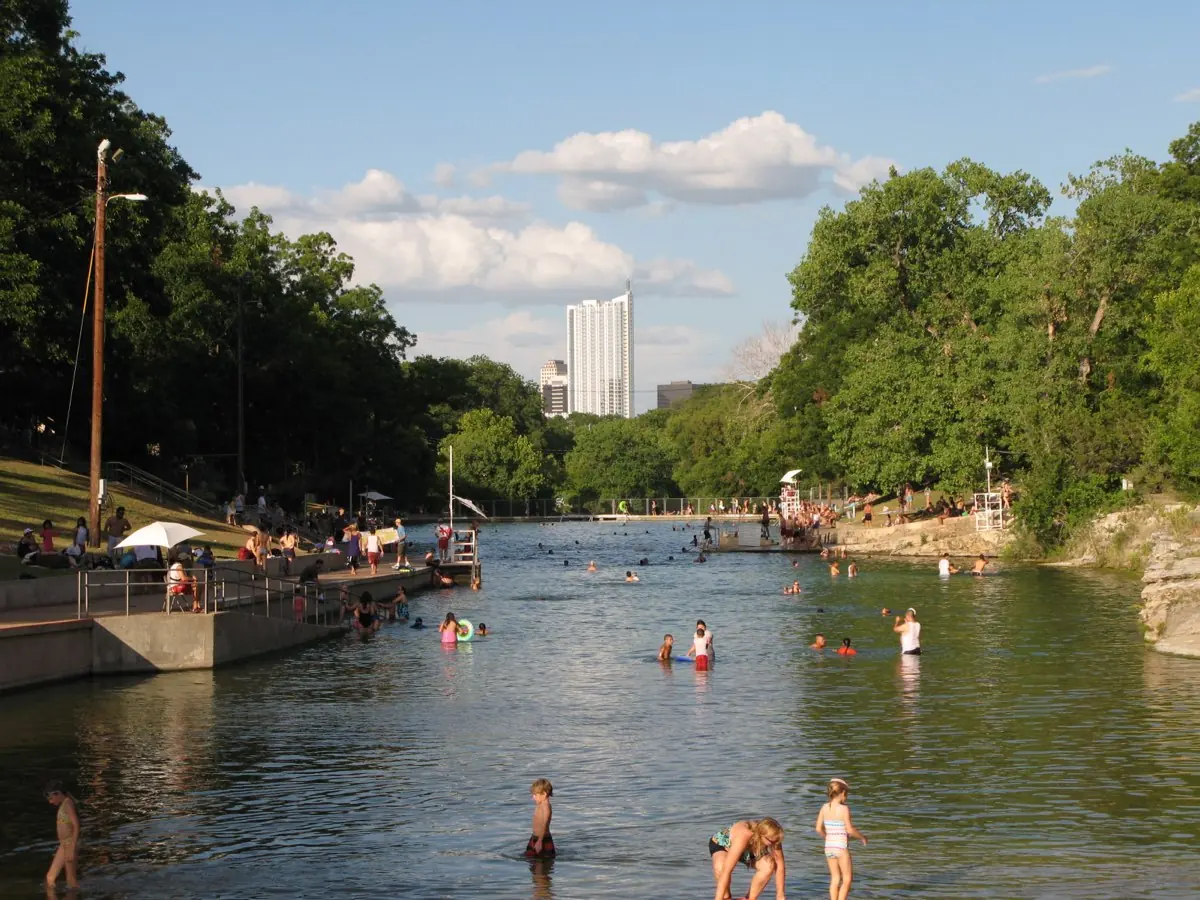
A spring-fed swimming pool that stays around 68°F year-round, in the middle of Zilker Park.
Visitor guide
Barton Springs Pool is a three-acre, spring-fed swimming pool in Zilker Park, Austin, fed by the Edwards Aquifer and kept at an average of about 68 to 70 degrees Fahrenheit. The City of Austin describes the temperature as ideal for year-round swimming. The pool sits around the main spring, the largest of the four Barton Springs, and its waters are also habitat for protected salamanders.
Barton Springs consists of four natural springs on Barton Creek: Main Barton Spring (also called Parthenia, the mother spring), Eliza Spring, Old Mill Spring and Upper Barton Spring. Main Barton Spring feeds the pool and lies underwater near the diving board. Its flow averages about 31 million US gallons a day, with a recorded low of 9 million gallons a day during the 1950s drought and a high of 85 million during floods in December 1991 and September 2016, according to Wikipedia. By comparison, Austin uses about 120 million gallons a day for its public water supply. The other three springs each average about 3 million gallons a day and sometimes dry up.
The water comes from the Edwards Aquifer, a limestone karst system formed in the Cretaceous period, roughly 100 million years ago, whose fractures, conduits and caves were enlarged by faulting and dissolution in the Balcones Fault Zone. All of the springs' discharge begins as rain that soaks in through the recharge zone or through creeks that cross it, which is why land use upstream has long mattered to the pool.
The springs were a gathering place long before the city existed. The Texas State Historical Association notes that Indigenous peoples gathered here for thousands of years, and Wikipedia says Coahuiltecan descendants include Barton Springs among four springs in a prehistoric creation story. The Handbook of Texas records Spanish explorers reporting many wild horses nearby in 1714. William Barton settled by the late 1830s, and The Cultural Landscape Foundation dates his house near a spring to about 1838. Saw, flour and grist mills and ice-making machines were later powered by the springs' water. Andrew Jackson Zilker bought the land in 1901 and deeded it to the city in 1917, though Wikipedia gives 1918.
Shaping the pool took years. Wikipedia says the city dammed the springs in the 1920s, while the city's account puts a permanent lower concrete dam in 1929, and the Guide to Austin Architecture dates the large pool to about 1920. By 1931 retaining walls, a playground and a dam had created a pool roughly 100 by 1,000 feet. In 1933 architect Charles Page's master plan added a bandstand and an entrance road, with the Civilian Conservation Corps doing most of the work; flooding in 1935 prompted further construction; and in 1938 Delmar Groos designed a terraced Sunken Garden overlooking the springs. In 1947 Dan Driscoll, who also designed the bathhouse at Deep Eddy Pool, designed the masonry Streamline Moderne bathhouse with its ticket booth and open-air dressing rooms. Today the pool's bathhouse is named for Joan Means Khabele. The City of Austin notes that visitors have included state legislators and sunbathers in the 1970s, and that Robert Redford learned to swim here as a child. Barton Springs was added to the National Register of Historic Places on November 27, 1985, as an archaeological and historical district that became part of the Zilker Park Historic District in 1997.
The pool runs from zero to 18 feet deep, according to the city. Grassy lawns surround it for lounging, and beside the bathhouse is Splash!, an educational exhibit on the springs' history, biology and the Edwards Aquifer. Visitor numbers have neared 800,000 in some years, per the city. The pool is closed from time to time for maintenance, flooding or water-quality reasons, so check the City of Austin for current status, hours and fees.
Barton Springs is the only known habitat of the endangered Barton Springs salamander, and the Austin blind salamander is also found only here. The U.S. Fish and Wildlife Service listed the Barton Springs salamander as endangered in a final rule published April 30, 1997; it is entirely aquatic and keeps its bright red external gills throughout life. The Austin blind salamander was formally named in 2001 and listed as endangered in a rule effective September 19, 2013. The city lists the area as a federally protected habitat, which is why you will see signs and rules about what may enter the water, and Wikipedia notes that studies have concluded swimmers and salamanders can coexist.
Concern for the springs also shaped Austin politics. The Handbook of Texas notes that pollution periodically limited use in the 1980s and that a widely publicized campaign in 1992 led to legislation with stricter water-quality standards; the Save Our Springs Alliance grew out of that effort.
The pool is in the heart of Zilker Park, so it pairs naturally with a lakeside walk or the botanical garden. On a Voyzo private tour, a driver can drop you at the park and return when you are ready, which suits a swim followed by a change of clothes and a few hours elsewhere in Austin.
See every tour and attraction we cover in Austin.