TorontoOntario · 36 tours
 Niagara FallsOntario · 25 tours
 New York CityNew York · 30 tours
 Las VegasNevada · 8 tours
 San FranciscoCalifornia · 16 tours
 VancouverBritish Columbia · 17 tours
 DubaiUAE · 54 tours
 Abu DhabiUAE · 5 tours
 Buenos AiresArgentina · 23 tours
 AthensGreece · 31 tours
 AucklandNew Zealand · 38 tours
 CancunMexico · 54 tours
No destinations match “”. Try searching all tours instead — that search understands full questions, not just place names.
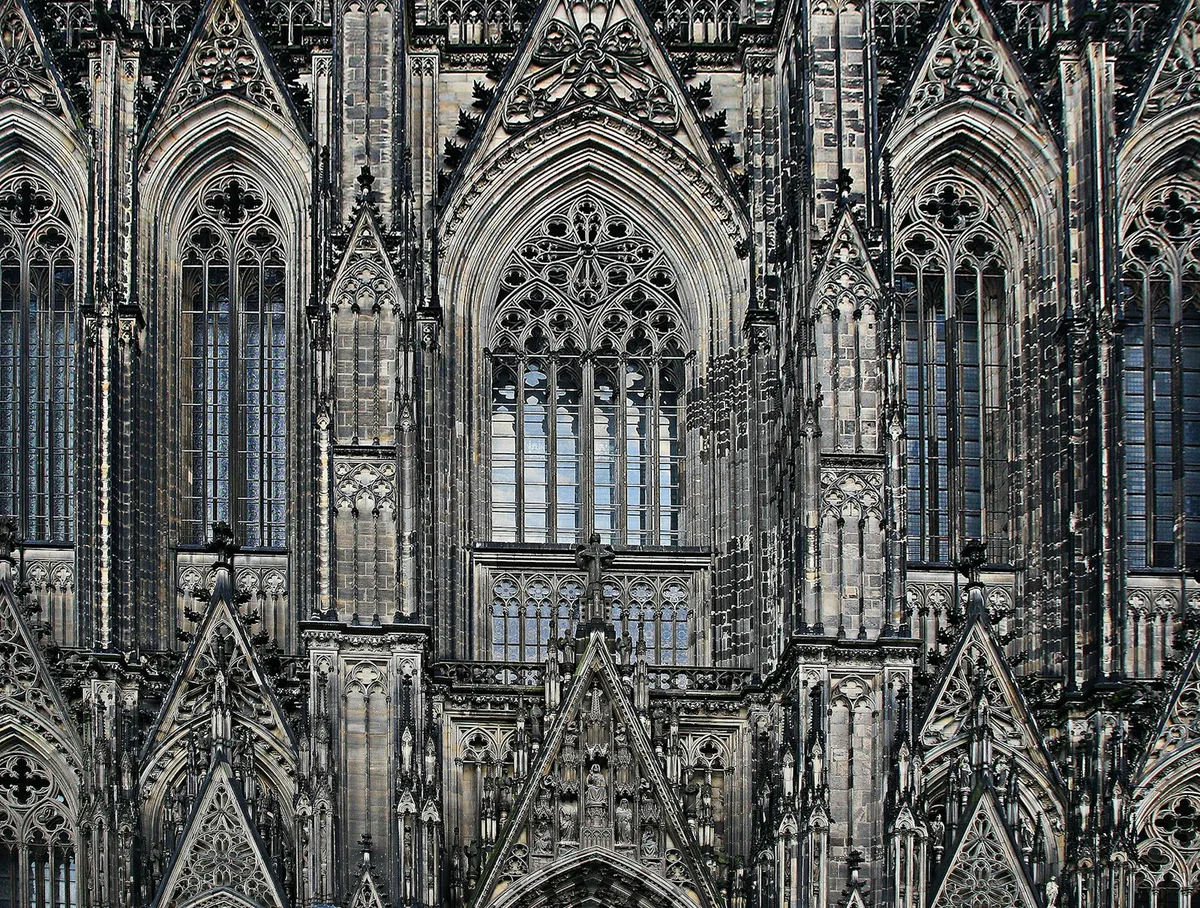
A Gothic cathedral begun in 1248 and not completed until 1880, its twin spires dominating Cologne's skyline as Germany's most-visited landmark and a UNESCO World Heritage Site.
Visitor guide
Cologne Cathedral, known in German as the Koelner Dom, is a Roman Catholic Gothic cathedral on the banks of the Rhine in Cologne, western Germany. Dedicated to Saint Peter, it is the seat of the Archbishop of Cologne and, according to Wikipedia, Germany's most visited landmark, with its twin spires reaching about 157 metres.
The foundation stone was laid on 15 August 1248 by Archbishop Konrad von Hochstaden. The cathedral was built to house the relics of the Three Kings, which Archbishop Rainald of Dassel had brought from Milan to Cologne in 1164. The eastern arm was consecrated in 1322, but work stopped in 1473 with the south tower complete only to belfry level, and a large construction crane stood on top of it as a skyline landmark for roughly four centuries.
Building resumed in 1842, following the original medieval plans but using modern methods such as iron roof girders. A cathedral-building association paid about two-thirds of the cost and the Prussian state the rest. The cathedral was declared complete on 15 October 1880, 632 years after work began, in the presence of Emperor Wilhelm I.
The ground plan is a Latin cross closely based on Amiens Cathedral, with a high nave vault carried by aisles and flying buttresses in the French manner and a chevet of seven radiating chapels. The openwork spires are Germanic in character and comparable to those of Ulm and Strasbourg. Wikipedia lists the cathedral as the tallest twin-spired church in the world.
The Shrine of the Three Kings, begun in 1190 and made of gilded bronze and silver set with gemstones, is regarded as one of the most sophisticated goldsmith's works of the Middle Ages. The Gero Crucifix, an oak crucifix dating to around 960, is described as the oldest large crucifix north of the Alps. In 2007 the artist Gerhard Richter created a window for the south transept made of about 11,000 square pieces (11,263 in the most detailed count) of coloured glass arranged randomly by computer in a pixel-like pattern.
The cathedral has eleven bells, the largest being the St. Peter's Bell, known as Dicker Pitter, which weighs about 24 tonnes, was cast in 1923 and is rung only on a handful of major feast days.
The twin spires served as a navigational landmark for Allied bombers, and the cathedral was hit by aerial bombs repeatedly during the Second World War, yet it remained standing in a largely flattened city. Repairs were completed and it reopened in 1956. UNESCO inscribed the cathedral as a World Heritage Site in 1996, describing it as a masterpiece of exceptional intrinsic value. It was placed on the in-danger list in 2004 over plans for nearby high-rise buildings and removed from it in 2006 after height limits were introduced.
Scaffolding is almost always present somewhere on the building, because wind, rain and pollution wear the stone and repairs never stop. Visitors who climb the spiral staircase of 533 steps reach a viewing platform about 100 metres above the ground with views over the Rhine. The cathedral stands beside the river in the heart of the old city, making it an easy anchor for a private guided walk through Cologne.
See every tour and attraction we cover in Germany.