TorontoOntario · 36 tours
 Niagara FallsOntario · 25 tours
 New York CityNew York · 30 tours
 Las VegasNevada · 8 tours
 San FranciscoCalifornia · 16 tours
 VancouverBritish Columbia · 17 tours
 DubaiUAE · 54 tours
 Abu DhabiUAE · 5 tours
 Buenos AiresArgentina · 23 tours
 AthensGreece · 31 tours
 AucklandNew Zealand · 38 tours
 CancunMexico · 54 tours
No destinations match “”. Try searching all tours instead — that search understands full questions, not just place names.
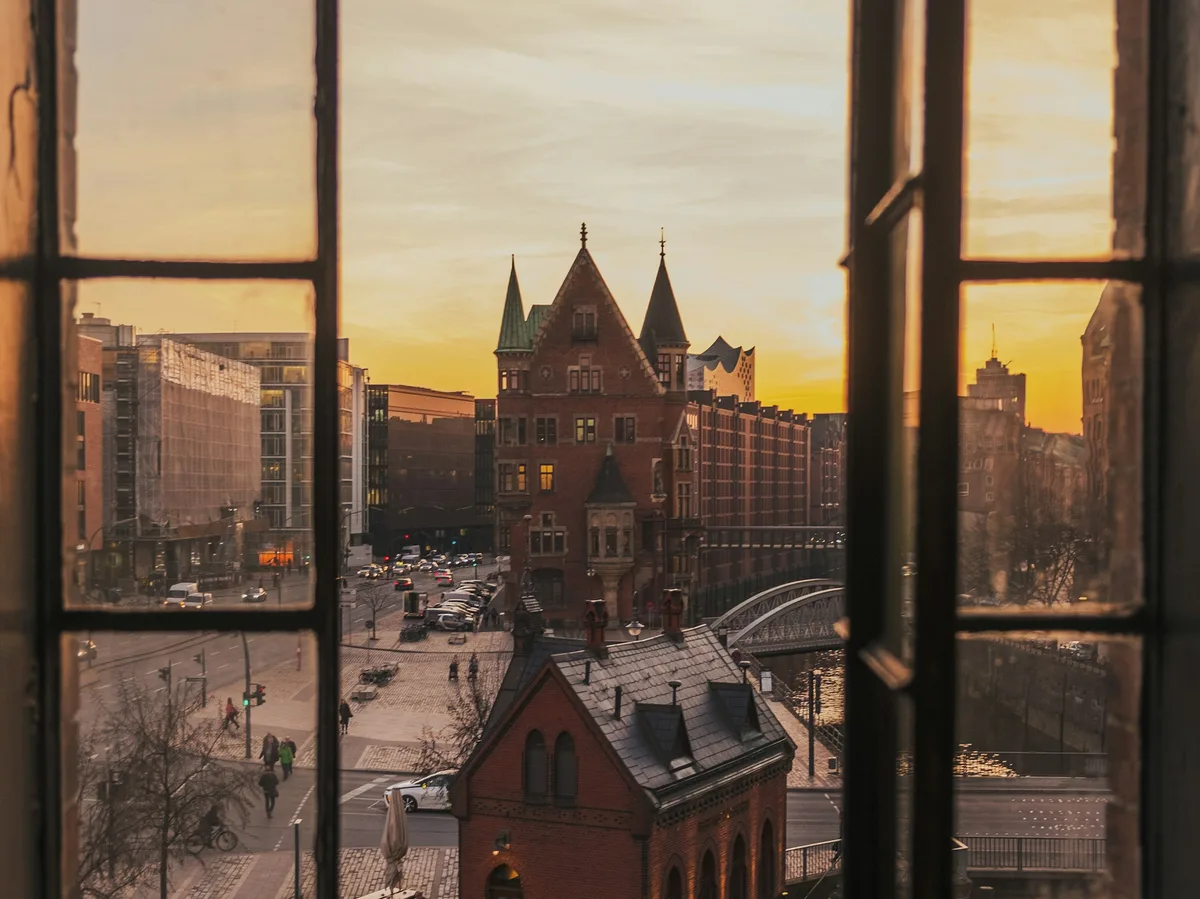
Described as the world's largest warehouse district built on timber-pile foundations, a UNESCO World Heritage Site of red-brick warehouses laced with canals, bordering the modern Hafencity and the Elbphilharmonie concert hall.
Visitor guide
The Speicherstadt, meaning City of Warehouses, is a district of red-brick warehouses in the port of Hamburg, northern Germany, threaded with canals known locally as fleets. Wikipedia describes it as the largest warehouse district in the world whose buildings stand on timber-pile foundations, and it is part of a UNESCO World Heritage Site.
Hamburg joined the German Customs Union under an agreement dated 1881, but a free port district was carved out so that goods could be transferred and stored without paying customs. In 1883 the Kehrwieder and Wandrahm areas were cleared to make room for the new warehouses, and more than 20,000 residents had to be relocated. The district was built between 1883 and 1927, and a predecessor of the port company HHLA, the Freihafen-Lagerhaus-Gesellschaft, managed it.
The architect Carl Johann Christian Zimmermann designed the complex, and the engineer Franz Andreas Meyer supervised construction. The buildings rest on oak piles driven into the soft ground of the Elbe's islands. Their multi-storey structures can be reached from both the street and the water, so that goods could be moved between barges and warehouse lofts directly.
Meyer gave the warehouses a neo-Gothic outer layer of red brick, enlivened with small towers, alcoves and glazed terracotta ornaments. The effect is of a fortified brick town on the water, especially where gabled blocks stand reflected in the fleets. Kaispeicher B, one of the oldest buildings, houses part of the International Maritime Museum Hamburg.
Many buildings still serve their original purpose. According to Wikipedia, the warehouses have handled goods such as cocoa, coffee, tea, spices and maritime equipment, and the district has been associated with the trade in oriental carpets, though the figures quoted for that trade are flagged as needing clarification.
Bombing in World War II, during the operation known as Gomorrah, destroyed about half of the buildings. Conservative reconstruction was completed in 1967, and the Hanseatic Trade Center now stands on the sites of buildings that were entirely lost. The Speicherstadt was listed as a protected Hamburg heritage site in 1991 and became part of the HafenCity quarter in 2008.
On 5 July 2015 UNESCO inscribed the Speicherstadt together with the Kontorhaus District and the Chilehaus. The inscription recognises it as an exceptional example of neo-Gothic and modernist architecture and as evidence of the development of international maritime trade.
Today the district is a major draw for visitors and the focus of many harbour tours. Museums in and around it include the German Customs Museum, the Miniatur Wunderland model railway and the Hamburg Dungeon. It sits beside HafenCity, whose redevelopment includes the Elbphilharmonie concert hall, so that old brick warehouses and contemporary architecture stand side by side. The area is compact and suits a private guided walk, with the vehicle and driver handling the longer distances around the port.
See every tour and attraction we cover in Germany.