TorontoOntario · 36 tours
 Niagara FallsOntario · 25 tours
 New York CityNew York · 30 tours
 Las VegasNevada · 8 tours
 San FranciscoCalifornia · 16 tours
 VancouverBritish Columbia · 17 tours
 DubaiUAE · 54 tours
 Abu DhabiUAE · 5 tours
 Buenos AiresArgentina · 23 tours
 AthensGreece · 31 tours
 AucklandNew Zealand · 38 tours
 CancunMexico · 54 tours
No destinations match “”. Try searching all tours instead — that search understands full questions, not just place names.
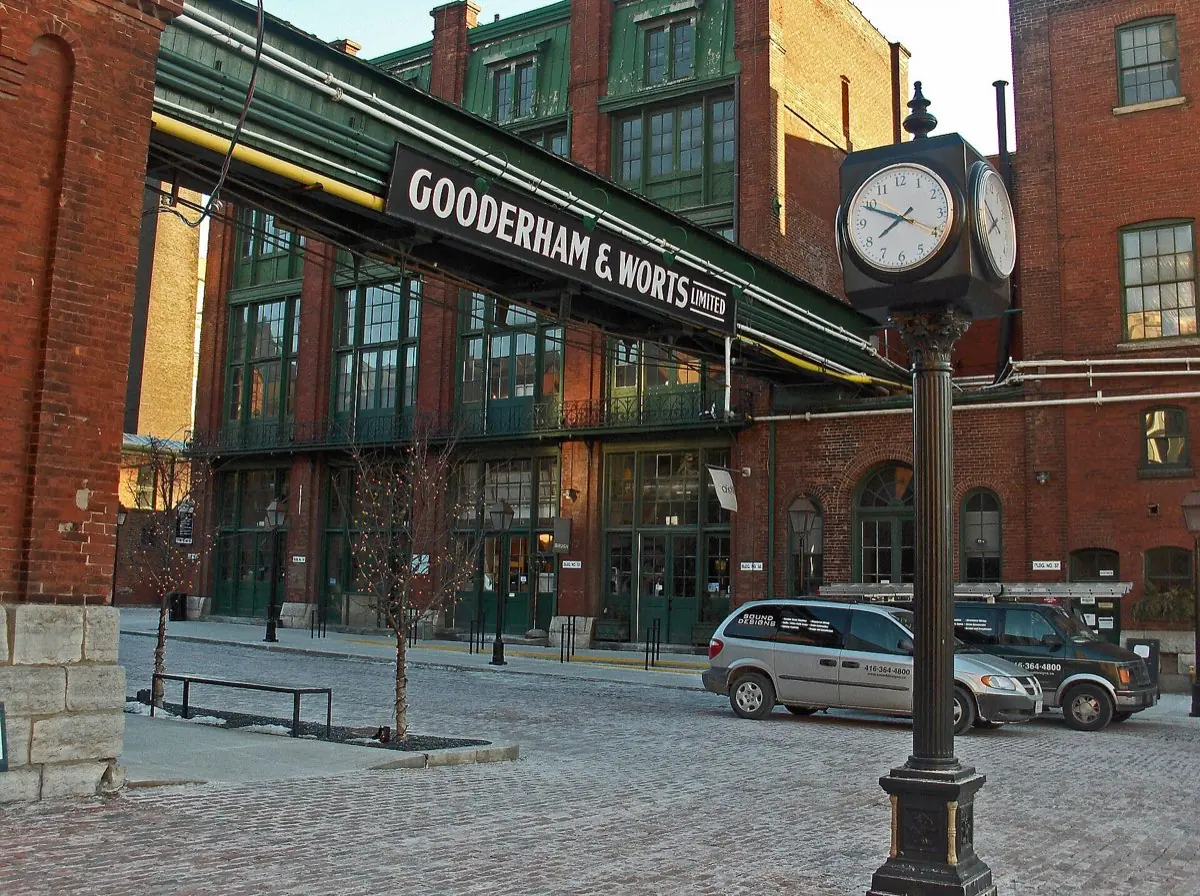
A preserved Victorian-era industrial complex turned into a pedestrian district of galleries, cafes, and shops.
Visitor guide
The Distillery District is a pedestrian-oriented neighbourhood of restored Victorian industrial buildings on the east side of downtown Toronto, on the site of the former Gooderham and Worts distillery. It covers about 13 acres (5.3 hectares), includes 30 brick and stone industrial buildings built between 1859 and 1927 in Parks Canada's national historic site description, and the district itself describes it as the largest collection of Victorian industrial architecture in North America.
William Gooderham and his brother-in-law James Worts were milling grain in Toronto in the early 1830s, with a windmill on the harbour. Gooderham expanded into distilling in 1837, and the company grew into one of Canada's most prominent industrial firms. A new distillery complex was started in 1859, and later accounts credit the firm with producing over two million gallons a year, much of it for export, though those production figures come from a single published source and are not precise. Earlier claims that it was the largest distillery in the world are not supported by the sources consulted, so treat that as legend rather than fact.
Ownership changed in the 1920s when the company was combined with Hiram Walker & Sons, and the firm was renamed Hiram Walker-Gooderham & Worts. Distilling operations wound down and the facility was closed around 1990 as obsolete.
The site has been protected under the Ontario Heritage Act since 1976 and was designated a National Historic Site of Canada on November 11, 1988. After closure it became a heavily used film location, with more than 800 film and television productions reported since 1990. In 2001 Cityscape Holdings bought the site and set out to preserve the buildings as a pedestrian-oriented arts district, which reopened on May 22, 2003. The owners declined to lease retail space to chains and franchises, which is why the streets feel more like a local village than a mall.
The original windmill and wharf are gone, but the surviving brick buildings include the Stone Distillery (1859), the Boiler House, the Malt House and the later Case Goods warehouse (1927). Trinity Street is the widest lane and often works as a public square. Tenants include art galleries, boutiques, restaurants, a brewery, and the Young Centre for the Performing Arts, home to Soulpepper Theatre Company and the George Brown Theatre School. The Toronto Christmas Market has run in the district since 2010; it was cancelled in 2020 and returned in 2021 as the Distillery Winter Village, so check current event details.
The neighbourhood sits between the downtown core and the waterfront with the 2015 Pan Am Games athletes' village built nearby along Cherry Street. With a Voyzo private tour, your driver can drop you at the district's edge, wait nearby while you walk the cobbled lanes, and then continue to the CN Tower or elsewhere on your itinerary.
See every tour and attraction we cover in Toronto.