TorontoOntario · 36 tours
 Niagara FallsOntario · 25 tours
 New York CityNew York · 30 tours
 Las VegasNevada · 8 tours
 San FranciscoCalifornia · 16 tours
 VancouverBritish Columbia · 17 tours
 DubaiUAE · 54 tours
 Abu DhabiUAE · 5 tours
 Buenos AiresArgentina · 23 tours
 AthensGreece · 31 tours
 AucklandNew Zealand · 38 tours
 CancunMexico · 54 tours
No destinations match “”. Try searching all tours instead — that search understands full questions, not just place names.
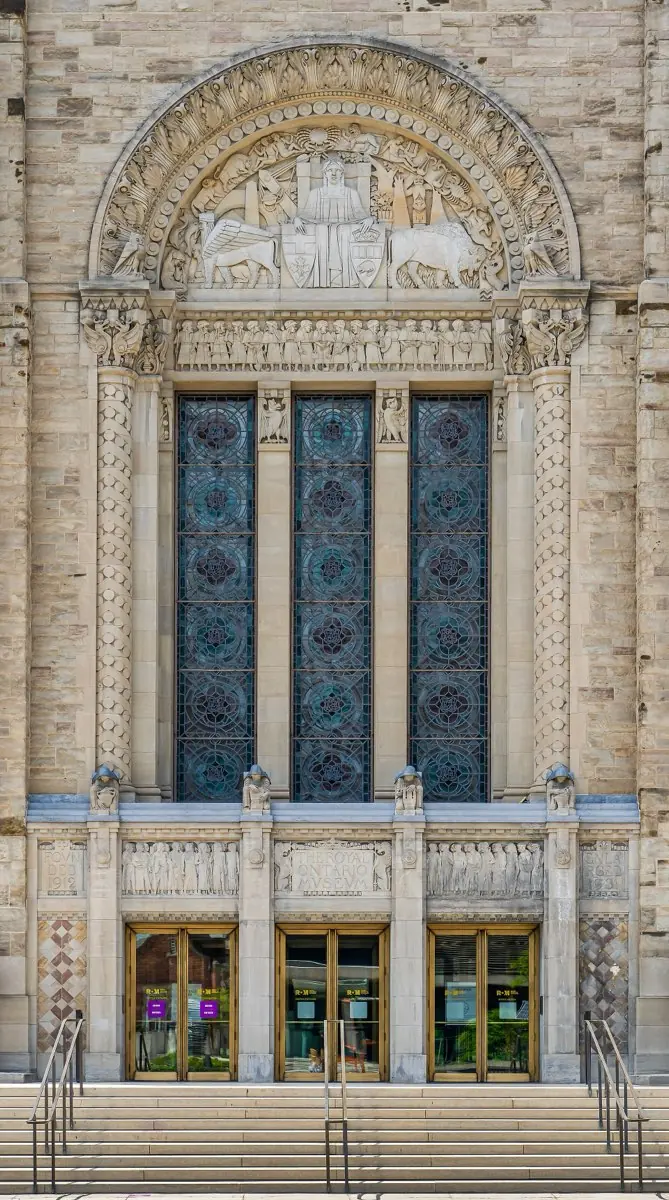
Canada's largest museum of world cultures and natural history, known for its crystal-shaped addition.
Visitor guide
The Royal Ontario Museum, known as the ROM, is Toronto's museum of world cultures and natural history, on Bloor Street West at the edge of Queen's Park and the University of Toronto. It opened to the public on March 19, 1914, and the museum reports a collection of about 18 million artworks, cultural objects and natural history specimens across roughly 40 gallery and exhibition spaces, according to the ROM, which makes it one of the largest museums in North America.
The museum was formally established in 1912 and shared governance between the Government of Ontario and the University of Toronto. Its first building, designed by Frank Darling and John A. Pearson, was conceived as a home for five separate museums: archaeology, palaeontology, mineralogy, zoology and geology. The Duke of Connaught opened it in 1914. An eastern wing designed by Alfred H. Chapman and James Oxley followed in 1933. The ROM remained under university control until 1968, when it became an independent Crown agency of Ontario.
The heritage buildings are now joined by the Michael Lee-Chin Crystal, an angular addition by architect Daniel Libeskind that opened in 2007 as the centrepiece of the Renaissance ROM project. Libeskind was selected from an international field of finalists, and he has spoken of crystals as a source of inspiration. The Crystal's slanted walls of glass and aluminum cantilever over Bloor Street, and they create odd, sloping gallery spaces inside. The Crystal is named for businessman Michael Lee-Chin, who gave CA$30 million toward the project, whose total cost was reported at about CA$270 million. Opinions on the design have always been divided, and many Torontonians love it and many do not.
The ROM pairs art, archaeology and natural science under one roof. The Bishop White Gallery of Chinese Temple Art holds three large Yuan-dynasty temple wall paintings, and the Gallery of Chinese Architecture includes a reconstructed Ming-era tomb complex. The Daphne Cockwell Gallery of Canada shows First Peoples material and Canadian history, with Nisga'a and Haida crest poles rising beside the central staircase. The natural history side includes dinosaurs, minerals and meteorites, and the museum is reported to hold the world's largest collection of Burgess Shale fossils, more than 150,000 specimens from the Canadian Rockies, though only a small share is on display. The Bat Cave, an immersive habitat, first opened in 1988 and reopened in 2010. Other galleries cover Egypt and the ancient Near East, Africa, East Asia and European decorative arts.
The ROM stands in Toronto's Yorkville and Annex area, a short walk from the Gardiner Museum, the University of Toronto campus and the Ontario Legislative Building in Queen's Park. Yorkville's boutiques and restaurants are minutes away on foot. For a private Voyzo tour, your driver and vehicle can bring you to the Bloor Street entrance and meet you afterwards, which is useful if you want to pair the museum with Casa Loma, which is only a few kilometres north.
See every tour and attraction we cover in Toronto.