TorontoOntario · 36 tours
 Niagara FallsOntario · 25 tours
 New York CityNew York · 30 tours
 Las VegasNevada · 8 tours
 San FranciscoCalifornia · 16 tours
 VancouverBritish Columbia · 17 tours
 DubaiUAE · 54 tours
 Abu DhabiUAE · 5 tours
 Buenos AiresArgentina · 23 tours
 AthensGreece · 31 tours
 AucklandNew Zealand · 38 tours
 CancunMexico · 54 tours
No destinations match “”. Try searching all tours instead — that search understands full questions, not just place names.
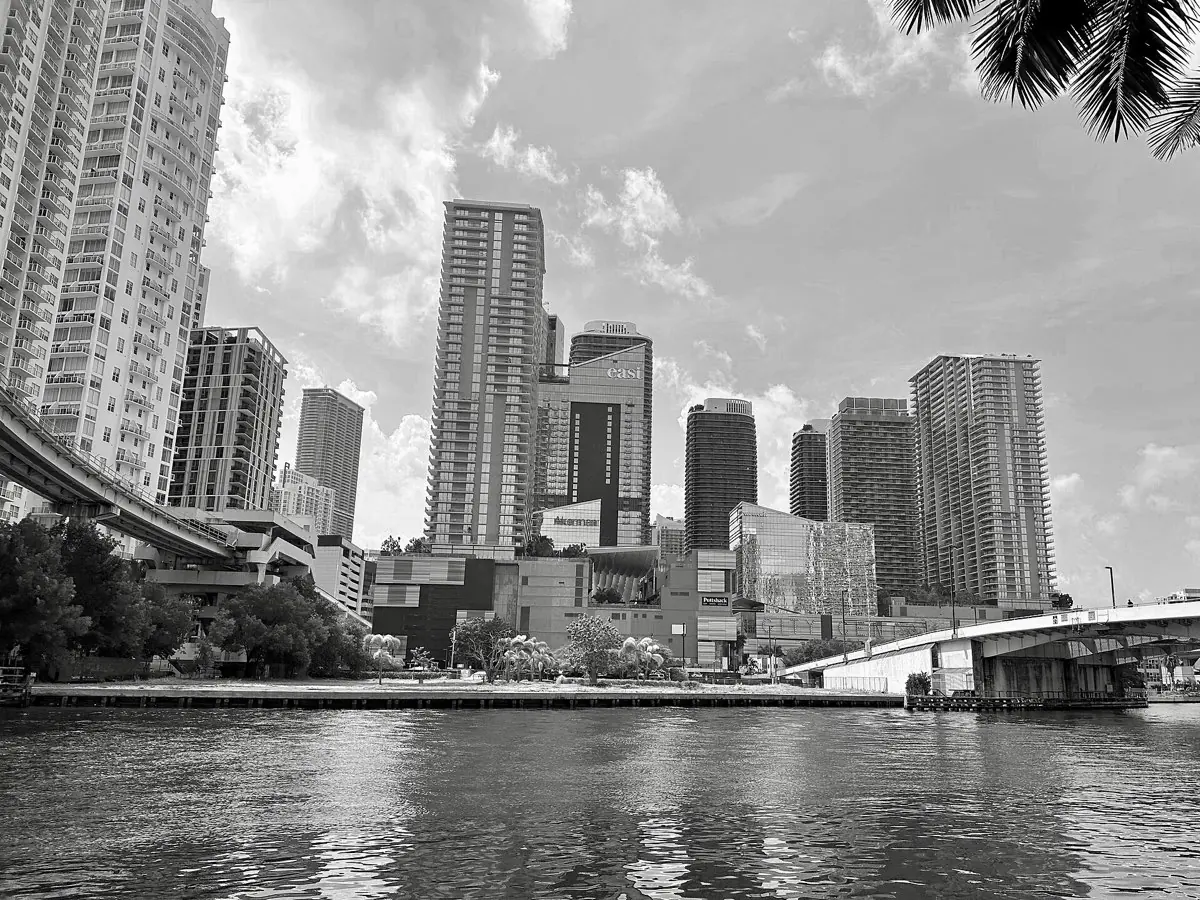
Miami's modern financial core, a fast-growing skyline of high-rises on Biscayne Bay.
Visitor guide
Downtown Miami and Brickell form the city's urban core, a dense strip of high-rise towers, banks, condominiums and restaurants rising directly from Biscayne Bay. Brickell, the neighborhood just south of the Miami River, is widely described as Miami's financial district and takes its name from pioneers William and Mary Brickell.
William Brickell and his wife Mary settled at the mouth of the Miami River in the early 1870s, setting up a home and a trading post that also served as a post office, and eventually accumulating thousands of acres of land. Accounts give different figures for their holdings. Mary, William and Julia Tuttle each gave land that helped bring Henry Flagler's railroad south, which led to the founding of the City of Miami. Brickell was folded into the city in 1896. After William died in 1908, Mary managed and developed the family's real estate, and by the early 1900s elegant estates lined Brickell Avenue, earning it the nickname Millionaire's Row. The only surviving structure linked to the family is the Brickell Mausoleum, built in 1924 and listed on the National Register in 1989; the surrounding land was donated to Miami as a public park.
From the 1970s, office towers, hotels and apartment buildings began replacing the mansions, and the area became the heart of Miami's banking community. Wikipedia describes Brickell as South Florida's financial district and one of the largest in the United States, a claim it does not source precisely, so it is best taken as a general description.
The Miami Circle, a Tequesta archaeological site near the Brickell Avenue Bridge, has been dated by Wikipedia to roughly 310 BC to AD 10. Simpson Park Hammock is a small nature preserve of native trees at the corner of South Miami Avenue and Broadway, while Brickell Park, at Brickell Avenue and SE 5th Street, holds the family mausoleum. Mary Brickell Village, opened in 2006, is a pedestrian entertainment district of restaurants and shops, and Brickell City Centre is a large shopping and residential complex. Brickell Key, an island east of the main district, is lined with high-rise residential and hotel towers, including the Mandarin Oriental.
Downtown proper, north of the river, includes Bayfront Park, the waterfront Bayside Marketplace and the cultural venues of the Museum Park area.
Metromover's Brickell Loop, a free elevated people-mover with stops roughly every two blocks, links Brickell and downtown, and a Metrorail station also serves the area. Traffic in the core can be heavy at rush hour, which is worth bearing in mind when scheduling.
Population figures for Brickell vary widely depending on how the area is defined. Wikipedia cites 27,776 residents in the 2010 census and an estimate of around 40,000 more recently, with higher numbers appearing for the wider Greater Downtown. The neighborhood is often called the densest in Florida or south of Manhattan, but treat superlatives like that as local shorthand.
Downtown and Brickell sit between Miami's main attractions, so a private vehicle and driver with door-to-door pickup makes a convenient base for moving between the cruise port, Little Havana, Wynwood and the beaches.
Little Havana and Coconut Grove are a short drive away, and Vizcaya lies a few miles south along the bay.
See every tour and attraction we cover in Miami.