TorontoOntario · 36 tours
 Niagara FallsOntario · 25 tours
 New York CityNew York · 30 tours
 Las VegasNevada · 8 tours
 San FranciscoCalifornia · 16 tours
 VancouverBritish Columbia · 17 tours
 DubaiUAE · 54 tours
 Abu DhabiUAE · 5 tours
 Buenos AiresArgentina · 23 tours
 AthensGreece · 31 tours
 AucklandNew Zealand · 38 tours
 CancunMexico · 54 tours
No destinations match “”. Try searching all tours instead — that search understands full questions, not just place names.
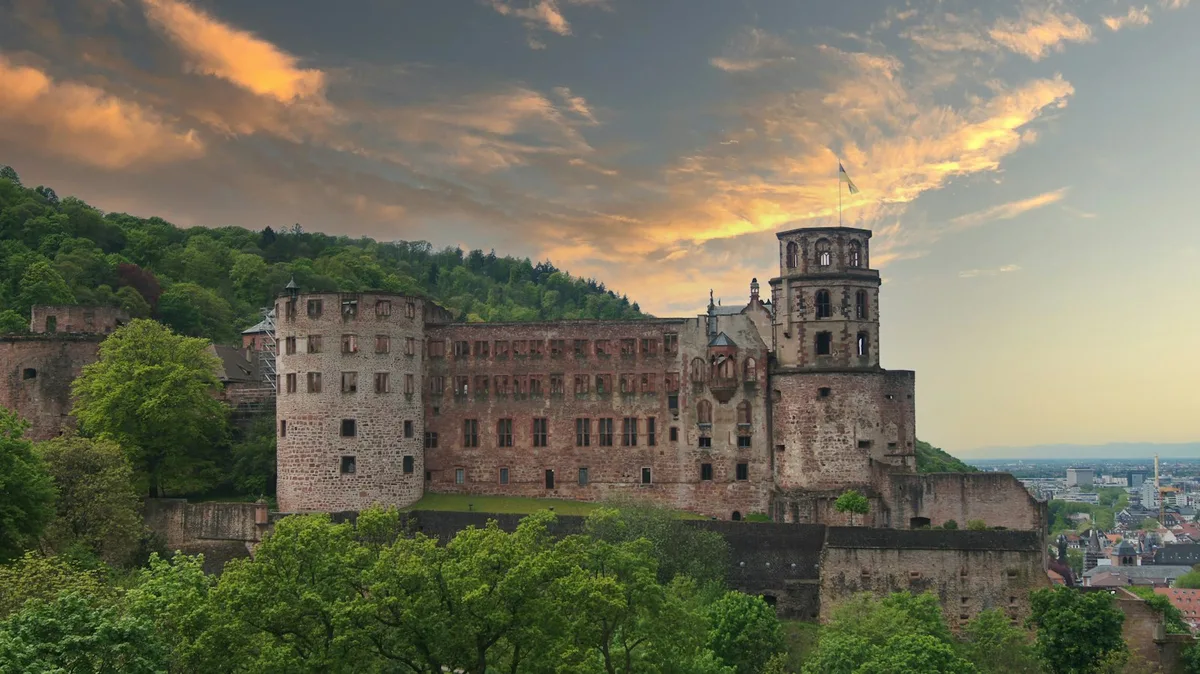
A partly ruined Renaissance castle overlooking the Neckar River and Heidelberg's old town, damaged by fire and war in the 17th and 18th centuries and left as a romantic ruin ever since.
Visitor guide
Heidelberg Castle is a ruined Renaissance castle in Heidelberg, Baden-Wurttemberg, Germany, standing about 80 metres up the northern slope of the Koenigstuhl hill above the old town and the Neckar River. Wikipedia describes its ruins as among the most important Renaissance structures north of the Alps.
Heidelberg itself is first mentioned in 1196, and sources place the first mention of a castle at 1214 or 1225, a conflict noted on Wikipedia. By 1303 two castles are recorded, an upper castle later destroyed by lightning in 1537 and a lower castle on the Jettenbuhl, which is the present site. After Ruprecht became King of Germany in 1401 the castle was enlarged into a larger residence and fortress for the Electors Palatine.
The most elegant surviving wing is the Friedrichsbau, built between 1601 and 1607 under Elector Friedrich IV with the architect Johannes Schoch. It is the best-preserved part of the castle and was restored in historicist style between 1890 and 1900. The Ottheinrichsbau is a Renaissance wing decorated with statuary, while the Torturm, or gate tower, dates from 1528 for the main gate. Other parts include the Ruprechtsbau, the Bibliotheksbau and the Englischer Bau.
After Frederick V, the Winter King, accepted the Bohemian crown in 1619 and lost at the Battle of White Mountain, Tilly took the castle in 1622, and it changed hands several times before the Peace of Westphalia. In the Nine Years' War French forces under Louis XIV set fire to the castle in 1689 and blew up its towers, and in 1693 destroyed the town and the remaining towers and walls with mines. The court moved to Mannheim in 1720, and in 1764 lightning struck twice and started a fire that destroyed parts of the rebuilt sections.
In the castle's cellars lies the Heidelberg Tun, an enormous wine vat. The current one, the Karl-Theodor-Fass of 1751, is described on the castle's official site as the third built at Heidelberg (Wikipedia counts four), and it held roughly 220,000 to 221,726 litres when new depending on the source. It has rarely held wine and is now a visitor attraction with a dance floor on top. Local legend holds that Perkeo, a court jester and keeper of the castle's spirits, still watches over it.
Around 1610 the Hortus Palatinus, a major terraced garden, was created on the hillside, with Salomon de Caus and Inigo Jones involved in early planning. The slope had to be reshaped for the project.
In 1868 the poet Wolfgang Muller von Konigswinter argued for full reconstruction, which provoked a strong backlash. A study in 1890 by a castle field office set up in 1883 concluded that the castle could be preserved as it stood but not rebuilt. The French count Charles de Graimberg had earlier championed its preservation, serving as voluntary castle warden until 1822. Mark Twain described the castle in A Tramp Abroad in 1880.
The castle can be reached by a funicular from the Kornmarkt, and the terraces give views over the roofs of the old town and the river. A private guided visit combines well with the old town below.
See every tour and attraction we cover in Germany.