TorontoOntario · 36 tours
 Niagara FallsOntario · 25 tours
 New York CityNew York · 30 tours
 Las VegasNevada · 8 tours
 San FranciscoCalifornia · 16 tours
 VancouverBritish Columbia · 17 tours
 DubaiUAE · 54 tours
 Abu DhabiUAE · 5 tours
 Buenos AiresArgentina · 23 tours
 AthensGreece · 31 tours
 AucklandNew Zealand · 38 tours
 CancunMexico · 54 tours
No destinations match “”. Try searching all tours instead — that search understands full questions, not just place names.
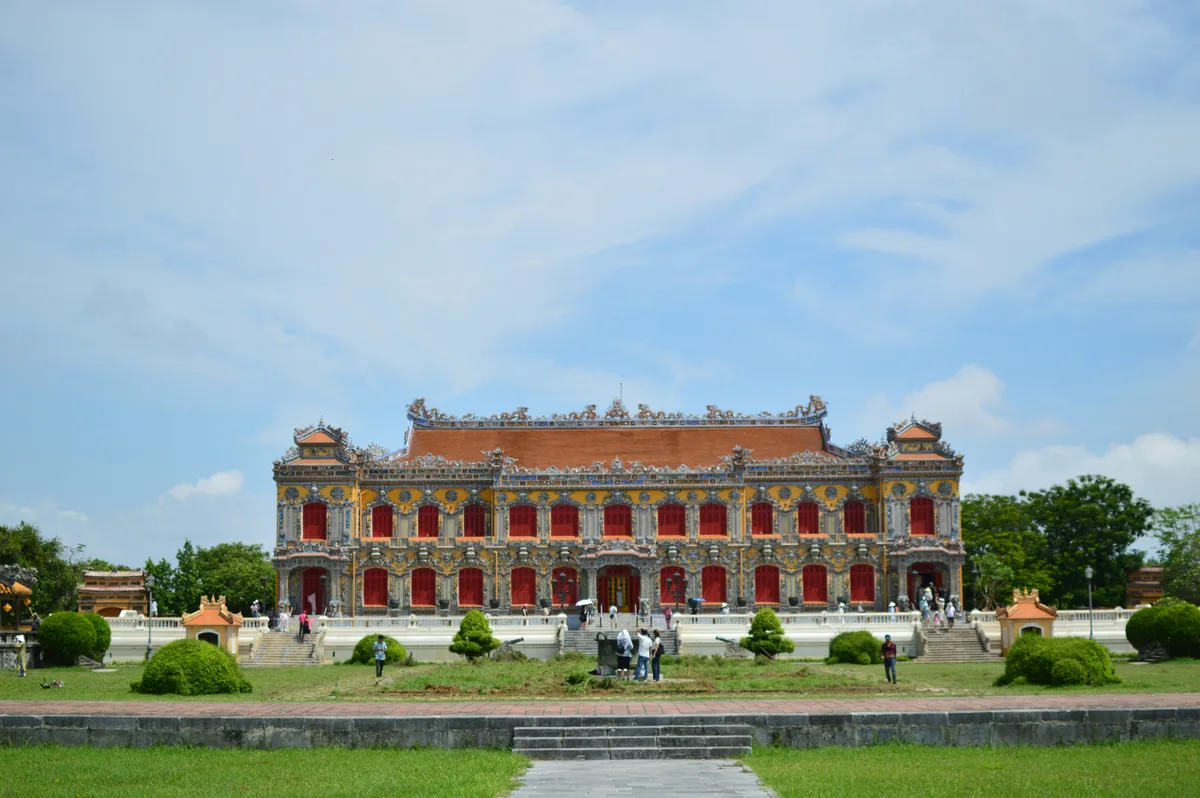
The walled seat of Vietnam's Nguyen emperors from 1802 to 1945, loosely modeled on Beijing's Forbidden City, with palaces, temples, and royal tombs spread across the complex.
Visitor guide
The Hue Imperial Citadel is the walled former capital complex of Vietnam's Nguyen dynasty, in the city of Hue in central Vietnam. It forms the core of the Complex of Hue Monuments, which UNESCO inscribed as a World Heritage Site in 1993.
According to Wikipedia, Nguyen Anh recaptured the Phu Xuan area in 1802, unified the country as Emperor Gia Long, and made Hue the national capital. The city remained the seat of the Nguyen emperors until Emperor Bao Dai abdicated in 1945 and the government moved to Hanoi. Gia Long rebuilt the citadel after 1802, and French architects working for him are said to have introduced some Western elements. Minh Mang, who reigned from 1820 to 1841, is remembered for strict Confucian orthodoxy and opposition to French involvement.
The complex is organised as three concentric parts: the outer Citadel (Kinh Thanh), the middle Imperial City (Hoang Thanh) and, at the centre, the Purple Forbidden City (Tu Cam Thanh), which was reserved for the emperor and his household. The Imperial City sits on the north bank of the Perfume River, surrounded by a moat and thick walls. Its design follows feng shui and the principles of the Five Elements, Five Cardinal Points and Five Colours, and it is oriented to the compass with the imperial palace at the centre. The architecture blends older Vietnamese dynastic styles, Chinese fine arts and some Western influence. Inside the grounds are the Flag Tower and the Royal Palace, among other halls.
Hue was the site of the Battle of Hue during the 1968 Tet Offensive, one of the longest and bloodiest battles of the Vietnam War, and historic buildings were damaged by bombing. The Purple Forbidden City was severely damaged, and little of it survives today, though reconstruction is ongoing. After 1975 many sites were neglected as relics of the old regime, and restoration began after the reforms of the late 1980s. Wikipedia reports that Kien Trung Palace was fully reconstructed in 2024.
UNESCO lists the Complex of Hue Monuments under cultural criterion (iv), with a core area of about 315 hectares and a buffer zone of about 72 hectares. The listing also covers imperial tombs set along the Perfume River, including those of Gia Long, Minh Mang, Thieu Tri, Tu Duc, Duc Duc, Dong Khanh and Khai Dinh, as well as temples such as the Thien Mu Pagoda, the city's official symbol according to Wikipedia.
Hue has a tropical monsoon climate, with a cooler season from November to March and a hot season from April to September; the wettest months fall between September and December. Because the citadel, tombs and pagodas are spread across the city, a private vehicle and a guide can help connect them in a logical order.
See every tour and attraction we cover in Vietnam.