TorontoOntario · 36 tours
 Niagara FallsOntario · 25 tours
 New York CityNew York · 30 tours
 Las VegasNevada · 8 tours
 San FranciscoCalifornia · 16 tours
 VancouverBritish Columbia · 17 tours
 DubaiUAE · 54 tours
 Abu DhabiUAE · 5 tours
 Buenos AiresArgentina · 23 tours
 AthensGreece · 31 tours
 AucklandNew Zealand · 38 tours
 CancunMexico · 54 tours
No destinations match “”. Try searching all tours instead — that search understands full questions, not just place names.
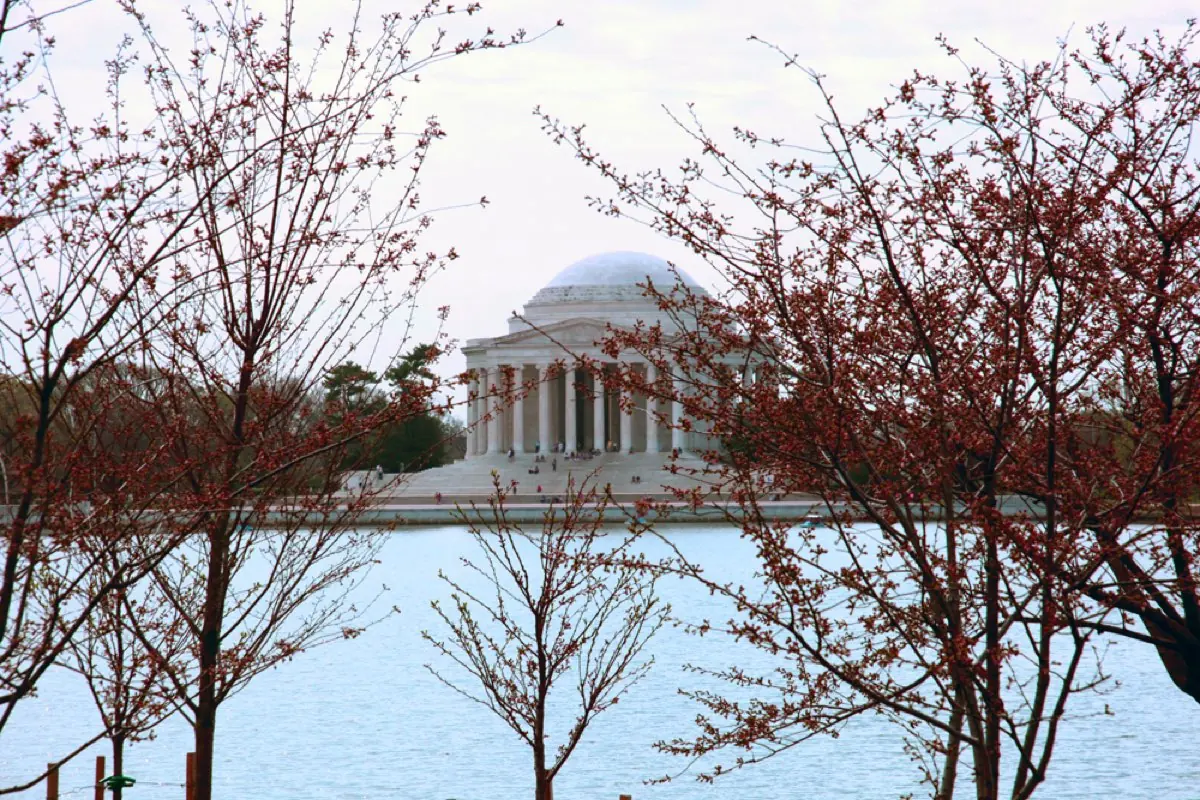
A domed neoclassical memorial to Thomas Jefferson on the Tidal Basin, famous for its spring cherry blossoms.
Visitor guide
The Jefferson Memorial is a domed, open-sided neoclassical rotunda on the south bank of the Tidal Basin in West Potomac Park, honoring Thomas Jefferson, author of the Declaration of Independence and third President. It was dedicated by Franklin D. Roosevelt on April 13, 1943, the 200th anniversary of Jefferson's birth, and it forms the southern anchor of the city's central axis in line with the White House.
The architect John Russell Pope drew on the Pantheon in Rome and on Jefferson's own classical buildings, notably Monticello and the Rotunda at the University of Virginia. Pope died in 1937, and the successor firm Eggers & Higgins completed the work. Construction began on December 15, 1938, and Roosevelt laid the cornerstone on November 15, 1939. The Commission of Fine Arts had opposed the design and the site, and in November 1938 protesters chained themselves to cherry trees that were due to be removed; the plans were revised to spare them. Frederick Law Olmsted Jr. designed the landscape.
The exterior uses white Danby marble from Vermont and the interior uses Georgia white marble. The pediment sculpture by Adolph Weinman shows the Committee of Five that drafted the Declaration of Independence. At the dedication a temporary plaster statue stood inside, and the final bronze statue by Rudulph Evans, about 19 feet (5.8 m) tall, was installed in 1947.
Inside, four panels carry quotations from Jefferson, drawn from the Declaration of Independence and the Virginia Statute for Religious Freedom among other writings; a frieze line reads 'I have sworn upon the altar of God eternal hostility against every form of tyranny over the mind of man.' The memorial is open on all sides, with a circular colonnade of Ionic columns, a portico and a shallow dome, so the statue is visible from the steps and the view back across the Tidal Basin to the Washington Monument is the most photographed in the area.
The surrounding Tidal Basin is lined with Japanese cherry trees, a 1912 gift from Tokyo, and the memorial is the best-known backdrop for the National Cherry Blossom Festival each spring; the National Park Service posts bloom forecasts. The memorial was listed on the National Register of Historic Places in 1966. The site is low-lying, and the Park Service has had to address settling ground and the seawall along the basin, so check for any ongoing works.
Because Voyzo runs private tours with a private vehicle and driver and door-to-door pickup, you can be dropped close to the steps at peak bloom without searching for parking, which is difficult around the Tidal Basin. Check the National Park Service for current hours, access and any construction.
The Martin Luther King Jr. Memorial and the Franklin Delano Roosevelt Memorial are on the Tidal Basin path, and the Washington Monument is a walk of under a mile across the park.
See every tour and attraction we cover in Washington DC.