TorontoOntario · 36 tours
 Niagara FallsOntario · 25 tours
 New York CityNew York · 30 tours
 Las VegasNevada · 8 tours
 San FranciscoCalifornia · 16 tours
 VancouverBritish Columbia · 17 tours
 DubaiUAE · 54 tours
 Abu DhabiUAE · 5 tours
 Buenos AiresArgentina · 23 tours
 AthensGreece · 31 tours
 AucklandNew Zealand · 38 tours
 CancunMexico · 54 tours
No destinations match “”. Try searching all tours instead — that search understands full questions, not just place names.
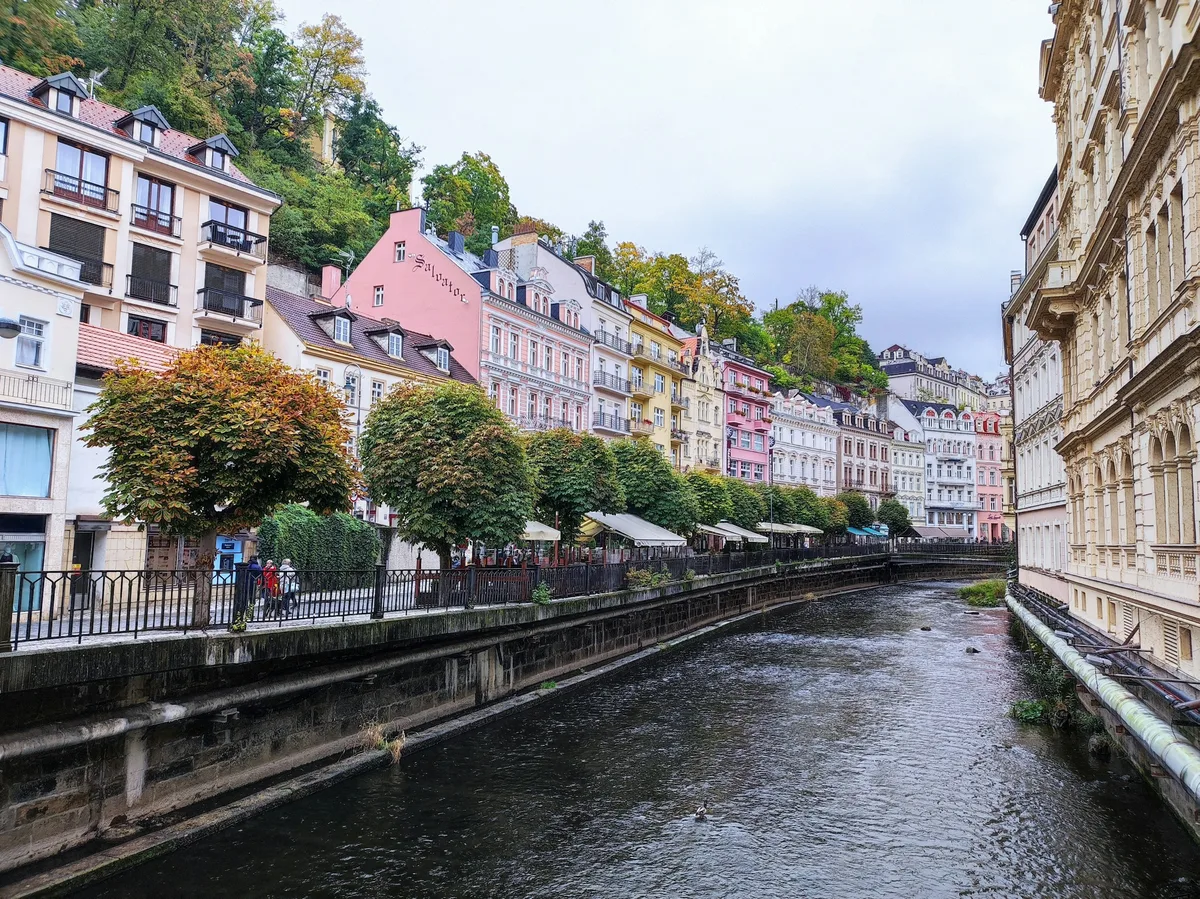
Czechia's best-known spa town, renowned for its thermal springs since the 18th century and once favoured by Beethoven, Goethe and Tsar Peter the Great; visitors still sip mineral water from its colonnades today.
Visitor guide
Karlovy Vary (Carlsbad in German, Karlsbad) is a spa city of about 49,000 inhabitants in western Bohemia, Czech Republic, at the confluence of the Ohře and Teplá rivers about 106 kilometres west of Prague. It is the most visited spa town in the country and part of the transnational UNESCO World Heritage Site Great Spa Towns of Europe, inscribed in 2021.
The name means Charles' Baths and honours Charles IV, Holy Roman Emperor and King of Bohemia. According to legend, Charles IV found a hot spring by accident while staying in Loket and healed an injured leg in its water; the spa settlement was founded most likely around 1349, and the king granted town privileges on 14 August 1370. People had probably known of the curative effects of the thermal springs even earlier. The story of the discovery is a legend rather than documented fact.
The city grew into a spa resort in the 19th century after publications by physicians such as David Becher and Josef von Löschner, and drew European aristocracy and celebrities. It became more popular after railway lines linked Prague and Cheb in 1870. The number of visitors rose from 134 families in the 1756 season to 26,000 guests a year by the end of the 19th century, and 1911 was the busiest year, with 70,956 visitors. World War I brought the city's rapid growth to an end.
Famous visitors included Peter the Great in 1711 and Beethoven, who came twice for treatment and performed a concert at the Grandhotel Pupp in 1812. Goethe published a paper on the local geology, Chopin met his parents here for the last time in 1835, and Turgenev visited many times. A political event, the Carlsbad Decrees of 1819 initiated by Metternich, took place after a conference here and imposed censorship in the German Confederation.
The Imperial Spa (Císařské lázně), built in French Neo-Renaissance style in 1893 to 1895, is described as the most important spa building. The Mill Colonnade, built 1871 to 1881, is the largest, with five mineral springs. The best-known spring is Vřídlo in the Hot Spring Colonnade, built in Functionalist style in 1975, where the spring gushes up to 12 metres high as a geyser. Other colonnades include the cast-iron Park Colonnade, the wooden Market Colonnade in Swiss style, and the Art Nouveau Castle Colonnade.
The Church of Saint Mary Magdalene, designed by Kilian Ignaz Dientzenhofer and built in 1732 to 1736, is among the most important Czech Baroque buildings. The Church of Saint Peter and Paul, built in Byzantine style in 1893 to 1897, is described by Wikipedia as the largest Orthodox church west of the post-Soviet states.
Karlovy Vary is known for the Czech herbal liqueur Becherovka, produced here since 1807, and for Carlsbad wafers, which originated in the city in 1867. The lead glass manufacturer Moser, founded in 1857, is considered a luxury Czech brand. The city also hosts the Karlovy Vary International Film Festival, among the leading film events in Europe. After the Velvet Revolution of 1989, the spa buildings were reconstructed and tourism developed rapidly again.
A private guided visit lets guests stroll the colonnades at their own pace and combine the spa district with side trips elsewhere in western Bohemia.
See every tour and attraction we cover in Czechia.