TorontoOntario · 36 tours
 Niagara FallsOntario · 25 tours
 New York CityNew York · 30 tours
 Las VegasNevada · 8 tours
 San FranciscoCalifornia · 16 tours
 VancouverBritish Columbia · 17 tours
 DubaiUAE · 54 tours
 Abu DhabiUAE · 5 tours
 Buenos AiresArgentina · 23 tours
 AthensGreece · 31 tours
 AucklandNew Zealand · 38 tours
 CancunMexico · 54 tours
No destinations match “”. Try searching all tours instead — that search understands full questions, not just place names.
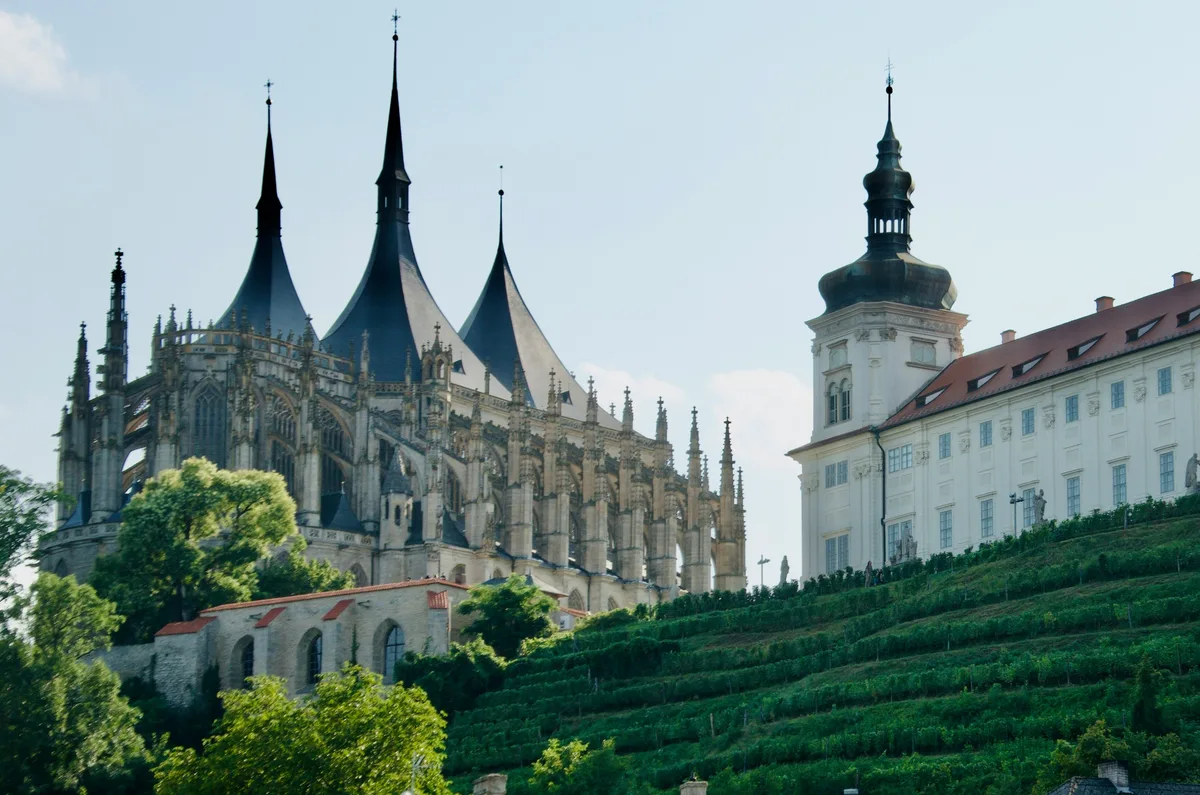
A UNESCO-listed medieval silver-mining town near Prague, anchored by the Gothic Church of St. Barbara and best known for the Sedlec Ossuary, a small chapel decorated with the bones of an estimated 40,000 people.
Visitor guide
Kutná Hora is a town of about 22,000 people in the Central Bohemian Region of the Czech Republic, about 52 kilometres east of Prague. Its centre, including the Sedlec Abbey and the Sedlec Ossuary, became a UNESCO World Heritage Site in 1995 for its outstanding architecture. The town grew rich from silver mining, and the Sedlec Ossuary, a chapel decorated with human bones, is one of the country's best-known sights.
Silver was found near Sedlec Abbey, the first Cistercian monastery in Bohemia, founded in 1142 by monks from Waldsassen in Bavaria, and mining began in 1260. The first mention of the town is from 1289 as Mons Cuthna. In 1300 King Wenceslaus II issued a royal mining code, and soon afterwards Kutná Hora became the seat of the central mint, where Prague groschen were struck. Wikipedia calls it the second most important town of the Kingdom of Bohemia after Prague and its main financial centre. The Hussites burned Sedlec Abbey in 1421, and silver mining was restored in 1469.
The Church of Saint Barbara is a main example of European Gothic architecture, begun in 1388, with Johann Parler generally credited as its first architect (Peter Parler may have contributed to the early design); work was interrupted several times. It was meant to display the town's wealth and to compete with the cathedral at Sedlec and St. Vitus in Prague. Later builders included Matěj Rejsek and Benedikt Rejt. The Italian Court, built in Gothic style between 1260 and 1300, is the oldest monument in Kutná Hora and housed the royal mint from 1300 until 1727. Its Chapel of Saints Wenceslaus and Ladislaus dates from about 1400.
Other monuments include the early Baroque Jesuit College begun in 1666, the late Gothic Stone House from the 1480s, which houses the Museum of Silver, and a dodecagonal late Gothic stone fountain from 1495 on Rejskovo náměstí.
The Sedlec Ossuary is a Roman Catholic chapel beneath the Cemetery Church of All Saints in Sedlec, part of the former abbey. It is estimated to contain the skeletons of between 40,000 and 70,000 people, and in many cases their bones have been artistically arranged as decorations and furnishings. A chandelier of bones containing at least one of every bone in the human body hangs from the nave, garlands of skulls drape the vault, and four bell-shaped mounds occupy the corners.
According to legend, the story begins in 1278, when Abbot Henry returned from the Holy Land with a handful of holy soil, often said to be from Golgotha, and sprinkled it over the abbey cemetery, making it a desirable burial site across central Europe. The Black Death and the Hussite Wars later brought many thousands of burials, so the bones exhumed from the overfull cemetery were stored in a two-storey cemetery church with a lower chapel; the Sedlec parish says the exact date of the church is unknown, with experts placing it in the first half of the 14th century. Legend says a half-blind monk was tasked with stacking the bones after 1511. Between 1703 and 1710 Jan Santini Aichel redesigned the entrance and upper chapel in Czech Baroque style. In 1870, woodcarver František Rint was employed by the Schwarzenberg family to put the heaps in order, and his signature in bone is on the wall near the entrance.
The ossuary draws over 200,000 visitors a year, according to Wikipedia, and is among the most visited attractions in the Czech Republic. It is a place of memorial as well as curiosity, and a private guided visit gives space to pair it with the town's Gothic church and historic centre.
See every tour and attraction we cover in Czechia.