TorontoOntario · 36 tours
 Niagara FallsOntario · 25 tours
 New York CityNew York · 30 tours
 Las VegasNevada · 8 tours
 San FranciscoCalifornia · 16 tours
 VancouverBritish Columbia · 17 tours
 DubaiUAE · 54 tours
 Abu DhabiUAE · 5 tours
 Buenos AiresArgentina · 23 tours
 AthensGreece · 31 tours
 AucklandNew Zealand · 38 tours
 CancunMexico · 54 tours
No destinations match “”. Try searching all tours instead — that search understands full questions, not just place names.
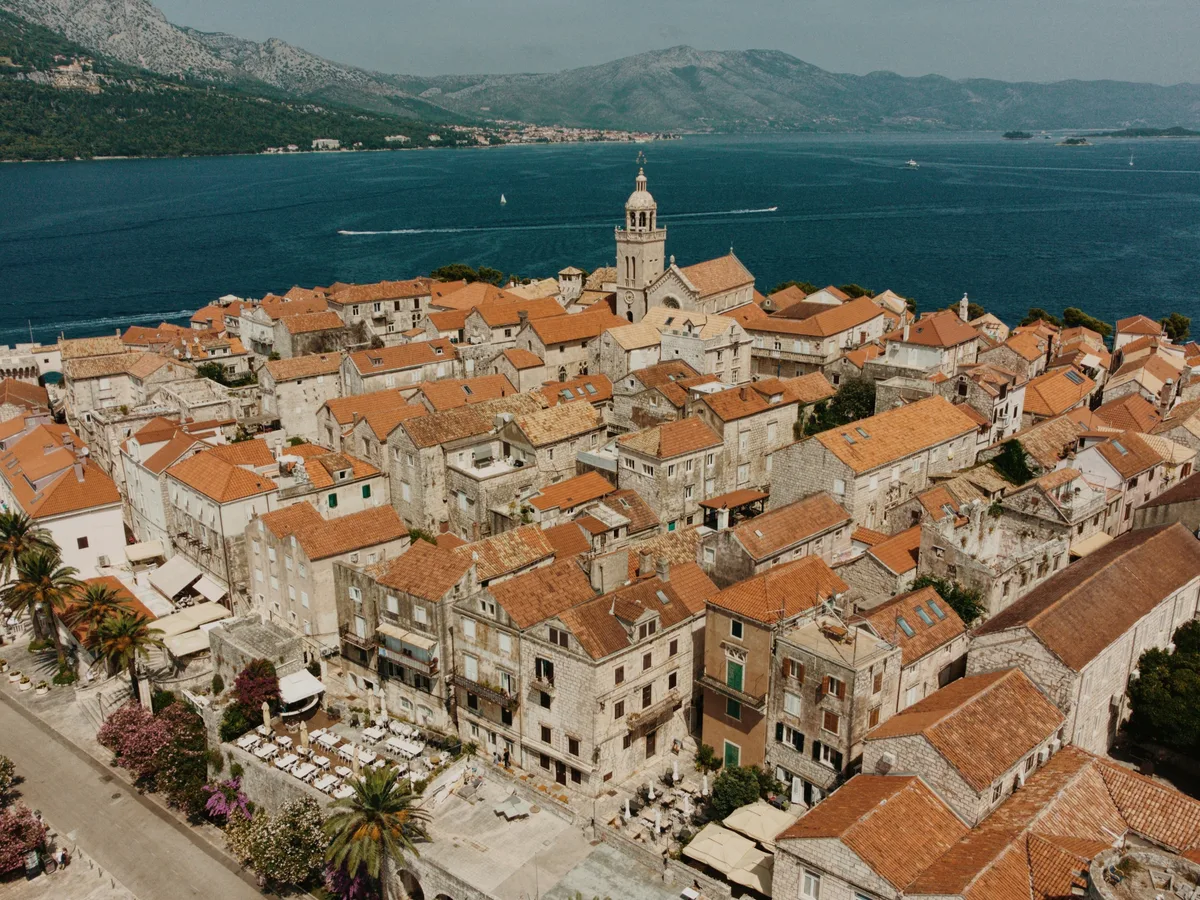
A walled medieval town on the island of Korcula, laid out in a herringbone street pattern to channel sea breezes, and traditionally claimed as the birthplace of Marco Polo.
Visitor guide
Korcula Old Town is the walled medieval town on the Adriatic island of Korcula in southern Dalmatia, Croatia. Built on a small peninsula and known in Latin as Cursola, it is celebrated for its fortified walls, stone palaces and a herringbone street plan, and local tradition links it with Marco Polo.
The old town is enclosed by walls, and building outside them was forbidden until the 18th century. A wooden drawbridge was only replaced in 1863. Twelve towers were built in the Middle Ages, of which seven still stand, including Zakerjan, Kanavelic, Revelin and the Sea Gate tower. Behind the walls the streets are laid out in a herringbone pattern, which according to Wikipedia lets air circulate while shielding the town from strong winds. Most streets are stepped, with the exception of the street along the south-eastern wall, nicknamed the Street of Thoughts, which is level.
Korcula became a Venetian possession in the 15th century, and most of the buildings are in the Venetian Renaissance style. The Cathedral of St Mark stands on the highest point of the peninsula and was built over several centuries, from the 14th century, in a Gothic-Renaissance idiom with later Renaissance touches. Statues of Adam and Eve frame the main entrance, and the facade has a rose window and lion figures. Local stonemasons built the church, and stonework shapes the town's walls, palaces and churches. Notable palaces include the Arneri, Gabrielis, Bishop's and Caenazzo palaces, and a 15th-century Franciscan monastery has a Venetian Gothic cloister.
The town became an episcopal see in the early 14th century, when the bishop of Ston moved his seat there, and the Cursola diocese was merged into Dubrovnik in 1828. The town statute of 1214 is noted for prohibiting slavery.
Korcula is traditionally claimed as the birthplace of the Venetian traveller Marco Polo, and a house in the old town is promoted as his family home. Wikipedia's article on Polo says he was probably born in Venice, notes that the birthplace is not documented in archives, and states that theories placing it on Korcula have failed to win acceptance among most scholars. The Curzola connection is often tied to the 1298 naval battle, but sources differ. The claim is best treated as a charming local tradition.
The town is the home of the Moreska, a sword dance that stages a mock battle between two armies over a veiled young woman. Wikipedia dates the Korcula version to at least the mid-17th century, with roots in Reconquista-era conflict, and describes it as the only surviving form in which each soldier holds two swords. It was once staged only on special occasions around the feast of St Theodore, the town's patron saint, in July. Performers are traditionally natives of Korcula.
A private guided visit with a driver suits Korcula Old Town, which is small enough to explore on foot, with transfers handled to the town gates.
See every tour and attraction we cover in Croatia.