TorontoOntario · 36 tours
 Niagara FallsOntario · 25 tours
 New York CityNew York · 30 tours
 Las VegasNevada · 8 tours
 San FranciscoCalifornia · 16 tours
 VancouverBritish Columbia · 17 tours
 DubaiUAE · 54 tours
 Abu DhabiUAE · 5 tours
 Buenos AiresArgentina · 23 tours
 AthensGreece · 31 tours
 AucklandNew Zealand · 38 tours
 CancunMexico · 54 tours
No destinations match “”. Try searching all tours instead — that search understands full questions, not just place names.
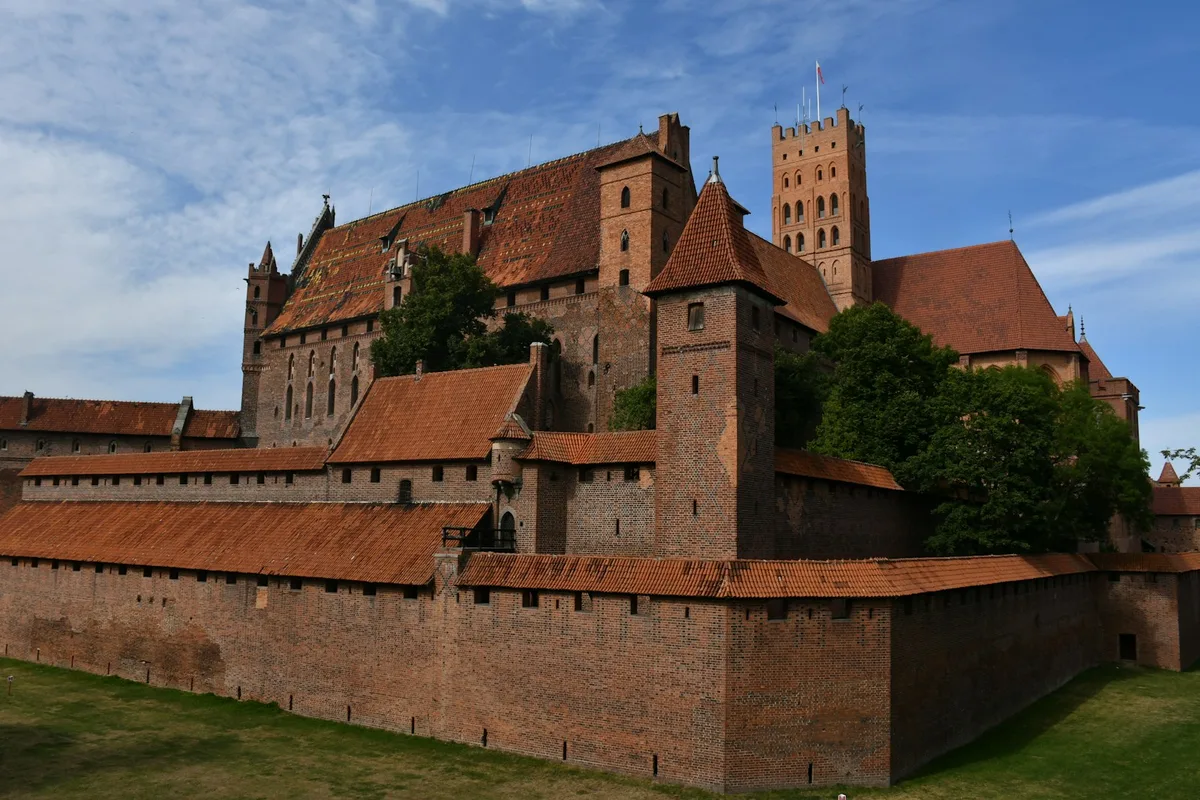
The largest brick castle in the world by land area, built by the Teutonic Knights on the Nogat River in the 13th century and now a UNESCO World Heritage Site.
Visitor guide
Malbork Castle, formally the Castle of the Teutonic Order in Malbork, is a Brick Gothic fortress on the Nogat River in northern Poland. Built by the Teutonic Order from the 13th century and greatly expanded in the 14th, it is described by Wikipedia as the largest castle in the world measured by land area, and it is a UNESCO World Heritage Site.
The Teutonic Order, a German Catholic crusading order created in 1191 in Acre, built the castle after its conquest of Old Prussia, with the aim of consolidating control after suppressing the Great Prussian Uprising in 1274. It was named Marienburg in honor of Mary, the Order's patron saint. Construction is a matter of debate among historians: the castle museum dates building from 1280, while Wikipedia cites 1274 to 1406 as the building period. The castle gained importance after the Order conquered Gdansk and Eastern Pomerania in 1308, and in 1309 the Grand Master Siegfried von Feuchtwangen moved the Order's headquarters here from Venice. The site on the Nogat gave easy access by barge to the Vistula and the Baltic, and the Order collected river tolls and controlled a monopoly on amber trade, according to Wikipedia.
The complex is made up of three separate castles, the High, Middle and Lower Castles, divided by dry moats, towers and layers of defensive walls. The outermost walls enclose about 21 hectares, which Wikipedia says is four times the enclosed area of Windsor Castle, and the castle once housed around 3,000 brothers in arms. Upon its completion in 1406 it was the world's largest brick castle. It remains a classic example of a medieval fortress in the Brick Gothic style, built of red brick with decorative details. Wikipedia also records that the Great Refectory was later used for balls and feasts when the castle was a Polish royal residence.
In the summer of 1410 the castle was besieged after the Order's defeat at the Battle of Grunwald, but the defence led by Heinrich von Plauen held. In 1457, during the Thirteen Years' War, Bohemian mercenaries sold the castle to King Casimir IV of Poland to settle unpaid wages. For over 300 years it served as one of several Polish royal residences and as the seat of regional offices, including the Polish Admiralty from 1568 and a royal mint from 1584. Swedish forces occupied it in 1626 and 1629, and again from 1656 to 1660. After the First Partition of Poland in 1772 the castle came under Prussian rule and fell into neglect, serving as a barracks and poorhouse.
Engravings of the castle published around 1800 helped the Prussian public rediscover it, and restoration began in 1816 under the West Prussian governor Theodor von Schon, continuing in stages until the Second World War. Between January and March 1945, fighting with the Red Army destroyed more than half of the castle. It was subsequently rebuilt. UNESCO inscribed the castle and the Malbork Castle Museum on the World Heritage List in December 1997, and it is also an official Polish Historic Monument.
Malbork lies on the route between Gdansk and the interior of northern Poland and is often visited as a day trip from Gdansk. A private tour with a driver and guide suits a site of this scale, letting you spend time on the courtyards, the Grand Master's areas and the museum collections at your own pace.
See every tour and attraction we cover in Poland.