TorontoOntario · 36 tours
 Niagara FallsOntario · 25 tours
 New York CityNew York · 30 tours
 Las VegasNevada · 8 tours
 San FranciscoCalifornia · 16 tours
 VancouverBritish Columbia · 17 tours
 DubaiUAE · 54 tours
 Abu DhabiUAE · 5 tours
 Buenos AiresArgentina · 23 tours
 AthensGreece · 31 tours
 AucklandNew Zealand · 38 tours
 CancunMexico · 54 tours
No destinations match “”. Try searching all tours instead — that search understands full questions, not just place names.
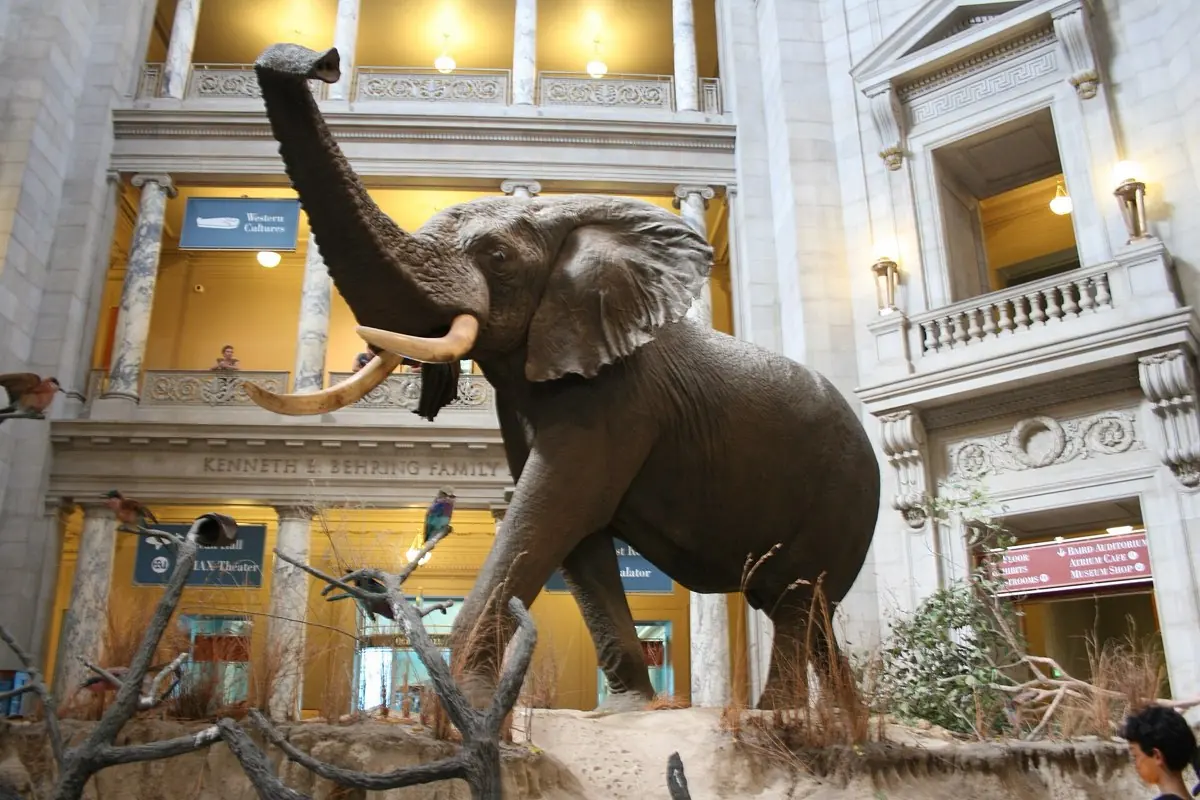
A Smithsonian museum holding the Hope Diamond and a vast collection of natural history specimens.
Visitor guide
Its neoclassical building opened on March 17, 1910, and it holds a research collection of about 148 million specimens and artifacts, according to the Smithsonian. Its Hope Diamond and rotunda elephant make it one of the Mall's best-known stops.
The museum's roots go back to 1846, when the United States National Museum was founded within the Smithsonian and first housed in the Smithsonian Institution Building, the Castle. A separate National Museum Building, now the Arts and Industries Building, opened in March 1881. Congress authorized a new building on June 28, 1902, and the Smithsonian regents chose a site on the north side of the Mall in 1903, with the firm Hornblower & Marshall as architects. Ground was broken in 1904, and the building was opened in 1910 and completed in 1911 at a reported cost of about $3.5 million. It was the first structure built on the north side of the Mall under the 1901 McMillan Commission plan.
The design of the central rotunda was revised during construction. Smithsonian accounts differ on details, but both name Charles Follen McKim, and one also names Daniel Burnham, as having pushed the plan in a more classical direction with a lower dome and a columned portico facing the Mall. The finished octagonal rotunda has Doric columns on the first floor and Ionic columns above, topped by a tiled dome with an oculus. Wikipedia gives the building about 1.5 million square feet, of which about 325,000 are exhibition and public space.
The research side is organized into seven departments, including anthropology, botany, entomology, mineral sciences, paleobiology and zoology. Off-site collections are kept at the Museum Support Center in Suitland, Maryland. Wikipedia reports about 3.3 million visits in 2025, which makes it among the Mall's busiest museums.
Beneath the rotunda is Baird Auditorium, named for Spencer Fullerton Baird, the Smithsonian's second Secretary. Hornblower & Marshall added it to the plans in 1903 at the staff's request for a lecture hall, and the R. Guastavino Company completed it in 1909. Its shallow tiled dome spans about 90 feet, and the American Institute of Architects has called it the museum's greatest interior space. On April 26, 1920, astronomers Harlow Shapley and Heber Curtis held their famous Great Debate there on whether spiral nebulae lay inside the Milky Way.
The rotunda is dominated by 'Henry', an African bush elephant mount. The hunter and engineer Josef Fénykövi shot the animal in Angola in 1955; the mount, prepared by Smithsonian taxidermists, was unveiled in the rotunda on March 6, 1959. The Smithsonian describes it as standing about 13 feet tall and weighing around 11 tons.
The Hall of Geology, Gems, and Minerals houses the National Gem and Mineral Collection, which Wikipedia says includes more than 15,000 gems, among them the 330-carat Star of Asia. Its star is the Hope Diamond, a 45.52-carat stone graded fancy dark grayish blue, whose color comes from traces of boron. It is believed to come from the Kollur mine in India's Guntur district. The gem merchant Jean-Baptiste Tavernier obtained the rough stone in India in 1666 and sold the cut 'French Blue' to Louis XIV in 1668. Thieves stole most of the French crown jewels in September 1792, and the stone is thought to have been recut later, with the largest remaining piece becoming the Hope Diamond. It appears in the 1839 catalog of banker Henry Philip Hope's collection and later belonged to Evalyn Walsh McLean.
Harry Winston gave it to the Smithsonian in 1958, famously sending it by registered mail; sources give November 8 or 10 for the mailing and arrival, and the postage was reported as $2.44, with a further sum for insurance. Under short-wave ultraviolet light the stone glows red for a time, which scientists attribute to boron and nitrogen in the crystal. The popular stories of a curse are considered unreliable and were spread largely by newspapers in 1908, 1909 and 1911, so the diamond's history is more interesting without them.
The Sant Ocean Hall opened in September 2008, the Behring Hall of Mammals in 2003 and the Hall of Human Origins in March 2010. The fossil hall, formally the David H. Koch Hall of Fossils - Deep Time, reopened in June 2019 after a five-year closure, with a Tyrannosaurus rex skeleton known as the 'Nation's T. rex'. The museum obtained the skeleton, found in Montana in 1988, under a 50-year lease in 2013 and it arrived in April 2014. Other attractions include the live O. Orkin Insect Zoo, the Butterflies + Plants pavilion and the hands-on Q?rius learning space, open since 2013.
See every tour and attraction we cover in Washington DC.