TorontoOntario · 36 tours
 Niagara FallsOntario · 25 tours
 New York CityNew York · 30 tours
 Las VegasNevada · 8 tours
 San FranciscoCalifornia · 16 tours
 VancouverBritish Columbia · 17 tours
 DubaiUAE · 54 tours
 Abu DhabiUAE · 5 tours
 Buenos AiresArgentina · 23 tours
 AthensGreece · 31 tours
 AucklandNew Zealand · 38 tours
 CancunMexico · 54 tours
No destinations match “”. Try searching all tours instead — that search understands full questions, not just place names.
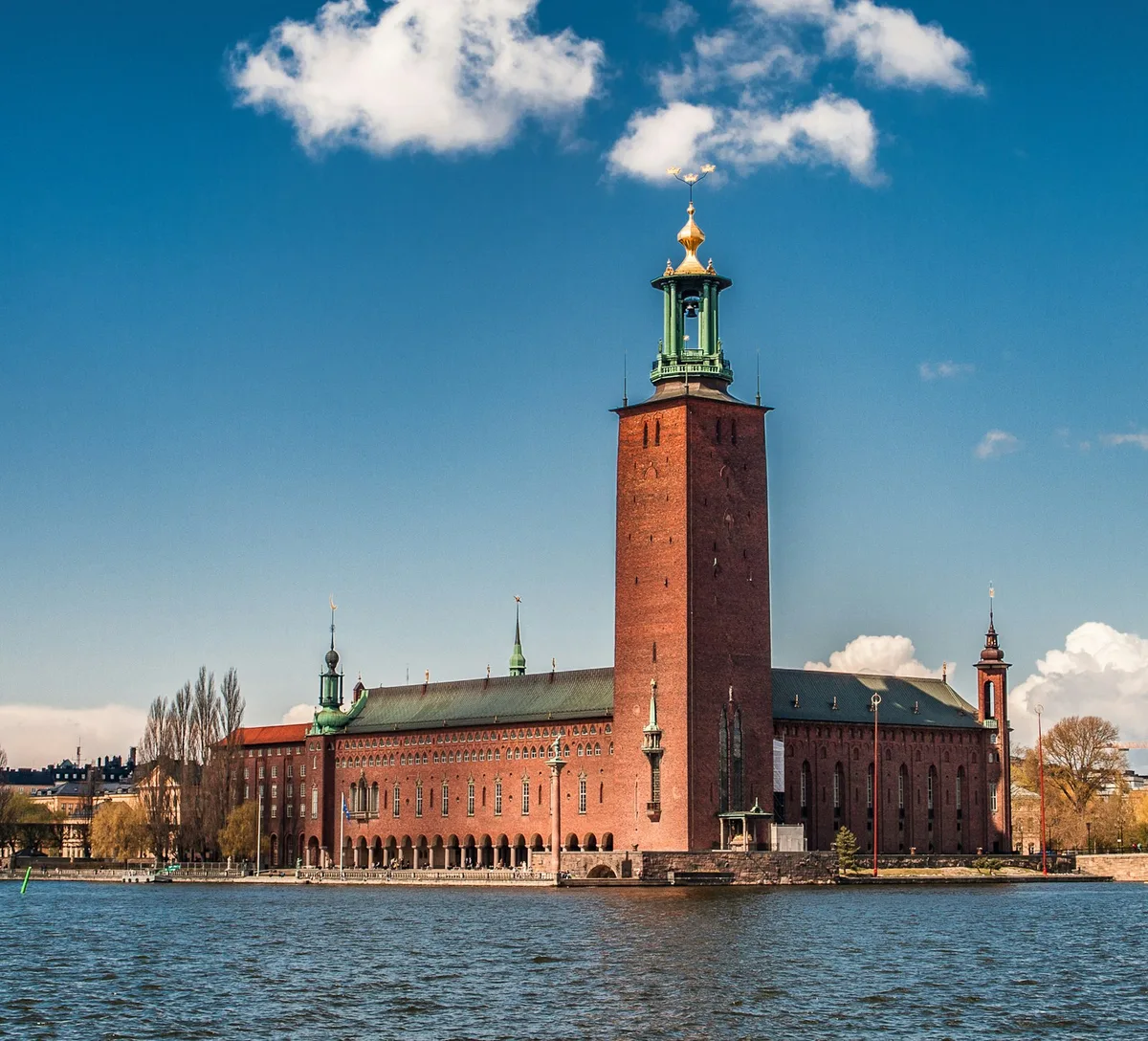
The red-brick landmark on Kungsholmen where the Nobel Prize banquet is held every December, with a mosaic-lined Golden Hall and views from its 106-metre tower.
Visitor guide
Stockholm City Hall, known in Swedish as Stadshuset, is a red-brick civic building on the shore of Lake Mälaren in Stockholm, Sweden. Designed by architect Ragnar Östberg and completed in 1923, it houses municipal offices and is known for hosting the Nobel Prize banquet in its Blue Hall.
Östberg was chosen after a further competition between himself and Carl Westman, and he reworked his plans during construction, which ran from 1911 to 1923. Nearly eight million red bricks were used, including dark red 'munktegel' bricks from the Lina brickworks in Södertälje. The building was inaugurated on 23 June 1923, a date chosen to mark the 400th anniversary of Gustav Vasa's entry into Stockholm, although the anniversary actually fell on 4 July.
The Blue Hall is the dining hall where Nobel Prize banquets are held. Its name comes from Östberg's first draft, and in fact its walls carry no blue decoration. The hall houses a pipe organ with 10,270 pipes, described by Wikipedia as the largest in Scandinavia. The hall's design incorporates elements of a formal courtyard.
Above the Blue Hall lies the Golden Hall, named for its mosaics. They are made of more than 18 million tiles, produced by the Berlin firm Puhl and Wagner. The mosaic walls are the building's most striking interior feature and give the room its glittering character.
The tower is 106 metres tall and topped with the Three Crowns, a Swedish national emblem. It can be reached by lift or by a 365-step staircase, and its base holds a gold-plated cenotaph of Birger Jarl, traditionally credited as an early organiser of medieval Stockholm.
Between the building and Lake Mälaren lies a small park, Stadshusparken. It holds sculptures including Carl Eldh's ensemble of Strindberg, Fröding and Josephson, and a statue of Engelbrekt Engelbrektsson on a pillar. The waterside setting makes the building a recognisable part of the Stockholm skyline.
The City Hall is associated with the Swedish National Romantic style, drawing on medieval brick architecture and Nordic craft traditions rather than Neoclassical models. Its mix of heavy brick masses, arcades and a slender tower gives it a distinctive silhouette, and it remains an active working building as well as a visitor attraction.
Ragnar Östberg (1866 to 1945), a Stockholm-born architect, is best known for the City Hall and was the most famous architect of the national romanticist movement in Sweden. He studied at the KTH Royal Institute of Technology and the Royal Swedish Academy of Fine Arts, and from 1896 made a three-year study trip to England, France, Italy and Greece. His other works include Östra Real in Stockholm (1906 to 1910), the Riksbron bridge (1926 to 1930) and the Zorn Museum in Mora (1938 to 1939).
The City Hall is best appreciated with background on its design and ceremonial role. A private guided visit, combined with a vehicle and driver for the wider Stockholm day, suits visitors who want the story of the Blue Hall and Golden Hall explained in context.
See every tour and attraction we cover in Sweden.