TorontoOntario · 36 tours
 Niagara FallsOntario · 25 tours
 New York CityNew York · 30 tours
 Las VegasNevada · 8 tours
 San FranciscoCalifornia · 16 tours
 VancouverBritish Columbia · 17 tours
 DubaiUAE · 54 tours
 Abu DhabiUAE · 5 tours
 Buenos AiresArgentina · 23 tours
 AthensGreece · 31 tours
 AucklandNew Zealand · 38 tours
 CancunMexico · 54 tours
No destinations match “”. Try searching all tours instead — that search understands full questions, not just place names.
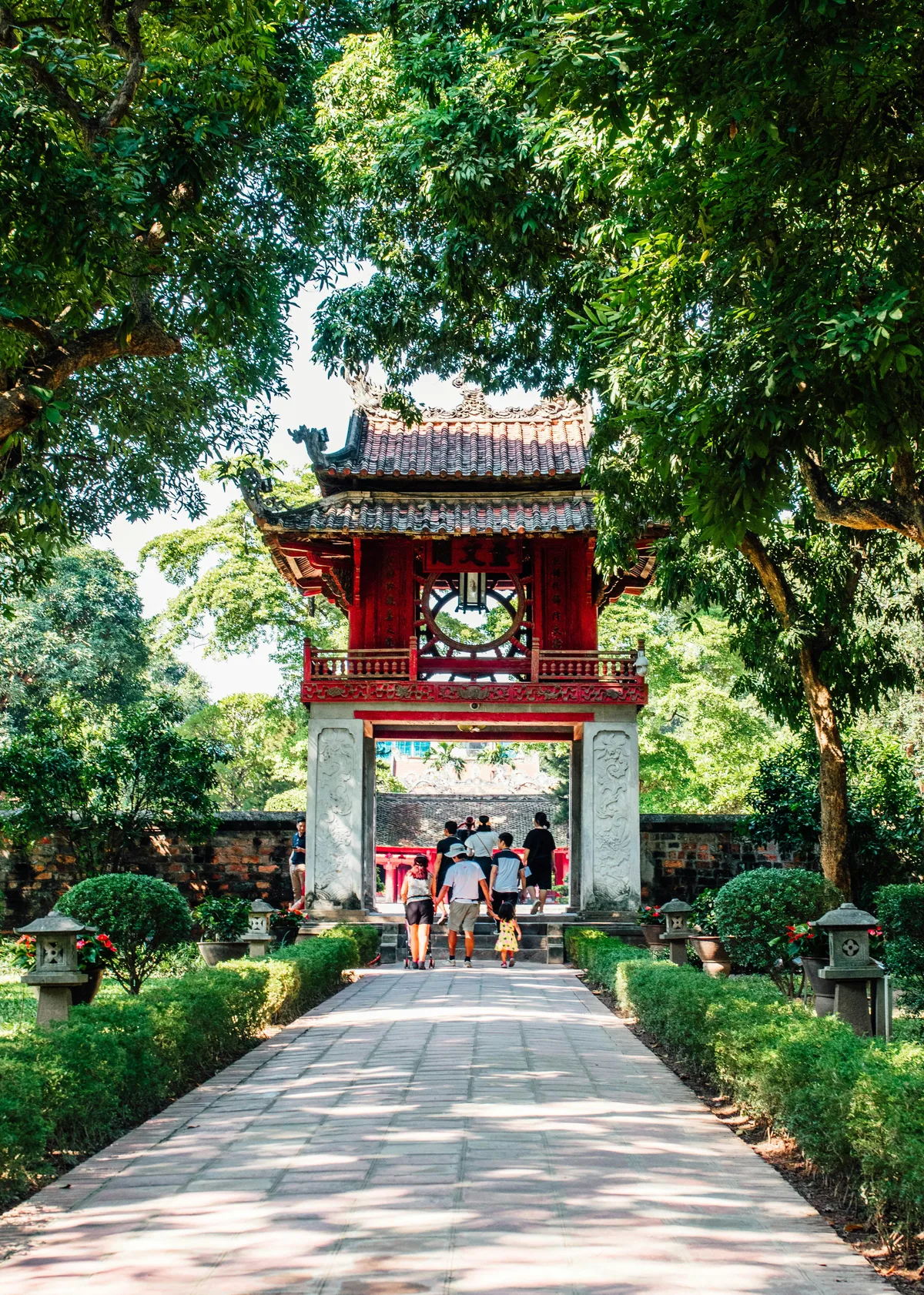
Hanoi's Confucian temple and Vietnam's first national university, founded in 1070, with stone stelae recording the names of doctoral graduates dating back centuries.
Visitor guide
The Temple of Literature (Van Mieu) in Hanoi, Vietnam, is a temple of Confucius, sages and scholars founded in 1070. It also housed Vietnam's first national university, the Imperial Academy, and is famous for its rows of stone stelae set on carved turtles.
According to Wikipedia, the temple was founded in 1070 under Emperor Ly Thanh Tong, who had statues of Confucius, his four leading disciples and the Duke of Zhou made. In 1076, under Ly Nhan Tong, the Imperial Academy (Quoc Tu Giam) opened on the grounds and trained officials, nobles and royalty until 1779. The temple's layout is modelled on the Confucius temple at Qufu in Shandong. When the Nguyen dynasty moved the capital to Hue in 1802, a new imperial academy was founded there and the Hanoi site lost prominence. Major restorations followed in 1920, 1954 and 2000, and the French registered the site as a historic monument in 1906.
The complex covers more than 54,000 square metres and is arranged as walled courtyards leading deeper into the site. The first two are quiet spaces with old trees, and the second contains Khue Van Cac, the pavilion built in 1805 on stone stilts that is now a symbol of Hanoi and appears on the 100,000 dong banknote. The third courtyard holds the Thien Quang well, while the fourth is the ceremonial heart, where Confucius and his four closest disciples are worshipped. The fifth courtyard, built in 1077 for the Imperial Academy, was destroyed in 1946 during the First Indochina War and rebuilt in 2000. Three paths once led through the site: the central for the monarch, the left for civil mandarins and the right for military mandarins.
Emperor Le Thanh Tong began the stone stelae in 1484 to honour talent and encourage study. Of the 116 turtle-borne stelae commissioned, 82 survive, recording the names and birthplaces of graduates from 82 royal examinations held between 1442 and 1779; the total is quoted differently, from about 1,300 in recent Vietnamese coverage to 2,313 in older reports. The inscriptions also praise the monarch and explain why the exams were held. The stelae were inscribed on UNESCO's Memory of the World Register in 2011. Visitors once rubbed the turtles' heads for luck, so a fence now protects them.
Most students had already passed the regional examination before enrolling, and studied Chinese language, philosophy, history and poetry, based on the Four Books and the Five Classics. They enrolled for three to seven years, sat monthly tests and four major exams a year, and could advance to the national and palace exams where the monarch ranked candidates.
Before the Tet holiday, calligraphers gather outside the temple to write wishes in Han characters, which are given as gifts or displayed at home. A guided visit adds helpful context about the stelae and the courtyards, and a private driver can connect the temple with other sites in Hanoi.
See every tour and attraction we cover in Vietnam.