TorontoOntario · 36 tours
 Niagara FallsOntario · 25 tours
 New York CityNew York · 30 tours
 Las VegasNevada · 8 tours
 San FranciscoCalifornia · 16 tours
 VancouverBritish Columbia · 17 tours
 DubaiUAE · 54 tours
 Abu DhabiUAE · 5 tours
 Buenos AiresArgentina · 23 tours
 AthensGreece · 31 tours
 AucklandNew Zealand · 38 tours
 CancunMexico · 54 tours
No destinations match “”. Try searching all tours instead — that search understands full questions, not just place names.

A narrow ocean inlet where incoming waves compress into a thunderous crash and spray.
Visitor guide
Thunder Hole is a narrow, carved-out inlet on the rocky eastern shoreline of Mount Desert Island in Acadia National Park, where the right combination of waves and tide forces water into a slot in the rock and sends back a booming roar. Spray at Thunder Hole has been seen reaching more than 40 feet, according to the National Park Service.
The National Park Service explains that storms or a turning tide push waves into a narrow channel, and the trapped air escapes with a loud, thunderous sound. The effect depends heavily on conditions, so the park recommends arriving one to two hours before high tide for the best chance of hearing it. At low tide the show is quiet, but the park notes that stairs lead down to a closer look at cliff walls carved by the water. The formation sits between Sand Beach's cove to the east and Otter Point to the west.
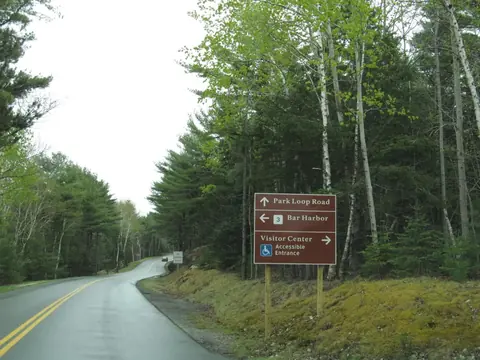
The name is old. Clara Barnes Martin's 1867 Guide Book for Mount Desert Island, quoted by the National Park Service, describes Thunder Hole or Thunder Cave as a deep chasm where waves swirl and, under the right wind and tide, strike the overhanging rock with a crash like thunder. In the early 1900s, local village improvement associations built hiking paths to the site, and roads followed later, including the Park Loop Road in the 1930s.
A 1934 ranger station built by the Works Progress Administration stands on the west side of the parking lot; the park describes it as a one-story building in the NPS Rustic style and as one of the first buildings at Acadia designed that way. In the late 1960s it became a concessioner's gift shop. Walkways were built and widened in the 1960s, and the current lower walkway system was completely rebuilt in 1992 and 1993, when an accessible ramp with switchbacks was added. The Thunder Hole area is listed on the National Register of Historic Places for its rustic design and its New Deal-era history.
The upper viewing deck is wheelchair accessible and has interpretive waysides, reached by a path off the Park Loop Road. The lower viewing area is reached by a 55-step stairway, and the park says the stairs and lower decks are not accessible. Amenities listed by the park include parking, a restroom, a gift shop, interpretive exhibits and an Island Explorer bus stop. You can also reach Thunder Hole on foot along the Ocean Path.
The stairway and lower viewing deck are often wet and slippery, especially in winter, and rogue waves can wash over the granite ledges even in calm weather. Sections of the walkway close during storms, so follow National Park Service guidance and posted signs, and check the park for current hours, permits, and access.
With a private vehicle and driver, timing Thunder Hole around a rising tide is easier because your group sets the schedule. Voyzo can build the stop into a coastal loop without worrying about parking.
See every tour and attraction we cover in Bar Harbor.