TorontoOntario · 36 tours
 Niagara FallsOntario · 25 tours
 New York CityNew York · 30 tours
 Las VegasNevada · 8 tours
 San FranciscoCalifornia · 16 tours
 VancouverBritish Columbia · 17 tours
 DubaiUAE · 54 tours
 Abu DhabiUAE · 5 tours
 Buenos AiresArgentina · 23 tours
 AthensGreece · 31 tours
 AucklandNew Zealand · 38 tours
 CancunMexico · 54 tours
No destinations match “”. Try searching all tours instead — that search understands full questions, not just place names.

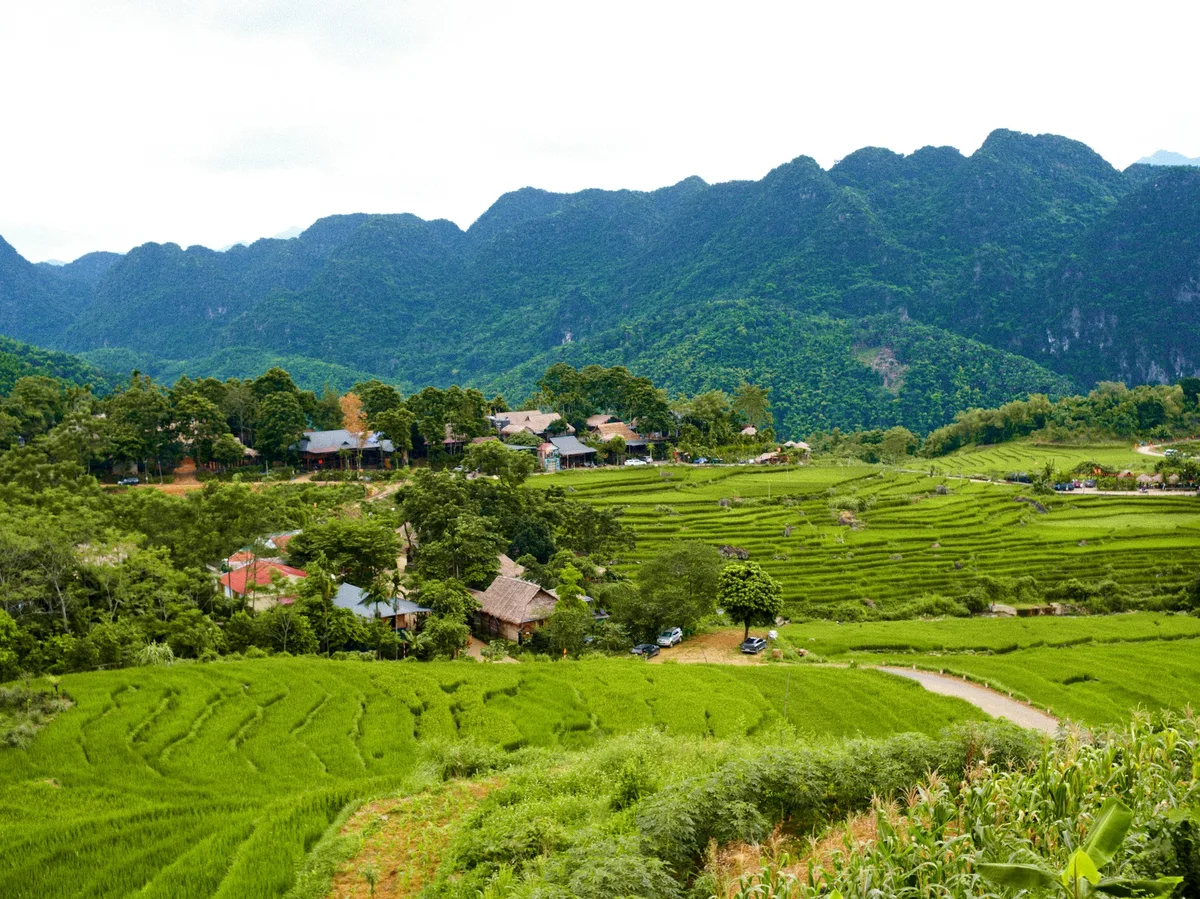
A UNESCO-listed landscape of limestone karst towers and flooded caves near Ninh Binh, toured by small rowboat along rivers that thread between the cliffs.
Visitor guide
Trang An is a landscape of limestone towers, rivers and flooded caves in Ninh Binh province, northern Vietnam, inscribed in 2014 as a mixed cultural and natural UNESCO World Heritage Site. It lies beside the ancient capital of Hoa Lu and is best known for its small rowboat trips that pass through caves between the cliffs.
According to Wikipedia, the Trang An Landscape Complex was inscribed on 23 June 2014 at the 38th session of the World Heritage Committee in Doha, under criteria (v), (vii) and (viii), covering the Hoa Lu ancient capital and the Tam Coc and Bich Dong area, with an extension noted in 2016. Sources differ on its size: UNESCO decision documents give about 6,172 hectares for the limestone massif, while the statement of outstanding universal value cites 6,226 hectares. The complex is described as having three linked parts: Hoa Lu in the north, the Trang An eco-tourism area in the centre and Tam Coc and Bich Dong in the south, connected by the Hoa Lu special-use forest of limestone mountains, rivers, lakes and swamps.
UNESCO's reasoning describes Trang An as an outstanding humid tropical tower karst landscape in the final stages of geomorphic evolution. Exploration of caves at different altitudes has revealed archaeological traces of human activity over a continuous period of more than 30,000 years, including seasonal hunter-gatherers adapting to major climate change and repeated flooding of the landscape by the sea after the last ice age. Wikipedia notes more than 600 plant species and about 200 animal species, many on Vietnam's red list, with endangered animals such as the mainland serow and Edward's pheasant.
Nearby Hoa Lu was the capital of the Dinh dynasty (968 to 980) and the early Le dynasty (980 to 1009), according to travel and heritage sources, though some give the end date as 1010. It sat in a flat valley ringed by steep limestone hills that acted as natural defences. The ancient citadel no longer stands, and few traces of the 10th century remain, but temples to the Dinh and Le emperors survive, and an annual festival honours the Dinh and Le kings with a ceremony in the courtyard of the Dinh Tien Hoang temple.
The main way to see Trang An is by rowing boat along the river, past limestone towers and through caves and tunnels, with a trip taking roughly two hours according to Wikipedia. Travel guides describe three alternative boat routes with differing numbers of caves, and note that the landscape was used as a filming location for Kong: Skull Island in 2017. These route details come from third-party guides and may change, so it is best to confirm them with your operator. Boats offer little shade, so a hat and sunscreen are suggested. A private driver from Hanoi and a local guide can make the day simpler and add context about Hoa Lu.
See every tour and attraction we cover in Vietnam.