TorontoOntario · 36 tours
 Niagara FallsOntario · 25 tours
 New York CityNew York · 30 tours
 Las VegasNevada · 8 tours
 San FranciscoCalifornia · 16 tours
 VancouverBritish Columbia · 17 tours
 DubaiUAE · 54 tours
 Abu DhabiUAE · 5 tours
 Buenos AiresArgentina · 23 tours
 AthensGreece · 31 tours
 AucklandNew Zealand · 38 tours
 CancunMexico · 54 tours
No destinations match “”. Try searching all tours instead — that search understands full questions, not just place names.
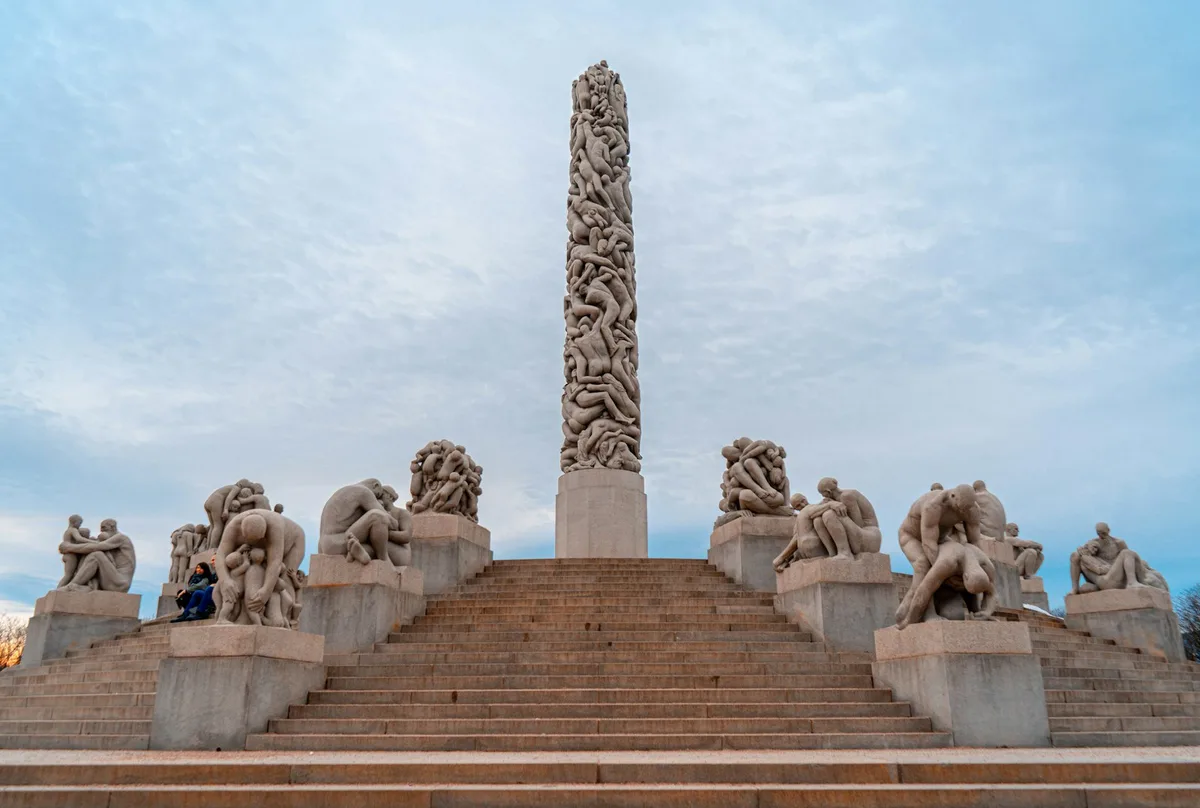
The world's largest sculpture park by a single artist, set within Oslo's Frogner Park, with over 200 bronze, granite and iron works by Gustav Vigeland, including the 14-metre Monolith.
Visitor guide
Vigeland Park is the name commonly used for the sculpture installation by Gustav Vigeland inside Frogner Park, Oslo's largest public park. It contains 212 bronze and granite sculptures, all designed by Vigeland, and Wikipedia describes it as the world's largest sculpture park made by a single artist. Its centrepiece is the Monolith, a granite column 14.12 metres high.
Frogner Park covers about 45 hectares in the Frogner borough and is open to the public at all times. Hans Jacob Scheel laid out a baroque garden here around 1750, and Bernt Anker bought the estate in 1790. Benjamin Wegner bought the manor in 1836 and turned the garden into a romantic park around 1840. The City of Oslo bought the remaining estate in 1896, and the area near the buildings opened to the public in 1904. The manor house now holds the Oslo City Museum, and the octagonal Henriette Wegner Pavilion, moved to the park in 1837, has a painted miniature copy of the Pantheon dome on its ceiling.
The sculptor Gustav Vigeland created the installation from the 1920s until his death in 1943. It covers about 320,000 square metres, and most of the statues are made of Iddefjord granite. A straight axis about 850 metres long runs west from the Main Gate through the Bridge and the Fountain to the Monolith and the Wheel of Life. The park and installation were protected under Norway's Heritage Act on 13 February 2009, the first park in Norway to receive this protection.
The Bridge, opened to the public in 1940, is 100 metres long and 15 metres wide and is lined with 58 sculptures, including The Angry Boy, known in Norwegian as Sinnataggen, one of the park's most popular statues. At its end is a children's playground with eight bronze statues of children at play. The bronze Fountain is decorated with 60 bronze reliefs and surrounded by a black and white granite mosaic of 1,800 square metres. It was originally designed for Eidsvolls plass in front of the Parliament. The granite and wrought-iron Main Gate was erected in 1942.
The Monolith is carved from a single piece of granite and consists of 121 human figures rising toward the sky. Vigeland began modelling it in clay in 1924. A granite block weighing several hundred tons was delivered from a quarry in Halden in the autumn of 1927 and erected in 1928 inside a wooden shed. Transferring the design to stone began in 1929 and took three masons 14 years. It was first shown to the public at Christmas 1944, when about 180,000 people visited the shed.
The Monolith Plateau around it is a stepped platform with 36 figure groups on a circle-of-life theme, enclosed by eight wrought-iron gates designed between 1933 and 1937. The Wheel of Life, carved in 1933 and 1934, depicts four adults, a child and a baby, and a sundial forged in 1930 stands at the end of the axis.
The sculpture Surprised, known as Overrasket, was completed in plaster in 1942. One of its models was the Austrian refugee Ruth Maier, who was later deported and murdered at Auschwitz. A bronze cast made in 2002 is installed in the park.
The installation reads as a walk from the gate to the Monolith, with the figures showing stages of human life and relationships. Wikipedia reports an estimated one to two million visitors a year. A private guided visit can explain the sculptures in sequence, and weather in Oslo is worth checking since the whole experience is outdoors.
See every tour and attraction we cover in Norway.