TorontoOntario · 36 tours
 Niagara FallsOntario · 25 tours
 New York CityNew York · 30 tours
 Las VegasNevada · 8 tours
 San FranciscoCalifornia · 16 tours
 VancouverBritish Columbia · 17 tours
 DubaiUAE · 54 tours
 Abu DhabiUAE · 5 tours
 Buenos AiresArgentina · 23 tours
 AthensGreece · 31 tours
 AucklandNew Zealand · 38 tours
 CancunMexico · 54 tours
No destinations match “”. Try searching all tours instead — that search understands full questions, not just place names.
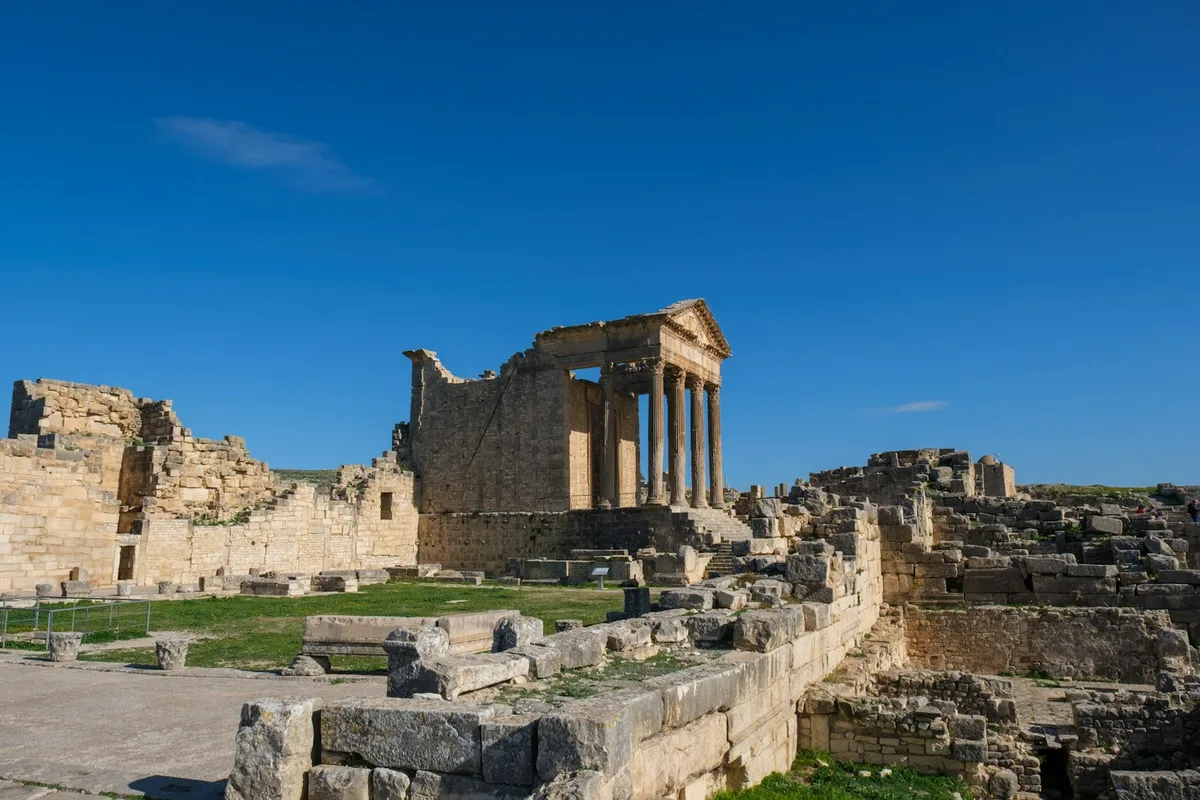
Among the best-preserved Roman ruins in North Africa, a UNESCO World Heritage hilltop site with a largely intact Capitol temple, theatre, and residential quarter.
Visitor guide
Dougga, also called Thugga, is a Berber, Punic and Roman settlement near Téboursouk in northern Tunisia. UNESCO listed it in 1997, and the listing describes it as the best-preserved Roman small town in North Africa. It sits on a hillside with views over the surrounding farmland.
Before Rome, Thugga was a Libyco-Punic settlement. It became a municipium in AD 205 and a separate Roman colony under Gallienus around AD 261. In the Byzantine period the area around the forum was turned into a fort, and several important buildings were dismantled to supply materials. The settlement was never fully abandoned after the Muslim invasions: a small village remained, and a mosque was built in the Temple of Augustan Piety.
The mausoleum, built in the 2nd century BC and about 21 metres tall, was dedicated to Ateban. Louis Poinssot largely reconstructed it. In 1842 Sir Thomas Reade, British consul in Tunis, seriously damaged the mausoleum while removing its bilingual inscription, which helped decode the Libyan script and is now in the British Museum.
The Capitol temple was dedicated mainly to the Capitoline Triad, and Wikipedia dates its completion to AD 166 to 167 from a dedication to Lucius Verus and Marcus Aurelius. The theatre was built in AD 168 or 169 and could seat about 3,500 spectators.
The Temple of Juno Caelestis, built on the outskirts, was excavated in the 1890s and restored between 1904 and 1914. The Temple of Saturn was built under Septimius Severus on a promontory overlooking the valley, with its roof water collected in cisterns. The Arch of Alexander Severus, dated to roughly AD 222 to 235, is relatively well preserved.
The Licinian Baths were donated by the Licinii family in the 3rd century, primarily as winter baths, with a long tunnel used by the slaves who worked there. Cisterns such as Aïn Mizeb and Aïn El Hammam, and reservoirs in the Temple of Caracalla's Victory, show how water was managed.
The Temple of Juno Caelestis was dedicated to Heavenly Juno, successor of the Punic goddess Tanit. It was built between AD 222 and 235, paid for by Q. Gabinius Rufus Felix. It is a Corinthian hexastyle peripteros on a podium reached by eleven steps, its cella is completely lost, and the surrounding temenos is 52 metres in diameter with a portico of 25 bays.
Mosaics remain in situ in the house of Venus and at the Aïn Doura Bath, while the house of Ulysses and the Pirates yielded the Ulysses mosaic, dated about AD 260 to 268, now displayed in the Bardo Museum. Streets are meandering lanes rather than a grid. Six cisterns at Aïn El Hammam hold 6,000 cubic metres and eight at Aïn Mizeb hold 9,000. The Victoria Church, built over a pagan cemetery at the end of the 4th or start of the 5th century, is the only Christian building excavated so far, and Thugga was the seat of a bishop through the Vandal and Byzantine periods.
The site is spread over a hillside with uneven ground. A private guide can explain the monuments and their dedications, and a private vehicle and driver can link Dougga with Tunis, Testour and other northern sites.
See every tour and attraction we cover in Tunisia.