TorontoOntario · 36 tours
 Niagara FallsOntario · 25 tours
 New York CityNew York · 30 tours
 Las VegasNevada · 8 tours
 San FranciscoCalifornia · 16 tours
 VancouverBritish Columbia · 17 tours
 DubaiUAE · 54 tours
 Abu DhabiUAE · 5 tours
 Buenos AiresArgentina · 23 tours
 AthensGreece · 31 tours
 AucklandNew Zealand · 38 tours
 CancunMexico · 54 tours
No destinations match “”. Try searching all tours instead — that search understands full questions, not just place names.
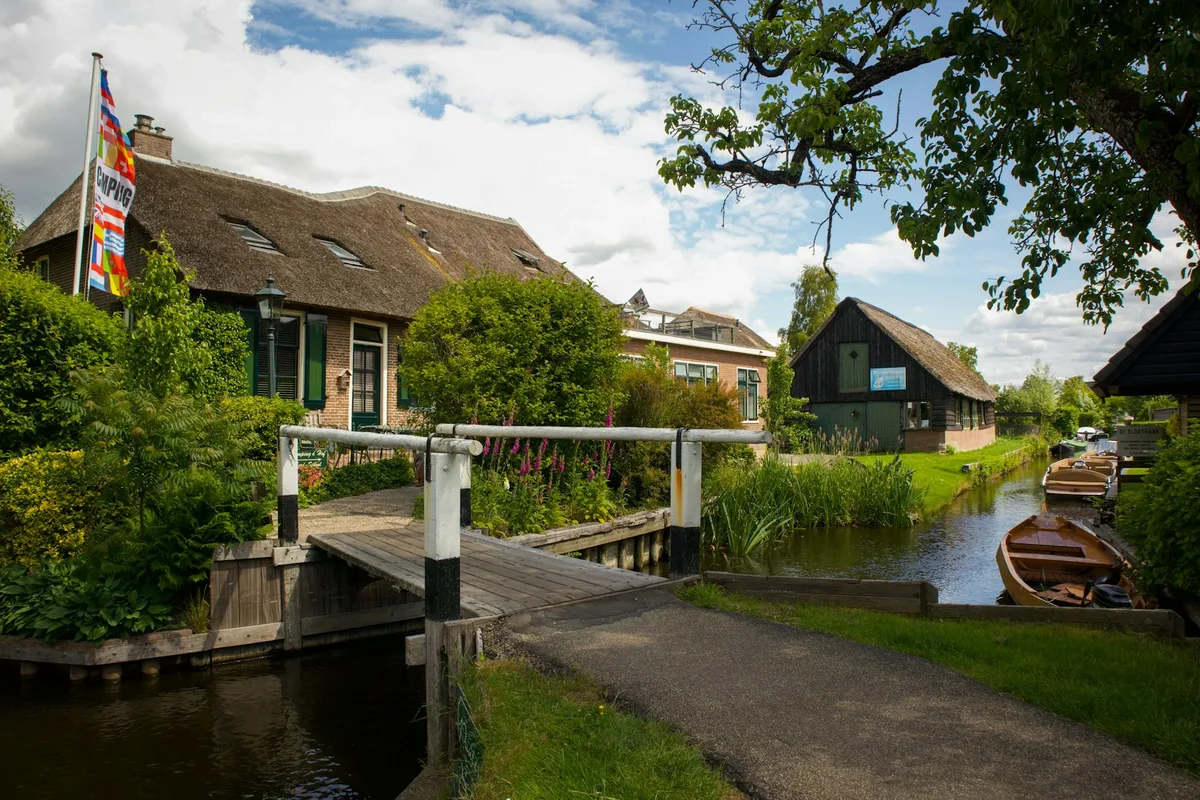
A car-free village in Overijssel province threaded by canals instead of roads, where thatched-roof farmhouses are reached by footbridge or boat — often nicknamed the 'Venice of the Netherlands.'
Visitor guide
Giethoorn is a village in the province of Overijssel in the Netherlands, in the municipality of Steenwijkerland, about 5 kilometres southwest of Steenwijk. Its old centre has canals in place of roads, which has earned it the nickname Venice of the North or Venice of the Netherlands.
The ponds and lakes around Giethoorn were formed by peat digging. Tourism accounts say settlers cut peat from the most favourable places, dried it, and dug waterways to move it, and the pits gradually filled with rainwater to form shallow lakes. Local tradition, repeated in travel writing, dates the settlement to about 1230 and says the name comes from Geytenhoren, meaning goat horns, supposedly found by the first inhabitants after a flood. This origin story comes mainly from tourism sources and legend, and should be treated as tradition and not firm history.
Wikipedia notes that the village was a separate municipality until 1973, when it became part of Brederwiede. Brederwiede itself lost its municipal status in 2001 when it merged with Steenwijk to form Steenwijkerland.
The old part of the village has no roads, so transport is by water, with a cycling path added later. Wikipedia counts 176 bridges in the village, and many farmhouses are reached by footbridge. The settlement is known for wooden bridges arching over narrow canals, houses with thatched roofs, and gardens running down to the water. Wikipedia says it was once a pedestrian precinct, although exceptions are now made.
The signature boat is the so-called whisper boat. According to tourism sources, boats here are mostly electric or without engines, and those with motors are quiet, which gives them the name. They travel at slow speed, and in the village visitors can rent a boat without a boating licence, according to one local operator. Rules and rental conditions can change, so it is best to check locally.
The village became widely known in the Netherlands after Bert Haanstra's 1958 comedy Fanfare was filmed there. In 2015 it was chosen from 182 contenders for a place on the international edition of Monopoly. The population was recorded as 2,795 in 2020 and 2,805 in 2021, depending on the Wikipedia section, and tourism is the main source of income. Giethoorn lies close to the Weerribben-Wieden area, a national park of reed beds and lakes that is reached largely by boat.
Giethoorn is quiet in the early morning and late in the day, when day trippers are fewer, and it is most active in the middle of the day in the main season. Because motor traffic is restricted in the old centre, a private vehicle will park at the edge of the village, and the visit continues on foot or by boat. A private tour from Amsterdam gives a flexible timetable for walking the paths, taking a boat through the canals and having lunch in the village.
See every tour and attraction we cover in Netherlands.