TorontoOntario · 36 tours
 Niagara FallsOntario · 25 tours
 New York CityNew York · 30 tours
 Las VegasNevada · 8 tours
 San FranciscoCalifornia · 16 tours
 VancouverBritish Columbia · 17 tours
 DubaiUAE · 54 tours
 Abu DhabiUAE · 5 tours
 Buenos AiresArgentina · 23 tours
 AthensGreece · 31 tours
 AucklandNew Zealand · 38 tours
 CancunMexico · 54 tours
No destinations match “”. Try searching all tours instead — that search understands full questions, not just place names.
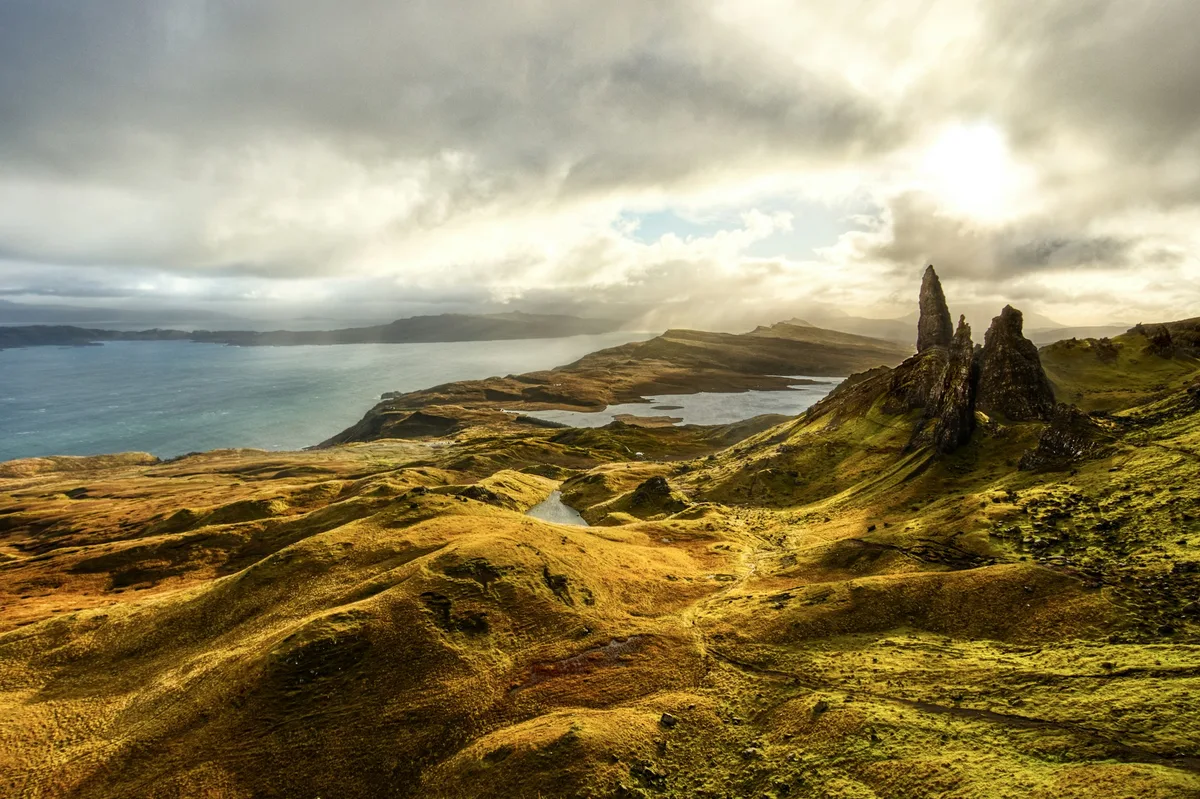
Scotland's largest island in the Inner Hebrides, known for dramatic landscapes like the Old Man of Storr and Dunvegan Castle, which its owners describe as the oldest continuously inhabited castle in Scotland.
Visitor guide
The Isle of Skye is the largest and northernmost of the major Inner Hebrides islands, off the west coast of the Scottish Highlands. Known for the jagged Cuillin mountains, the rock formations of the Trotternish peninsula and a long Gaelic and clan history, it is one of Scotland's most visited landscapes.
Skye covers about 1,656 square kilometres, making it the second-largest island in Scotland after Lewis and Harris. Several peninsulas radiate from a mountainous centre, and Wikipedia notes that the coastline has been likened to a lobster's claw. The highest point is Sgurr Alasdair at 993 metres, the tallest mountain on any Scottish island.
The Black Cuillin are mainly basalt and gabbro and include 12 Munros. The Inaccessible Pinnacle is the only Scottish Munro summit that requires technical climbing to reach, and a full traverse of the ridge can take 15 to 20 hours for experienced mountaineers. To the east, the Red Hills are mainly granite, with more rounded summits and long scree slopes.
The Trotternish peninsula in the north is underlain by basalt and is known for unusual rock features. The Old Man of Storr, a rock pillar, and the Quiraing, a series of pinnacles on the eastern side, appear often in tourism imagery. Kilt Rock has cliffs of about 70 metres with a columnar structure. Elsewhere, Duirinish has sea cliffs reaching 296 metres at Waterstein Head, Minginish has black basalt sand beaches, and Sleat in the south is underlain by Torridonian sandstone.
Trotternish also holds Middle Jurassic rock roughly 166 to 174 million years old, with dinosaur footprints and bones. Footprints have been recorded at Brother's Point, An Corran and Duntulm. All dinosaur and vertebrate fossils on Skye are legally protected, and the Staffin Museum displays local finds.
The oldest evidence of human presence is late Upper Palaeolithic stone tools, and a Mesolithic site at An Corran in Staffin is among the oldest archaeological sites in Scotland. The Norse held the Hebrides from the ninth century until the Treaty of Perth in 1266 transferred control to Scotland. The most powerful clans afterwards were MacLeod and Macdonald of Sleat, with Mackinnon holding Strathaird. Dunvegan Castle has been the seat of Clan MacLeod since the thirteenth century.
After the 1745 Jacobite rising, Flora MacDonald, who helped Prince Charles Edward Stuart escape, became part of Skye's story, and she is buried at Kilmuir. Samuel Johnson and James Boswell toured the island in 1773. Wikipedia records that about 30,000 people were evicted between 1840 and 1880, with many emigrating. The population peaked at 23,082 in 1841, fell to 7,183 in 1971 and has since recovered to about 10,500. Cleared villages can still be seen at places such as Boreraig and Suisnish.
Skye was overwhelmingly Gaelic-speaking into the early twentieth century, and the Gaelic college Sabhal Mor Ostaig near Kilmore draws students from around the world. Wildlife includes golden eagle, red deer and Atlantic salmon, and heather moorland dominates the vegetation. The climate is mild, wet and windy, shaped by the Atlantic, so weather can change quickly.
Portree is the island's largest settlement. The Skye Bridge links the island to the mainland at Kyle of Lochalsh, and ferries serve Armadale, Kylerhea, Uig and Sconser. Distances between sights are considerable and roads are often single-track, so a private guided tour with a driver lets you focus on the scenery.
See every tour and attraction we cover in United Kingdom.