TorontoOntario · 36 tours
 Niagara FallsOntario · 25 tours
 New York CityNew York · 30 tours
 Las VegasNevada · 8 tours
 San FranciscoCalifornia · 16 tours
 VancouverBritish Columbia · 17 tours
 DubaiUAE · 54 tours
 Abu DhabiUAE · 5 tours
 Buenos AiresArgentina · 23 tours
 AthensGreece · 31 tours
 AucklandNew Zealand · 38 tours
 CancunMexico · 54 tours
No destinations match “”. Try searching all tours instead — that search understands full questions, not just place names.
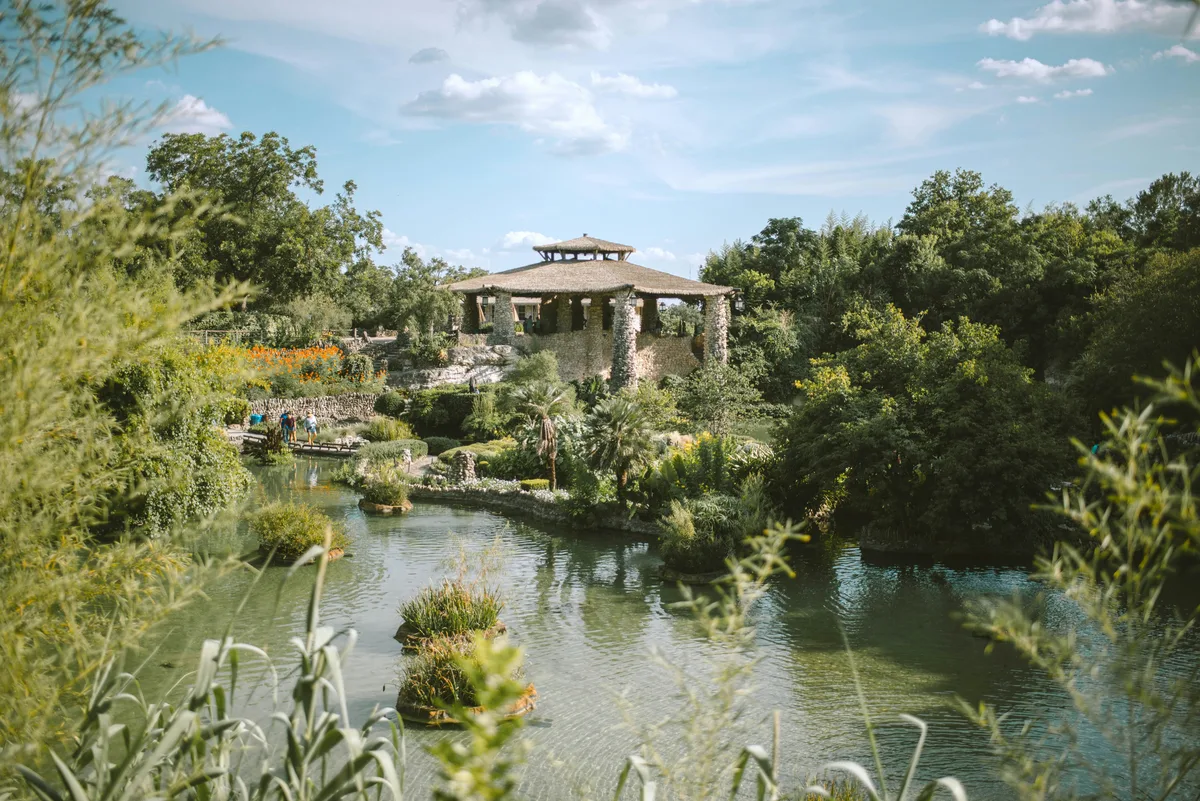
A sunken garden built into a former limestone quarry in Brackenridge Park, with koi ponds, stone footbridges, and a pagoda-topped pavilion.
Visitor guide
The Japanese Tea Garden is a sunken garden set inside an abandoned limestone quarry on the northwestern edge of Brackenridge Park in San Antonio, Texas. Stone bridges, pools, a tall waterfall and a pagoda fill the old excavation, and the quarry walls still rise around them. It is listed on the National Register of Historic Places and recognized as both a Registered Texas Historic Landmark and a Texas Civil Engineering Landmark.
Limestone was cut here from the mid-1800s, when the city leased the site to stone cutters; one account dates the first German masons' work to about 1840, and stone from the quarry went into local buildings including the Menger Hotel. The Alamo Portland and Roman Cement Company worked the site from 1880 until it closed its operation in 1908, and a cement kiln chimney from that era still stands. Its role in the region's cement industry is part of the reason the garden carries its landmark designations.
Parks Commissioner Ray Lambert is credited with turning the empty pit into an ornamental landscape. Sources differ slightly on timing, placing the start of the work between 1915 and 1918, but they agree that prison labor built the walkways, stone arch bridges, an island and a Japanese-style pagoda. Local accounts put the cost at only a few thousand dollars. The concrete entrance gate in the style of a torii is the work of Dionicio Rodriguez, whose faux bois technique shapes cement to resemble weathered wood.
Kimi Eizo Jingu, a Japanese-American artist, was invited by the city to live at the garden and opened a small refreshment room called the Bamboo Room; accounts give 1919 or 1926 for his arrival, so the exact year is uncertain. After Kimi Eizo Jingu died in 1938, his widow Miyoshi and their children, who had raised eight children there, kept running the grounds until the family was evicted amid anti-Japanese sentiment during World War II; the garden's own timeline dates the eviction to 1941. The garden was then known as the Chinese Sunken Garden, and a Chinese-American family ran the refreshment concession into the early 1960s. In 1984 the city rededicated it as the Japanese Tea Garden in a ceremony attended by Jingu family members and Japanese government representatives.
Two limestone-lined pools are linked by paths and stone arch bridges around a central island, and a waterfall of roughly 60 feet drops from the quarry's northern wall. The ponds hold koi, and a pavilion, a stone gazebo and the Jingu House sit among shaded walkways and flowerbeds. A restoration of the ponds and waterways, including a recirculation system, was completed in 2007-2008, and the Jingu House was later restored as well.
The garden is compact and the sunken paths involve steps, so it suits an unhurried visit. On a private Voyzo tour your driver collects you at your door and can fit it alongside Brackenridge Park and the nearby zoo, leaving you free to linger. Check the City of San Antonio Parks and Recreation Department for current hours and access.
See every tour and attraction we cover in San Antonio.