TorontoOntario · 36 tours
 Niagara FallsOntario · 25 tours
 New York CityNew York · 30 tours
 Las VegasNevada · 8 tours
 San FranciscoCalifornia · 16 tours
 VancouverBritish Columbia · 17 tours
 DubaiUAE · 54 tours
 Abu DhabiUAE · 5 tours
 Buenos AiresArgentina · 23 tours
 AthensGreece · 31 tours
 AucklandNew Zealand · 38 tours
 CancunMexico · 54 tours
No destinations match “”. Try searching all tours instead — that search understands full questions, not just place names.
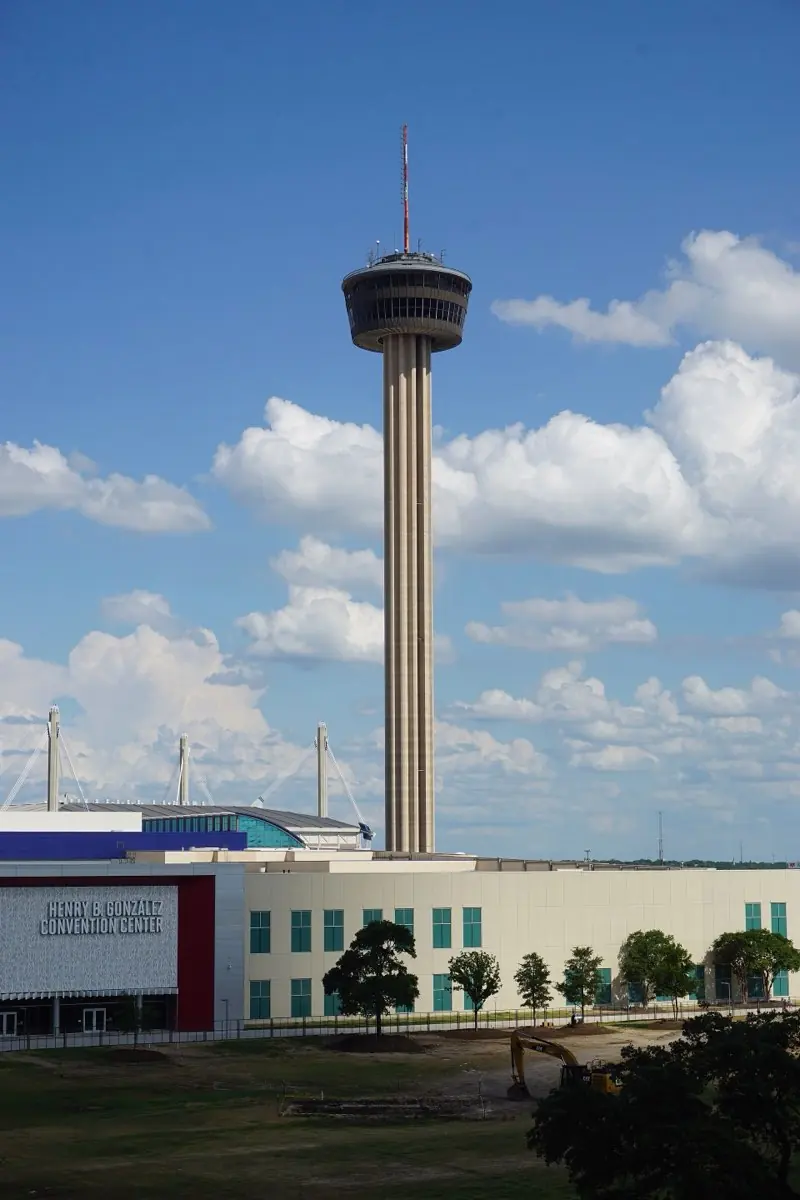
A 750-foot observation tower built for the 1968 World's Fair, with sweeping views of downtown.
Visitor guide
The Tower of the Americas is a 750-foot observation tower and revolving restaurant in San Antonio's Hemisfair district, built as the theme structure of the 1968 World's Fair. Designed by San Antonio architect O'Neil Ford, it is the city's tallest occupiable structure and the most recognizable piece of the fairgrounds that survives.
HemisFair '68 marked San Antonio's 250th anniversary and drew about 6.3 million visitors, according to The Cultural Landscape Foundation. The fair's international exhibition status was granted on November 17, 1965, and its theme was the confluence of civilizations in the Americas. The tower was originally called the HemisFair Tower until a naming contest produced its current name; 68 people submitted the winning name, and the prize went to the earliest postmark, an all-expenses-paid trip to San Antonio, according to the Texas Section of the American Society of Civil Engineers (ASCE). Construction began on August 10, 1966, per Wikipedia, and the tower opened on April 6, 1968. The 640-tonne top house was assembled at ground level and then raised up the concrete shaft over about 20 days using 24 steel lifting rods.
For nearly three decades the tower was the tallest observation tower in the United States, from 1968 until Las Vegas's Stratosphere Tower was completed in 1996. Wikipedia adds that from 1968 to 2009 it was the tallest building in Texas outside Dallas and Houston. The city owns the tower, and it is operated by the city together with Landry's Restaurants.
The ASCE's history says the site was cleared on August 9, 1966, within hours of the financing documents being signed, which is one day before the start date Wikipedia gives. Voters approved $5.2 million in bonds for the tower, though Wikipedia's fair article lists $5.5 million of city general revenue for it, so treat the cost figure as approximate. Ford's firm was Ford, Powell & Carson, with Feigenspan and Pinnell as structural engineers; Darrash & Lyda and H. A. Lott Construction of Houston, a firm that had worked on the Astrodome, were among the low bidders.
The shaft was a continuously poured concrete structure, built with a slip form that climbed between about 3 and 20 inches an hour, holding the concrete in place long enough to harden. The ASCE puts the concrete at roughly 4,000 cubic yards and says crews worked three shifts around the clock, with some workers recruited from the Pecos River High Bridge job because they were used to heights. The whole project took about 18 months, slowed by strikes, weather and the need to modify equipment for such an unusual structure. The rotating top house is described as 76 feet tall and turning about a 45-foot-diameter shaft; during the October 1967 lift three of the 24 rods are reported to have broken and a crane held the building until it was leveled.
Sources give several heights depending on what is measured: the antenna reaches 750 feet, the roof about 622 feet, the upper indoor observation deck 579 feet, the lower deck 560 feet and the revolving restaurant 550 feet. Three elevators are mounted on the tower's exterior, the cladding is stucco, and a mast on the roof has carried FM antennas since 1970; in 2007 three separate antennas were replaced by a single 16-bay master antenna.
A curiosity from the tower's record: on January 29, 1981, Tommy Johnson climbed its 952 steps in 5 minutes 18 seconds.
The tower stands in Hemisfair, a park of about 96 acres southeast of downtown. O'Neil Ford and Allison Peery oversaw the exposition's development from 1964. Building the fair required clearing the Germantown neighborhood, which displaced 1,600 people and demolished 1,349 structures, according to The Cultural Landscape Foundation. The San Antonio Conservation Society had recommended saving 129 buildings; an August 1966 agreement saved far fewer, with Wikipedia giving 20, or 24 overall. In 1968 the River Walk was extended a quarter mile into the site.
Ford himself was born in 1905 in Pink Hill, Texas, trained through a mail-order architecture certificate rather than a university degree, began private practice in 1934, and died in San Antonio in 1982. After the fair, unused structures were removed in 1986 and the grounds were rededicated as HemisFair Park in April 1988. A few fair structures remain, including the former Mexican Pavilion (now the Instituto de Mexico) and the former U.S. Pavilion; The Cultural Landscape Foundation also lists the Institute of Texan Cultures, though Wikipedia reports that building has since been demolished, so check Hemisfair for what stands today. Since the Hemisfair Park Area Redevelopment Corporation was created in 2009, the park has been reworked in phases, beginning with Yanaguana Garden, which opened on October 2, 2015, and followed by Civic Park, designed by a team led by GGN.
Hemisfair sits at the edge of downtown, close to the River Walk. Voyzo can include it in a private San Antonio tour with your own vehicle and driver and door-to-door pickup. Check the City of San Antonio and the tower operator for current access, hours and any repair or maintenance work.
See every tour and attraction we cover in San Antonio.