TorontoOntario · 36 tours
 Niagara FallsOntario · 25 tours
 New York CityNew York · 30 tours
 Las VegasNevada · 8 tours
 San FranciscoCalifornia · 16 tours
 VancouverBritish Columbia · 17 tours
 DubaiUAE · 54 tours
 Abu DhabiUAE · 5 tours
 Buenos AiresArgentina · 23 tours
 AthensGreece · 31 tours
 AucklandNew Zealand · 38 tours
 CancunMexico · 54 tours
No destinations match “”. Try searching all tours instead — that search understands full questions, not just place names.
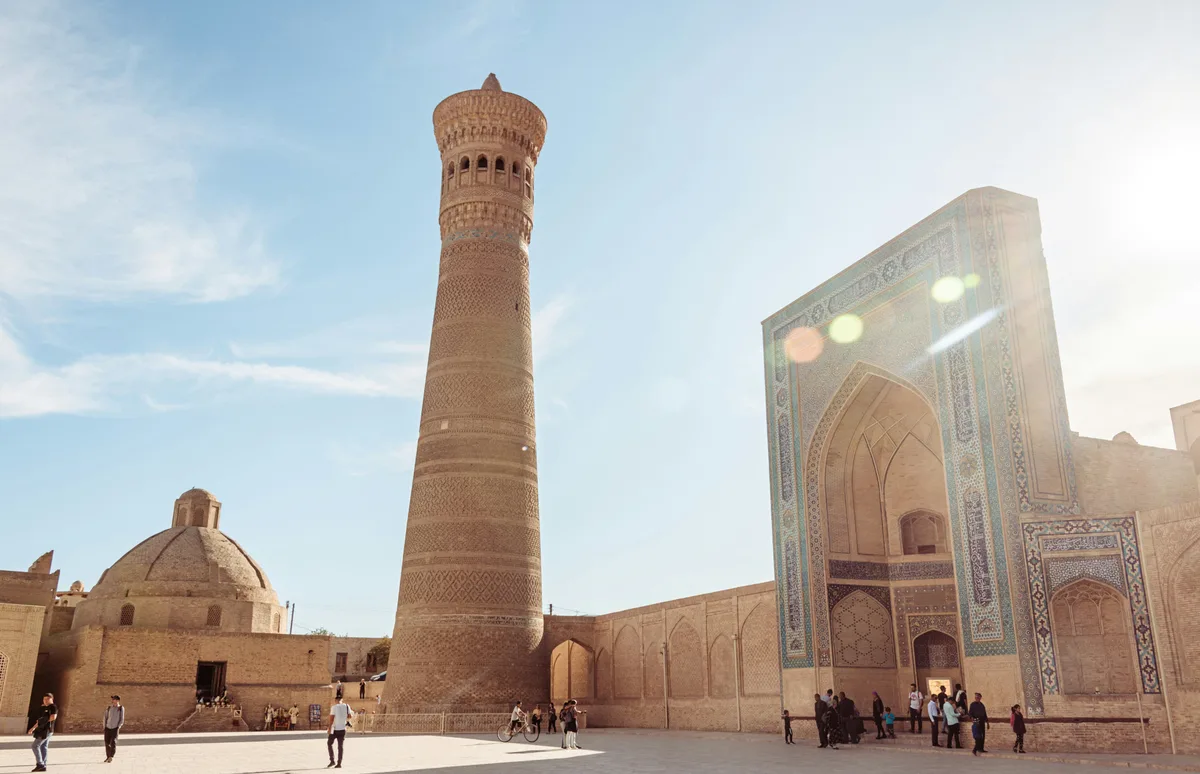
Bukhara's central religious complex, anchored by the 12th-century Kalyan Minaret — reportedly tall enough that Genghis Khan spared it when he destroyed the rest of the city — alongside the Kalyan Mosque and Mir-i-Arab Madrasa.
Visitor guide
The Poi-Kalyan complex, also written Po-i-Kalan, is the religious heart of old Bukhara in Uzbekistan. It consists of the Kalan Minaret, the Kalan Mosque and the Mir-i Arab Madrasah, which together enclose a square courtyard.
Wikipedia says that Arslan Khan reportedly commissioned the original mosque and minaret in 1121, with the minaret completed in 1127. Genghis Khan destroyed the original Friday Mosque in 1220, but the minaret survived. It stands roughly 45 to 46 metres tall (sources vary slightly) with a base diameter of about 9 metres, and is built entirely of baked brick, cylindrical in form and narrowing toward the lantern.
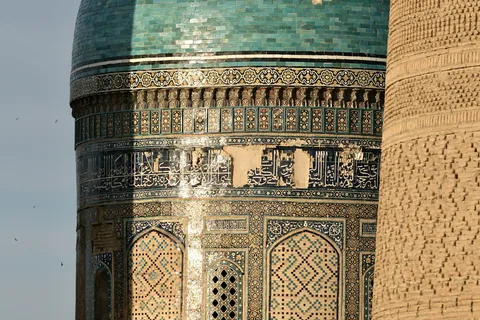
The shaft is decorated with bands of brickwork in which no pattern repeats, and the lantern has a sixteen-arched rotunda with terracotta stalactites and a turquoise band of tile inscriptions. Two stories are told about it. One says the master builder, named Bako, completed only the base and waited three years for the foundation to settle. The other says Genghis Khan spared the tower. Both are local tradition without firm sourcing.
The present Kalan Mosque is credited to the Shaybanid ruler Ubaydullah Khan, with Wikipedia giving completion dates of 1514 or 1515 in different places; Leiden University's Iran Turan project describes it as the Shaybanid extension, in 1514, of an earlier Timurid mosque of 1430. Ubaydullah ruled Bukhara from 1512 and became khan of the wider Shaybanid state in 1533. The mosque measures about 130 by 81 metres, and a large blue dome about 30 metres high rises over the mihrab. Four iwans line the courtyard, with a larger iwan on the east facade, and the interior is hypostyle, supported by rows of columns.
The decoration includes majolica, banna'i brickwork and blue-and-white tile mosaics, and the building faces inward without exterior windows. Wikipedia describes it as one of the largest congregational mosques in Central Asia, behind Samarkand's Bibi Khanum Mosque and Herat's Great Mosque. A figure of 288 domes around the courtyard is quoted without a source.
Across the square from the mosque, the Mir-i Arab Madrasah is credited to Sheikh Abdullah Yamani of Yemen, the spiritual mentor of Ubaydullah, and was built in 1535 according to Wikipedia. Its internal courtyard measures 37 by 33 metres, with four iwans serving as lecture halls, plus its own mosque and mausoleum. A two-storey glazed mosaic facade faces the Kalan Mosque, flanked by blue domes. Ubaydullah, who died in 1539, is buried in the madrasah.
Wikipedia says the madrasah has operated continuously to the present and that Soviet authorities allowed it to remain as one of three permitted religious centres, though the claim that it is unique in Central Asia is strong and should be treated cautiously.
The complex is often visited for the view of the minaret rising over the courtyard and the contrast between the sky-blue domes and the baked-brick shaft. A private guided tour with a driver suits Bukhara well, as the complex sits among the old town's other main sights.
See every tour and attraction we cover in Uzbekistan.