TorontoOntario · 36 tours
 Niagara FallsOntario · 25 tours
 New York CityNew York · 30 tours
 Las VegasNevada · 8 tours
 San FranciscoCalifornia · 16 tours
 VancouverBritish Columbia · 17 tours
 DubaiUAE · 54 tours
 Abu DhabiUAE · 5 tours
 Buenos AiresArgentina · 23 tours
 AthensGreece · 31 tours
 AucklandNew Zealand · 38 tours
 CancunMexico · 54 tours
No destinations match “”. Try searching all tours instead — that search understands full questions, not just place names.
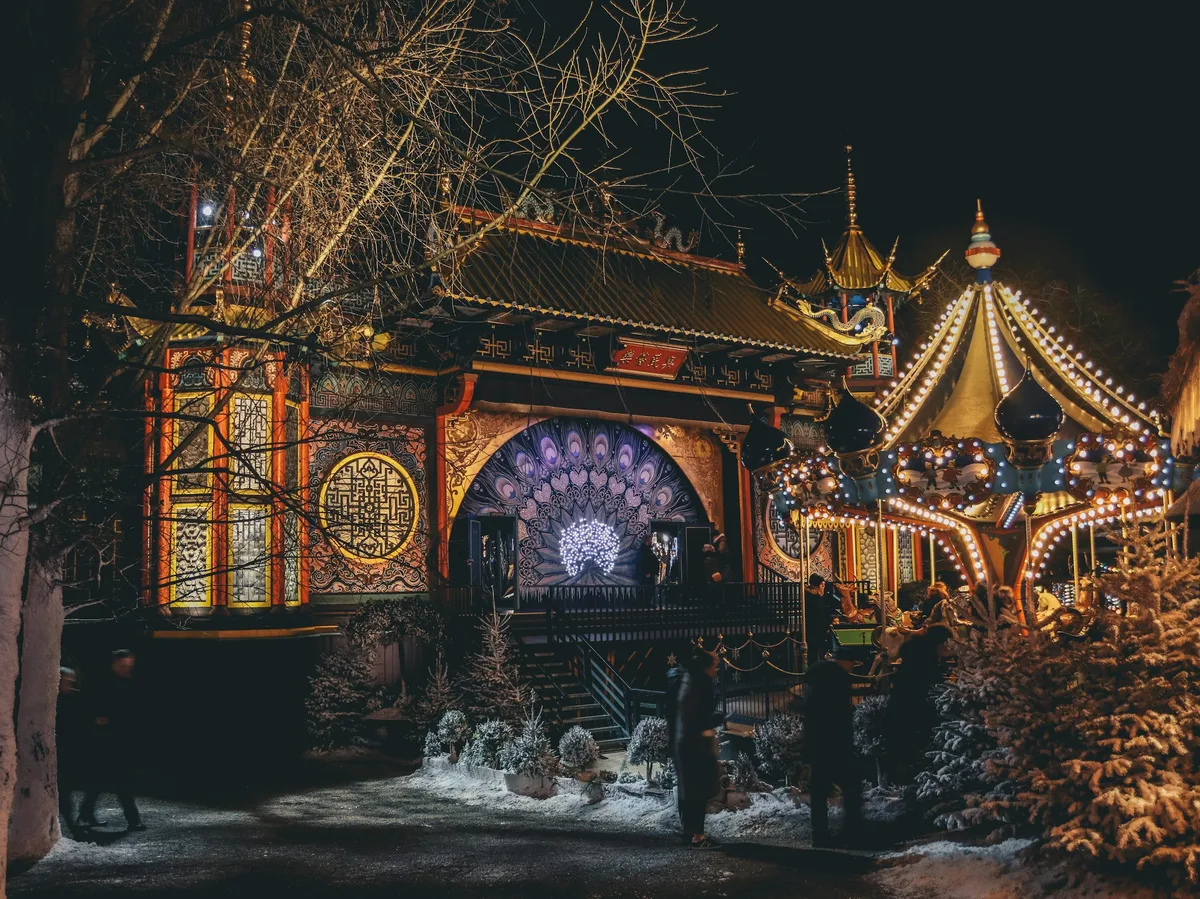
One of the world's oldest amusement parks, with fairytale gardens, classic rides, and live music in the heart of Copenhagen.
Visitor guide
Tivoli Gardens is an amusement park and pleasure garden in the centre of Copenhagen, Denmark. Opened on 15 August 1843, it combines rides, gardens, concerts and theatre, and Wikipedia describes it as the second-oldest operating amusement park in the world.
Tivoli's founder, Georg Carstensen, obtained a five-year charter from King Christian VIII by arguing that people who were entertained would not dwell on politics. The park originally occupied about 15 acres of the fortified glacis outside the city's West Gate. Its first name was Tivoli and Vauxhall, a reference to a Paris garden and to Vauxhall Gardens in London. From the start it offered Orient-inspired buildings, a theatre, bandstands, restaurants, flower gardens and a merry-go-round, with coloured lamps lighting the grounds after dark.
Hans Christian Lumbye was Tivoli's musical director from 1843 to 1872. Inspired by the Strauss family of Vienna, he was nicknamed the Strauss of the North, and the Tivoli orchestra still performs his works. In 1874 a Chinese-style Pantomime Theatre designed by Vilhelm Dahlerup replaced an older theatre. Its mechanical peacock-tail curtain and performances of commedia dell'arte with Harlequin, Columbine and Pierrot remain a highlight. The current Concert Hall was built in 1956 and seats about 1,660 people. The Glass Hall, rebuilt in 1946 after the earlier version was destroyed, hosts concerts and children's theatre, and the Tivoli Aquarium lies beneath the Concert Hall.
The wooden roller coaster Rutschebanen dates from 1914 and is among the world's oldest wooden coasters still in operation, with an operator controlling its speed on the descents. Newer rides include the floorless coaster Daemonen, which opened in 2004 and rises about 28 metres. A carousel dating from 1920 and a dragon boat pond serve younger children, while the Flying Suitcase dark ride, opened in 1993, draws on the stories of Hans Christian Andersen.
Tivoli's wartime history is dramatic. During the German occupation, on the night of 24-25 June 1944, Danish Nazi sympathisers set fire to several buildings, including the original concert hall and the Glass Hall Theatre, according to Tivoli's own history. Temporary structures were built and the park reopened within weeks. In June 1944 saboteurs bombed parts of Rutschebanen, which reopened just 25 days later.
The park keeps a seasonal calendar. A Tivoli Festival in late spring and summer brings dozens of concerts, Saturday fireworks are held in summer, and the park also stages Halloween and Christmas seasons. The Tivoli Youth Guard, founded in 1844, is a corps of young musicians in uniforms modelled on the Royal Danish Guard. The park's lake is a remnant of the old city moat, and in the early years fireworks were reflected in its waters. The Nimb Hotel, the only hotel inside the grounds, is known for its Moorish-style architecture.
Tivoli drew 4.25 million visitors in 2024 according to Wikipedia. The article states that Walt Disney drew inspiration from the park, and the Danish word tivoli is now used in several Nordic languages to mean an amusement park. Tivoli is close to Copenhagen Central Station, so it fits easily into a private city day.
See every tour and attraction we cover in Denmark.