TorontoOntario · 36 tours
 Niagara FallsOntario · 25 tours
 New York CityNew York · 30 tours
 Las VegasNevada · 8 tours
 San FranciscoCalifornia · 16 tours
 VancouverBritish Columbia · 17 tours
 DubaiUAE · 54 tours
 Abu DhabiUAE · 5 tours
 Buenos AiresArgentina · 23 tours
 AthensGreece · 31 tours
 AucklandNew Zealand · 38 tours
 CancunMexico · 54 tours
No destinations match “”. Try searching all tours instead — that search understands full questions, not just place names.
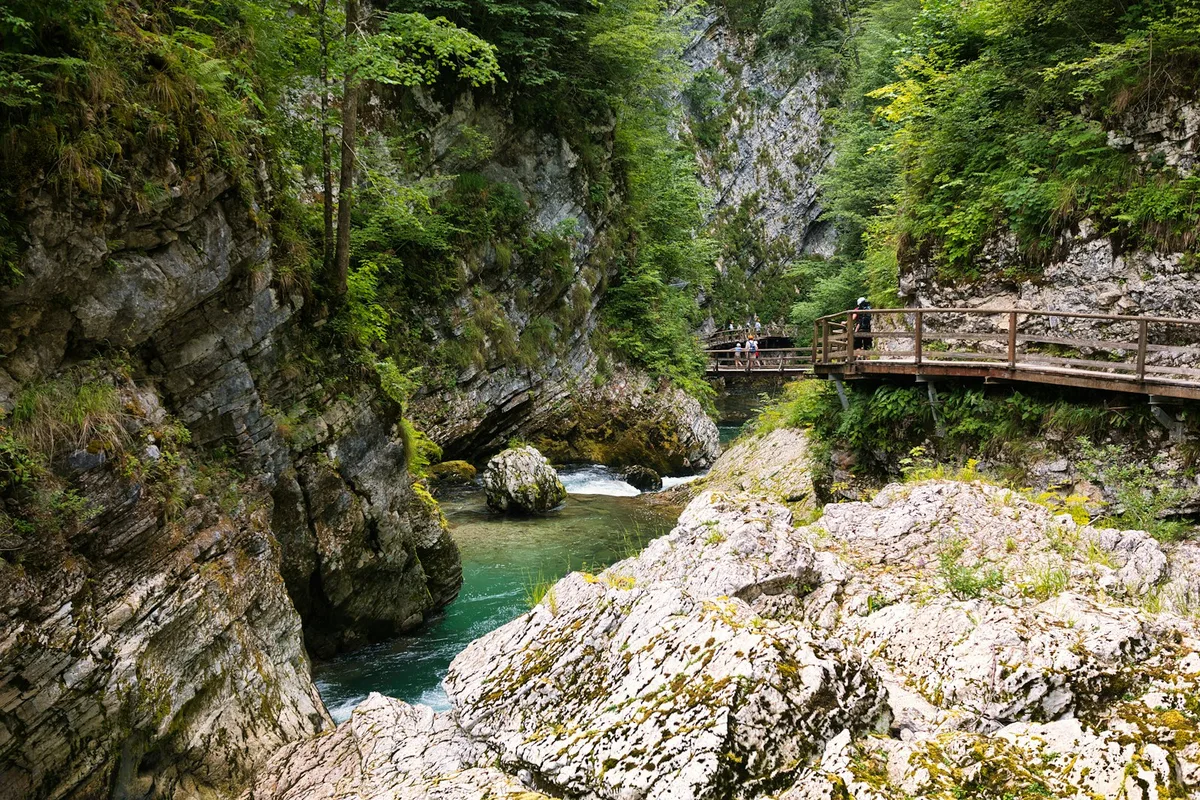
A narrow limestone gorge near Lake Bled, crossed by a wooden walkway suspended over the Radovna River's rapids and pools, ending at the Šum Waterfall.
Visitor guide
Vintgar Gorge, also called Bled Gorge, is a 1.6-kilometre gorge in northwestern Slovenia, about four kilometres northwest of Bled on the edge of Triglav National Park. Carved by the Radovna River, it has sheer walls 50 to 100 metres high and is known for wooden walkways above emerald pools, rapids and the Sum Falls.
According to Wikipedia, the gorge lies in the municipalities of Gorje and Bled and is the continuation of the Radovna Valley. The walls rise 50 to 100 metres, with a total slope of about 250 metres along the course. The stream has created pools and rapids and ends in the 13-metre Sum Falls, literally noisy falls, which Wikipedia calls the largest river waterfall in Slovenia. The gorge sits on the edge of Triglav National Park, Slovenia's only national park.
Geologically, the Radovna flowed eastward before the last ice age. After the Bohinj Glacier dammed it with ice and debris, the resulting lake cut a new path northeast through a soft layer of Triassic limestone between the hills Borst and Hom, toward the Upper Sava Valley. The result is a narrow, deep canyon with water that seems to shift between green and blue.
Until 1890 the gorge was mostly inaccessible except at two points where the Radovna could be reached, and a bridge over Sum Falls was already built in 1878. The rest of the gorge was explored in 1891 by Jakob Zumer, the mayor of Gorje, and the photographer Benedikt Lergetporer. In 1893 the gorge was fitted with wooden observation walkways and bridges, with great effort, and opened to the public on 26 August 1893. The walkways in the most prominent part are now named the Zumer Galleries and have been renovated several times. The gorge was the first mountain gorge in the area to be made accessible to tourists.
The word vintgar is derived from the German Windegg, a place exposed to the wind, via the hamlet of Vintgar at the head of the gorge. Another explanation suggests it comes from the German Weingarten, meaning vineyard, because of the gorge's glass-like shape. Wikipedia notes that the word has since come to refer to other scenic, protected gorges in Slovenia, such as the Iska Gorge and the Bistrica Gorge. Below the gorge are a hydroelectric dam and a stone arch railway bridge for the Bohinj Railway, built in 1904 and 1905. At 65 metres long and 33 metres high, it is described as the largest stone arch railway bridge preserved in its entirety in Slovenia.
The walk along the gorge is a short out-and-back or one-way route on the wooden walkways, with the falls at the far end. Because the gorge is narrow and the walkways are exposed to water and weather, conditions vary by season. It is an easy add-on to a visit to Lake Bled, and a private tour with a driver and guide can combine them in a relaxed day.
See every tour and attraction we cover in Slovenia.