TorontoOntario · 36 tours
 Niagara FallsOntario · 25 tours
 New York CityNew York · 30 tours
 Las VegasNevada · 8 tours
 San FranciscoCalifornia · 16 tours
 VancouverBritish Columbia · 17 tours
 DubaiUAE · 54 tours
 Abu DhabiUAE · 5 tours
 Buenos AiresArgentina · 23 tours
 AthensGreece · 31 tours
 AucklandNew Zealand · 38 tours
 CancunMexico · 54 tours
No destinations match “”. Try searching all tours instead — that search understands full questions, not just place names.
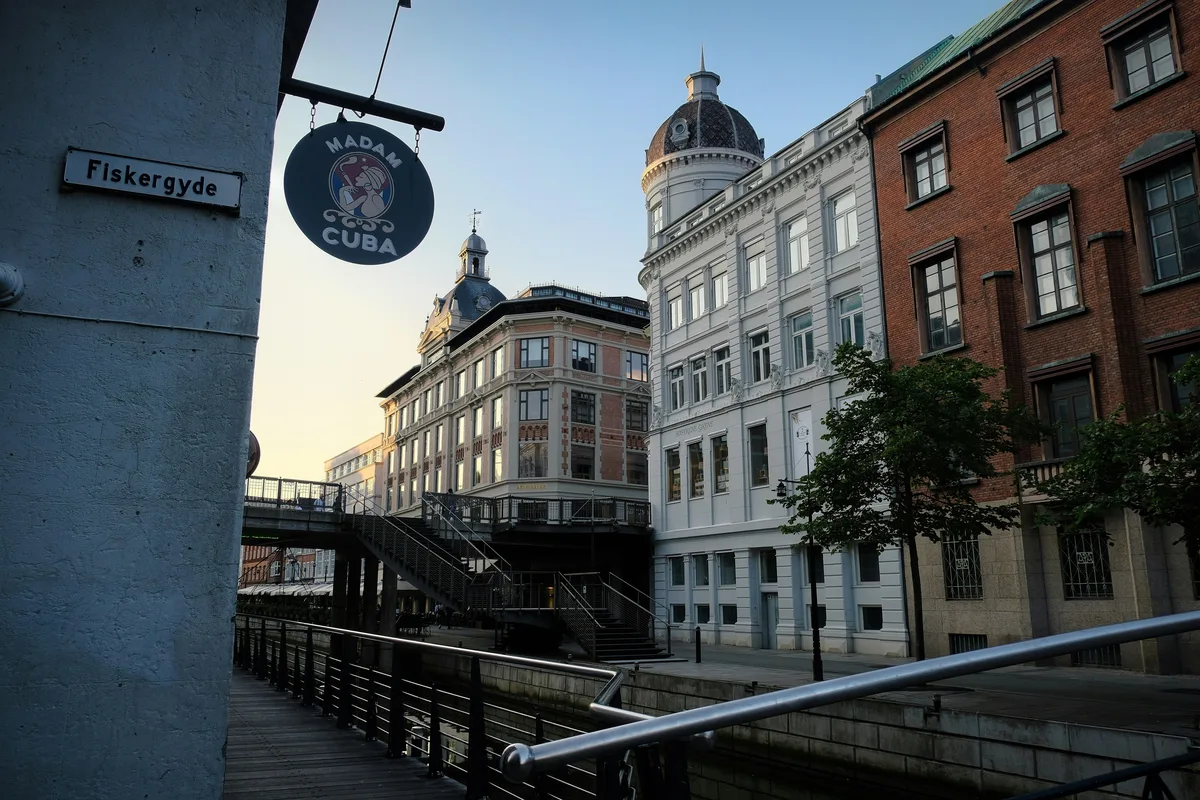
Aarhus's oldest neighborhood, a warren of narrow cobbled streets, half-timbered houses, cafes, and independent shops just behind the harbor and canal.
Visitor guide
The Latin Quarter, Latinerkvarteret in Danish, is the oldest part of Aarhus, Denmark's second city, and forms part of the inner city. It is known for narrow streets, old houses, cafes, small shops and live-music venues.
Wikipedia describes the quarter as the oldest part of the city, with some of the oldest houses dating to the 16th century. Its streets include Badstuegade, Klostergade, Volden, Studsgade, Borggade, Rosensgade, Mejlgade and Graven, with Pustervig Torv as the main square. The name was officially adopted in the 1990s and reflects the area's resemblance to the Latin Quarter on the Left Bank in Paris. Juuls Gard is described as one of the oldest buildings in Aarhus.
Aarhus itself is old. Wikipedia says archaeology suggests there was a town as early as the last quarter of the 8th century, and a 2003 dig found longhouses and a road from that period. The settlement, Aros, lay on the northern shore of a fjord at the mouth of the Aarhus River. Earthen ramparts were built in the early 900s, possibly under King Gorm the Old, and later expanded under Harald Bluetooth. The ramparts were abandoned in 1477, and the street names Volden, meaning The Rampart, and Graven, meaning The Moat, still preserve their memory in the Latin Quarter.
A stone church, St Nicholas, was finished around 1070 (VisitAarhus dates the surviving crypt church to about 1060) on the site of today's Church of Our Lady, Vor Frue Kirke, and an underground crypt survives from that building. The article describes the early church as the oldest stone church in Scandinavia. Nearby stands Aarhus Cathedral, dedicated to St Clement, patron saint of sailors. Begun in the 1190s under Bishop Peder Vognsen, it is 93 metres long and described as the longest and tallest church in Denmark. It contains about 220 square metres of frescoes from 1470 to 1520. Aarhus Theatre, completed in 1916 in Art Nouveau style opposite the cathedral, is the largest provincial theatre in Denmark. The cathedral's main organ was built in 1730 by Lambert Daniel Kastens and, after a restoration, has 89 stops, making it Denmark's largest church organ according to Wikipedia. The article also mentions Hans Tausen, a Danish reformer whose Lutheran ideas spread to Aarhus, and notes that a 1441 charter from Christopher III is considered by some to be the town's birth certificate.
Mollestien is a cobbled street of about 240 metres whose name refers to the Aarhus Mill, first mentioned in 1289. Most of its small houses date from 1870 to 1885. In the 1960s students and artists renovated homes in the western section, painting them in bright colours and planting roses, and the remaining stretch has changed little since the 1870s. The Latin Quarter is also a hub of cafes, galleries, workshops and small stages, and the KaosPilots enterprise emerged from its creative milieu.
A private guided visit with a driver can combine the Latin Quarter with Den Gamle By and the cathedral, and the compact quarter is best explored on foot.
See every tour and attraction we cover in Denmark.