TorontoOntario · 36 tours
 Niagara FallsOntario · 25 tours
 New York CityNew York · 30 tours
 Las VegasNevada · 8 tours
 San FranciscoCalifornia · 16 tours
 VancouverBritish Columbia · 17 tours
 DubaiUAE · 54 tours
 Abu DhabiUAE · 5 tours
 Buenos AiresArgentina · 23 tours
 AthensGreece · 31 tours
 AucklandNew Zealand · 38 tours
 CancunMexico · 54 tours
No destinations match “”. Try searching all tours instead — that search understands full questions, not just place names.
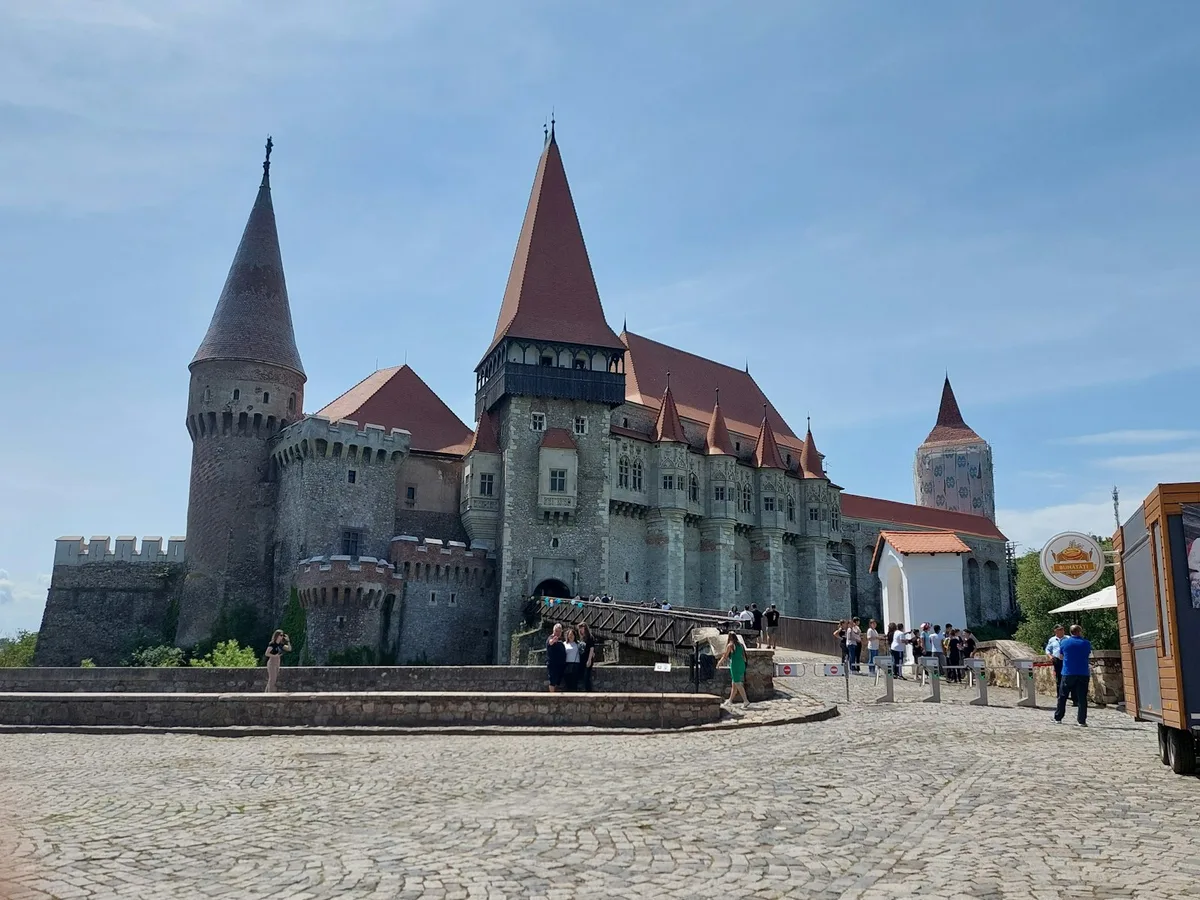
A Gothic-Renaissance castle in Hunedoara built on the foundations of a 14th-century fortress, its towers, drawbridge, and inner courtyard among the largest castles in Europe.
Visitor guide
Corvin Castle, also called Hunyadi Castle or Hunedoara Castle, is a Gothic-Renaissance castle in the town of Hunedoara in Transylvania, Romania. Built from 1446 for the Hungarian military leader John Hunyadi on the site of an older fortification, it is considered one of the largest castles in Europe and is counted among the Seven Wonders of Romania.
According to Wikipedia, the castle was originally given to John Hunyadi's father, Woyk, by Sigismund of Luxembourg, king of Hungary and Croatia, in 1409. Construction in its present form began in 1446, when Hunyadi, then voivode of Transylvania, set out to transform an earlier keep built under Charles I of Hungary. In the same year the Diet elected him regent governor. Hunyadi was a leading Hungarian military and political figure of the 15th century who served as regent of the Kingdom of Hungary from 1446 to 1453, and he earned the nickname Turk-buster for his campaigns against the Ottoman Empire. He died in 1456, the year he defended Belgrade against the sultan's army, and work on the castle slowed. New commissions from 1458 added the Matia Wing, but building stopped altogether in 1480, by which time the castle was recognized as one of the biggest and most impressive buildings in Eastern Europe.
The castle stands on a rock above the Zlasti River. Wikipedia describes a large, imposing structure with tall towers, bastions, an inner courtyard, variously colored roofs and many windows and balconies adorned with stone carvings. A double wall strengthens the fortification, and the castle is flanked by both rectangular and circular towers, an innovation for the Transylvanian architecture of the period. Several towers, including the Capistrano Tower, the Deserted Tower and the Drummers' Tower, were used as prisons, while the Buzdugan Tower was purely defensive and decorated with geometric motifs. The keep, called Neboisa, meaning Don't be afraid in Serbo-Croatian, and the Capistrano Tower are among the parts that remain unchanged from Hunyadi's time.
Inside, the Knights' Hall served for feasts and the Diet Hall for ceremonies and formal receptions. Both are rectangular halls decorated with marble. In the wing called the Mantle, a painting depicts the legend of the raven from which the Hunyadi descendants took the name Corvinus. This is a family legend rather than documented history.
The 16th century brought no improvements, but in the 17th century a large two-level palace facing the town was added with living chambers, plus the White Tower and the Artillery Tower for military use and an outer yard for administration and storage. Wikipedia cautions that the castle as seen today is the result of a fanciful restoration undertaken after a disastrous fire and many decades of neglect, and some critics think the architects projected their own idea of what a Gothic castle should look like. That makes it a place to enjoy for atmosphere as much as for strict historical authenticity.
Visitors are often told that Vlad the Impaler was held prisoner here by John Hunyadi. Wikipedia presents this as a claim made to tourists, and it is sometimes mentioned as a source of inspiration for Castle Dracula, though Bram Stoker himself was unaware of any link to Vlad. The castle has been used as a filming location for productions including The Nun and the 2024 remake of Nosferatu.
The castle lies in Hunedoara County in western Transylvania, a drive from Sibiu and Alba Iulia. A private tour with a driver and guide helps with the route and the history behind the Hunyadi story.
See every tour and attraction we cover in Romania.