TorontoOntario · 36 tours
 Niagara FallsOntario · 25 tours
 New York CityNew York · 30 tours
 Las VegasNevada · 8 tours
 San FranciscoCalifornia · 16 tours
 VancouverBritish Columbia · 17 tours
 DubaiUAE · 54 tours
 Abu DhabiUAE · 5 tours
 Buenos AiresArgentina · 23 tours
 AthensGreece · 31 tours
 AucklandNew Zealand · 38 tours
 CancunMexico · 54 tours
No destinations match “”. Try searching all tours instead — that search understands full questions, not just place names.
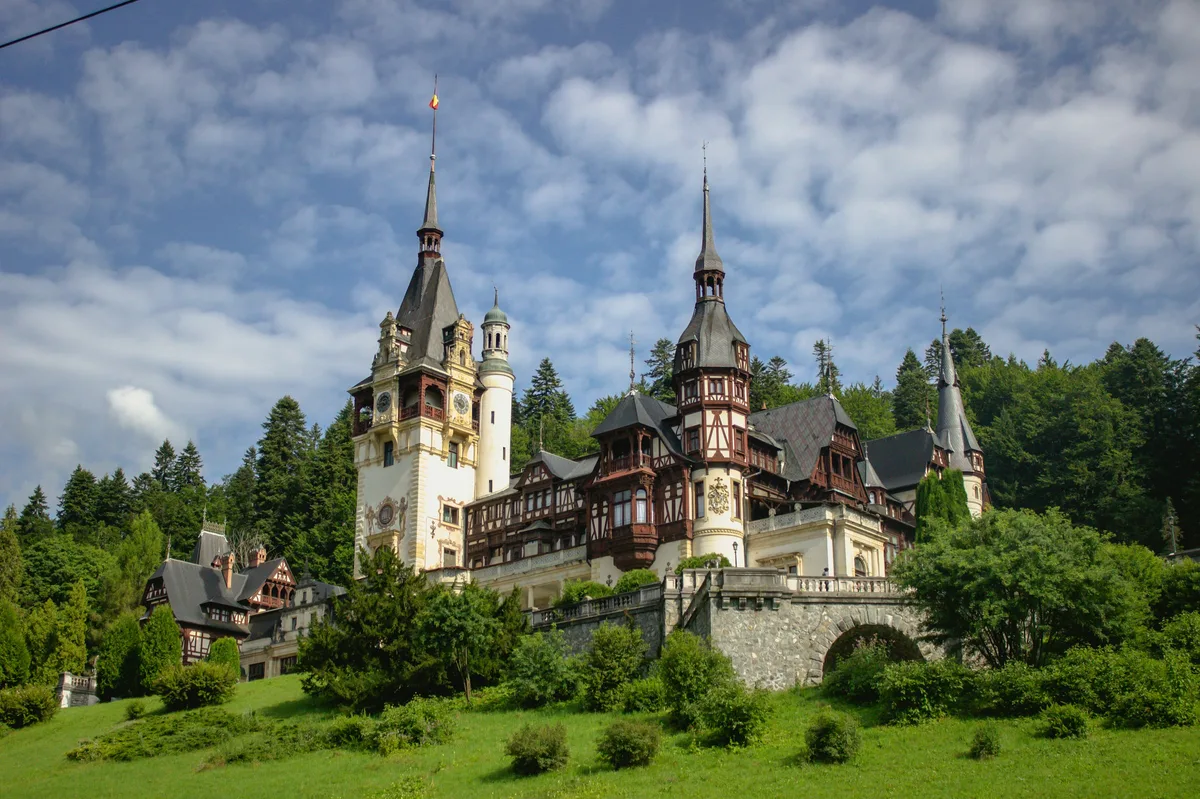
A Neo-Renaissance royal castle in the mountain resort town of Sinaia, built for King Carol I in the late 19th century and widely considered one of Europe's most beautiful castles.
Visitor guide
Peles Castle is a Neo-Renaissance palace in the Royal Domain of Sinaia, in the Carpathian Mountains of Prahova County, Romania. Built between 1873 and 1914 as a summer retreat for King Carol I, it sits on an old medieval route linking Transylvania and Wallachia, and is now a museum.
Wikipedia records that Carol I, under whose reign Romania gained its independence, first visited the site in 1866 and fell in love with the mountain scenery. In 1872 the Crown purchased about 5 square kilometres near the Piatra Arsa River, creating the Royal Estate of Sinaia. The foundation stone of the castle was laid on 22 August 1873. The king rejected the first three designs as unoriginal and too costly, and chose a plan by the German architect Johannes Schultz that blended Italian and German aesthetics along Renaissance lines. The Czech architect Karel Liman later designed additions between 1893 and 1914, including the towers, with the main central tower rising 66 metres. The castle was inaugurated in 1883 and was described by Wikipedia as the first castle in the world fully powered by locally produced electricity.
Hundreds of workers from many countries built it. Queen Elisabeth wrote in her journal that Italians, Romanians, Albanians, Greeks, Germans, Hungarians, Turks, Poles, Czechs and others worked on the site, speaking some fourteen languages. The cost of the work between 1875 and 1914 was estimated at 16 million gold Romanian lei.
Peles is by form a palace, though it is consistently called a castle. Wikipedia describes the style as a romantic blend of Neo-Renaissance and Gothic Revival, comparable to Neuschwanstein Castle in Bavaria, with half-timbered facades and painted murals on the courtyard walls showing Saxon influence. Inside, the decoration is mostly Baroque in character, with heavily carved woods and rich fabrics. The castle has over 170 rooms across a 3,200-square-metre floor plan, many decorated in themes such as Florentine, Turkish, Moorish and French. Collections include arms and armor with over 4,000 pieces, a painting collection of nearly 2,000 works, Sevres and Meissen porcelain, Cordoba leather and mostly Swiss stained glass.
The Hall of Honour, completed in 1911 under Liman, spans three floors with carved walnut walls, alabaster sculpture and retractable stained glass. The Imperial Suite is believed to be a tribute to Emperor Franz Joseph I of Austria-Hungary, who visited in 1896. Outside, seven Italianate terrace gardens hold marble statues by the sculptor Raffaello Romanelli, fountains and stairways.
Carol II of Romania was born at the castle in 1893, which Carol I called the cradle of the dynasty and the nation. After the forced abdication of King Michael I in 1947, the communist state seized royal property, and the castle was declared a museum in 1953. The whole estate was closed between 1975 and 1990, and after the 1989 revolution Peles and its neighbor Pelisor were reopened as heritage sites. In 2006 and 2007 the Romanian government restituted the Royal Domain to King Michael I, and the castle is now leased by the royal family to the Romanian state.
Wikipedia notes that public visits are by guided tour, with options covering different floors. The castle is about 48 kilometres from Brasov and 124 kilometres from Bucharest, making it a natural stop between the two. A private tour with a driver and guide suits the trip from either city, and the pretty town of Sinaia is worth time too.
See every tour and attraction we cover in Romania.