TorontoOntario · 36 tours
 Niagara FallsOntario · 25 tours
 New York CityNew York · 30 tours
 Las VegasNevada · 8 tours
 San FranciscoCalifornia · 16 tours
 VancouverBritish Columbia · 17 tours
 DubaiUAE · 54 tours
 Abu DhabiUAE · 5 tours
 Buenos AiresArgentina · 23 tours
 AthensGreece · 31 tours
 AucklandNew Zealand · 38 tours
 CancunMexico · 54 tours
No destinations match “”. Try searching all tours instead — that search understands full questions, not just place names.
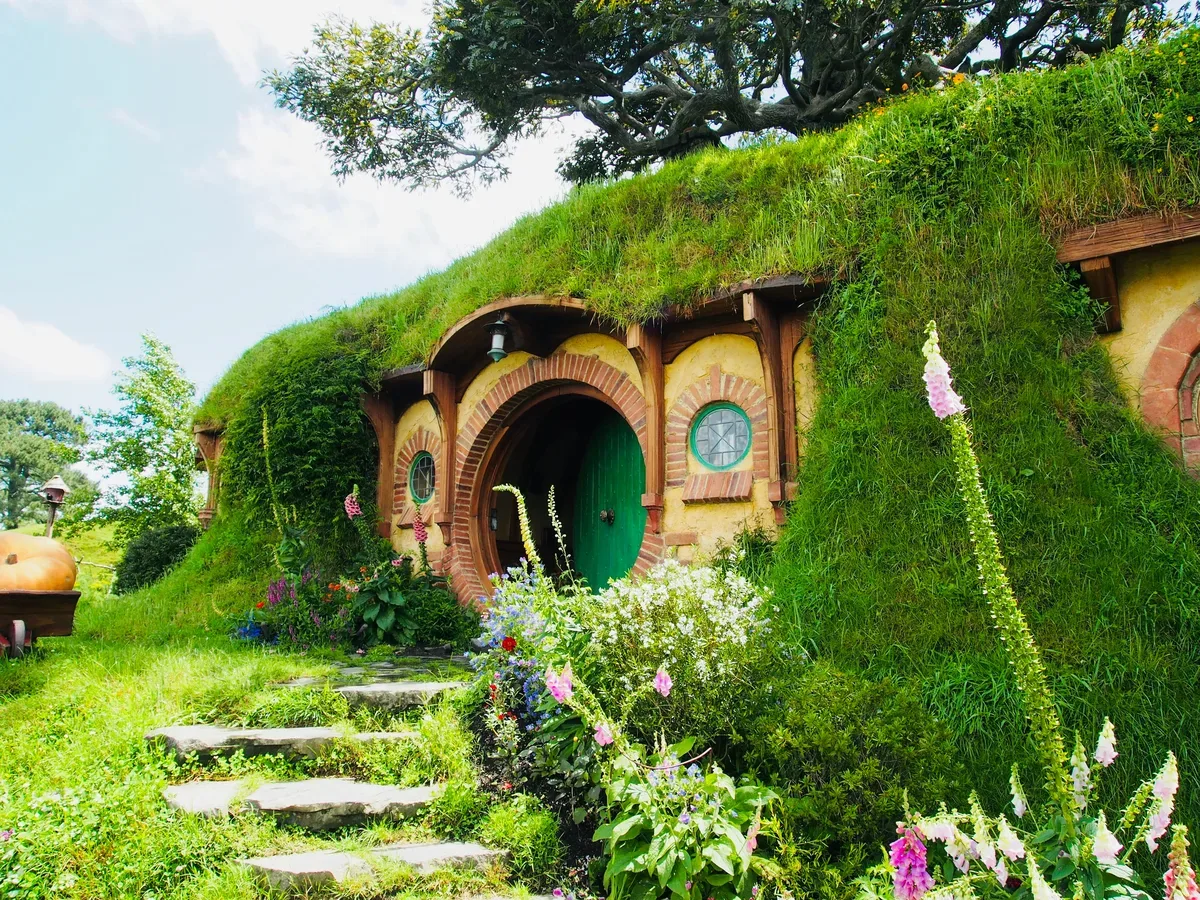
The permanent film set from The Lord of the Rings and The Hobbit trilogies, a re-created Shire of hobbit holes in the Waikato countryside near Matamata.
Visitor guide
The Hobbiton Movie Set is a permanent film set on a family-run farm in the Waikato region of New Zealand's North Island, about 10 km southwest of Matamata. It stood in for the Shire in Peter Jackson's The Lord of the Rings and The Hobbit trilogies and is now open for guided tours.
The set sits on the Alexander family's farm, a property of roughly 500 hectares that the family has farmed since 1978, raising sheep and Aberdeen Angus cattle. According to Wikipedia, Peter Jackson spotted it during an aerial search in 1998 and judged the countryside like a slice of ancient England. Set decorator Alan Lee noted that the hills looked as though hobbits had already started digging there, and a lake with a long arm could double as a river.
Work began in March 1999. The New Zealand Army cut about 1.5 km of road into the site and carried out the initial groundworks, after which crews built facades for 37 hobbit holes (the operator's own history says 39), gardens, hedges, a mill and a double-arched bridge. A 26-tonne oak was installed above Bag End; the tree was cut down near Matamata and recreated on site with artificial leaves. Jackson wanted the village to feel lived in, so hedges and gardens were planted a year before filming and weeds were left to grow through the cracks.
The original set was never meant to last. Its facades were built from untreated timber, plywood and polystyrene, and after filming the production crew pulled down much of it. Heavy rain delayed final demolition, so 18 of the 37 holes were left standing, and the Alexander family then reached a deal with the production company to keep the remaining structures and open the site for organised visits. Guided tours began in 2002.
In 2010 the set was rebuilt in a more permanent form for The Hobbit: An Unexpected Journey, with filming starting in 2011. Wikipedia notes that actor Martin Freeman, who played Bilbo, said the location felt like a real village where people lived and worked.
The site covers roughly 5 hectares (the operator gives about 12 acres), and Wikipedia says 44 hobbit holes are on view today, though only a few can be entered and some interiors are small, unfinished and earth-walled. The holes were built at three scales: correct size for hobbits, larger to make hobbit actors look smaller, and a dwarf scale for scenes with dwarves. The door colour generally signals the scale, and blue doors are built to human scale.
Highlights named in the source include Bagshot Row, the Party Tree and Bilbo's home, Bag End. The interior of Bag End, however, was filmed in a studio in Wellington rather than on the farm. In December 2023, two hobbit holes on Bagshot Row opened to the public with fully furnished interiors designed by Alan Lee and John Howe.
The Green Dragon Inn opened on the set in 2012 as a working inn serving drinks and hosting private banquets, and a cafe offers breakfast and second breakfast before or after tours. Evening events began in 2014, and the set welcomed its 500,000th guest in 2013.
Tour buses depart from the nearby town of Matamata, which has grown into a significant tourist destination, with new cafes and bars opening to serve visitors and creating local jobs. For many travellers the set is a stop within a longer North Island journey, and a private guided trip with a driver can combine it with other Waikato or Rotorua sights.
See every tour and attraction we cover in New Zealand.